Filed
6:00 a.m. EST
11.19.2025
The sitting president can be a better predictor of how safe someone feels than what the crime data shows.
U.S. President Donald Trump visited law enforcement officers in August 2025 at the U.S. Park Police Anacostia Operations Facility in Washington, D.C., after declaring a “crime emergency” and deploying federal officers in the nation’s capital.
The United States is experiencing historic drops in crime across almost all categories, including murder, burglary and motor vehicle theft. But crime statistics don’t necessarily change how safe Americans feel or whether they support the latest public safety proposals, like President Donald Trump’s deployments of the National Guard into U.S. cities. Those beliefs are driven by political preferences.
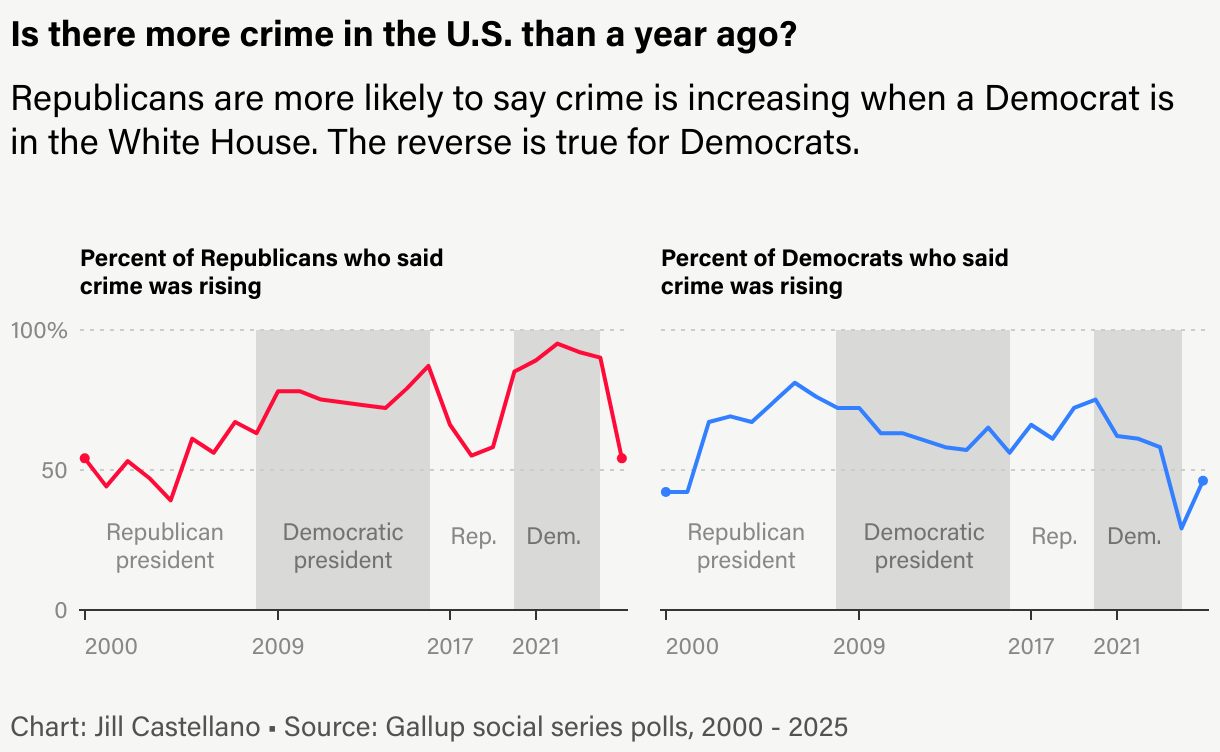
By many measures, Americans are more politically divided than ever, and this polarization colors people’s perceptions of the world around them. According to data from the research firm Gallup, which publishes an annual survey on crime perceptions, Republicans were more likely to believe crime was rising during the Barack Obama and Joe Biden presidencies than under George W. Bush or Donald Trump. The reverse was true for Democrats.
The partisan shift was especially dramatic in Gallup’s poll conducted this October, after Trump’s return to the White House. While 90% of Republicans surveyed in 2024 said national crime rates had risen over the past year, just over half believed the same was true in 2025. Meanwhile, Democrats were more likely to say crime was on the rise this year than they were in 2024, but their shift was smaller than Republicans’.
National murder rates began falling in 2023, well before Trump’s second term, and have continued to decline ever since. This year could result in the largest one-year drop in murder ever recorded, with data going as far back as the 1960s. Similar trends are taking place with other violent and property crimes.
On the surface, the latest polls reflect this safer reality. Less than 50% of people surveyed by Gallup this year said they believed crime was rising in the U.S., the lowest proportion since 2001. Yet the data also shows Republicans are driving the decline, following a decades-old pattern of party members shifting their views under new presidential administrations.
Long-term trends make it clear that partisanship is deeply embedded in Americans’ crime perceptions, even in their own communities. People report being less afraid of walking around at night and believing crime rates are lower in their neighborhood when their political party runs the Executive Branch, according to data from 25 years of Gallup surveys. This finding is especially true for Republicans.
“There is a political dimension to it, absolutely,” said John Roman, senior fellow at NORC, a research group at the University of Chicago. Roman said a growing number of Republicans and Democrats answer questions about crime and safety in a way that signals support for their party, even if it’s contrary to their personal experiences.
“It’s people being afraid of things that objectively they probably shouldn’t be that afraid of, or at least reporting it that way,” he added. “And other people defiantly saying, ‘I’m not afraid of these things,’ that maybe they should be a little more afraid of.”
In recent years, Republicans and Democrats have been more consistently voting for their party’s candidates in elections. Fewer Americans are willing to vote for the opposing party’s presidential nominee or down-ballot candidates.
As many as 43% of Americans now identify as independents, the highest proportion in more than three decades, while self-proclaimed Republicans and Democrats are dwindling. About as many independents “lean Democrat” as “lean Republican,” which helps explain why their survey responses and voting patterns appear to fall in between the two political parties.
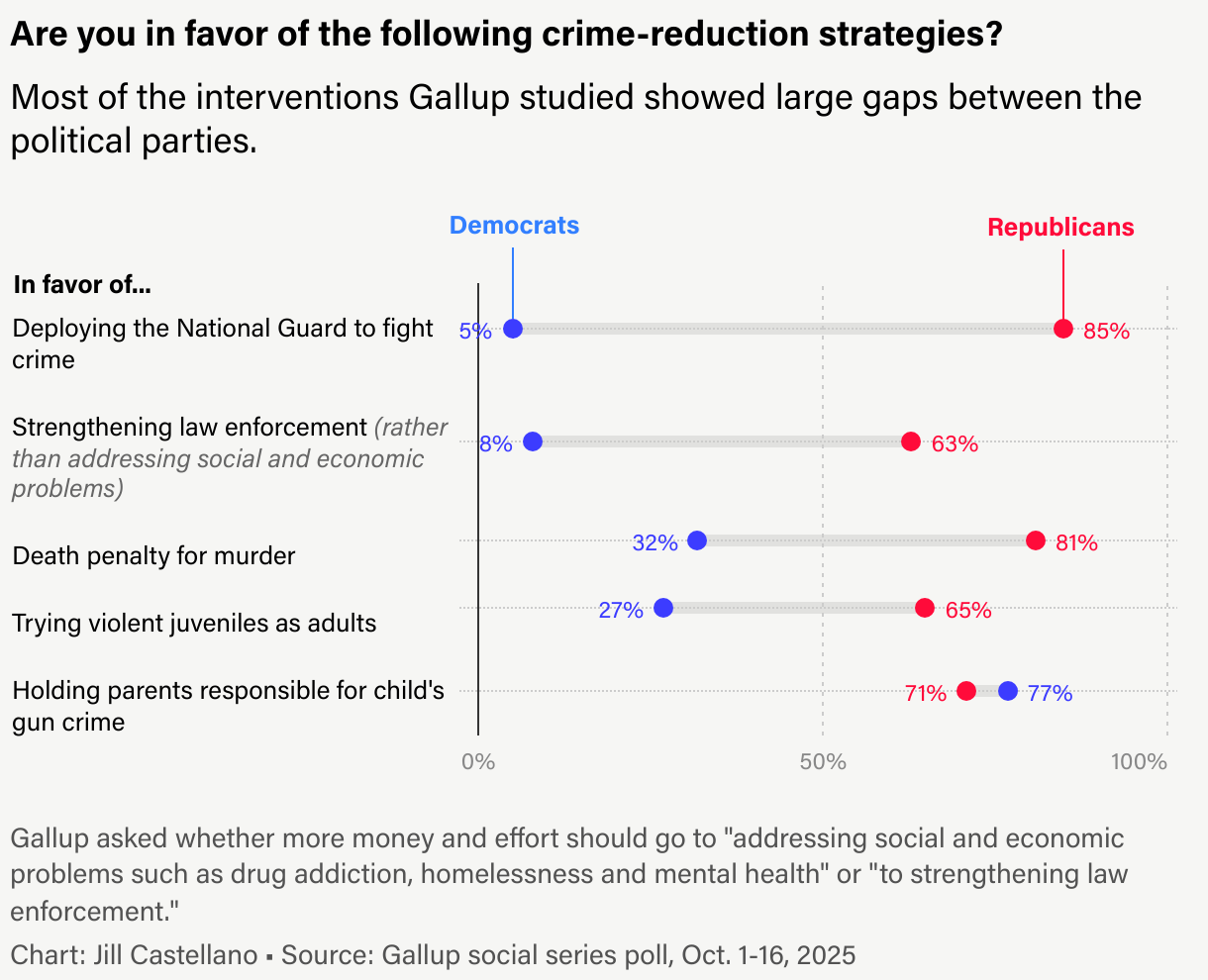
These polarization patterns are also reflected in what crime-reduction strategies people support. While the majority of Americans oppose Trump deploying the National Guard as a crime-fighting force in U.S. cities and his proposal to charge 14-year-olds as adults in Washington, D.C., his Republican base remains staunchly supportive.
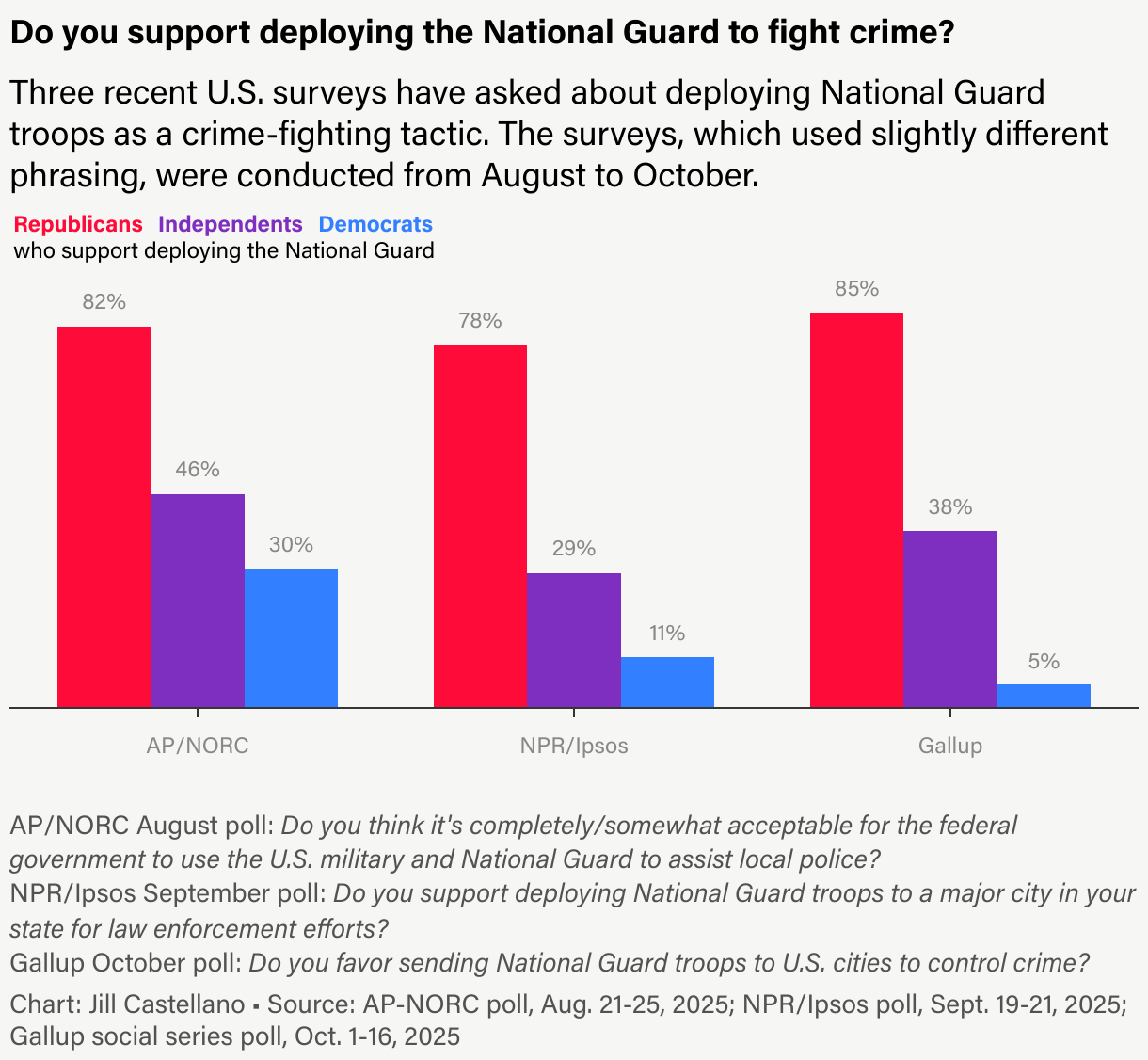
Since August, at least three national surveys have tested public attitudes on National Guard deployments. Each found a stark partisan gap. The most recent poll showed around 80% of Republicans in favor, compared to only 5% of Democrats.
“It’s almost like a referendum on Trump,” said Lydia Saad, the director of U.S. social research at Gallup.
The October survey found that military deployment was the most polarizing of the five interventions studied. Researchers also asked about trying violent juvenile offenders as adults, boosting resources for police or social programs, and supporting the death penalty. All of them showed a political party divide. Only one intervention — whether to hold parents legally responsible for a child’s gun crime — lacked a substantial partisan gap.
Saad said the more an issue is discussed by political party leaders, the wider the party divergence. “The gaps correspond perfectly with how much these issues are in the news and who is associated with them,” she explained.
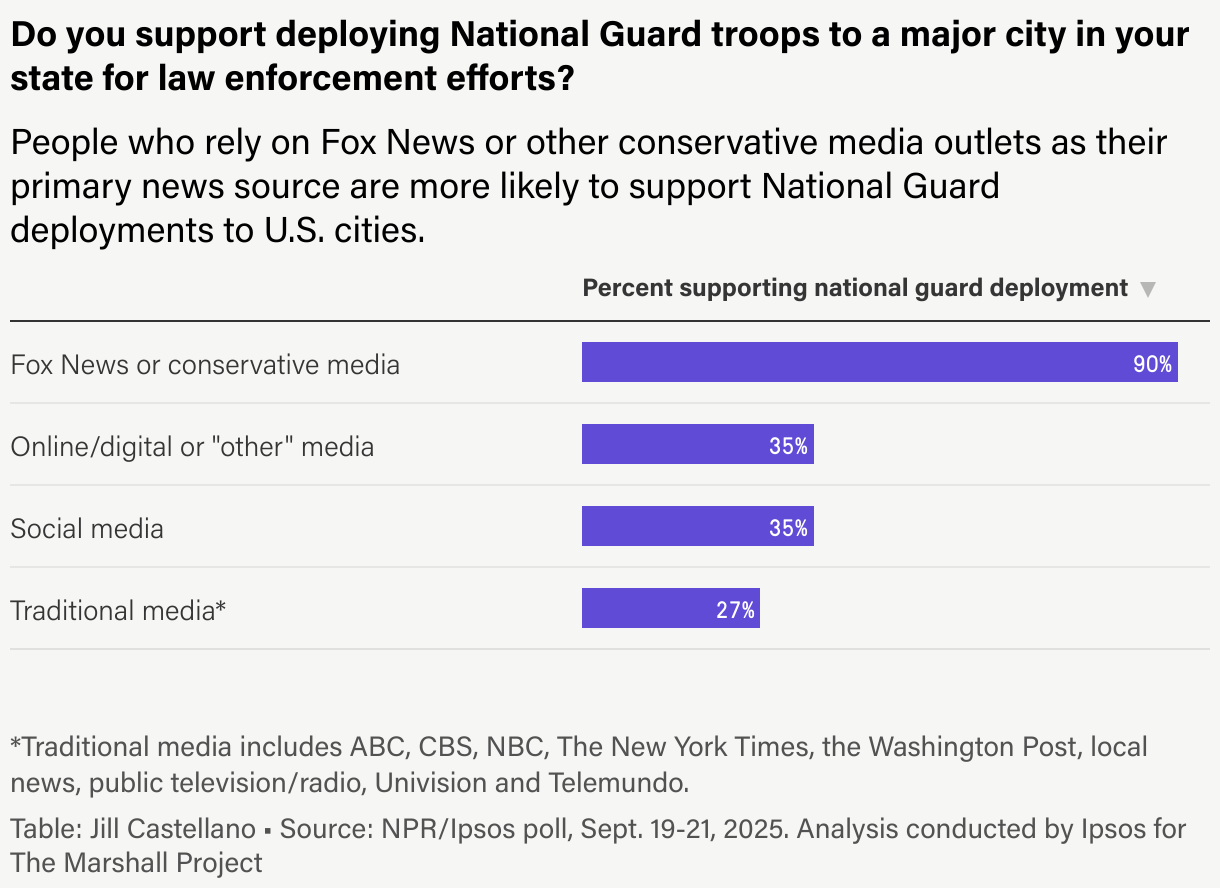
In a September NPR/Ipsos survey, Republicans whose main news source was Fox News or other conservative media outlets, like Breitbart or Newsmax, were almost universally supportive of deploying the National Guard, with 95% in favor, compared to 70% of Republicans who rely on other information sources.
“Our fractured media landscape and disparate sources of information is helping to exacerbate some of these political divides,” said Mallory Newall, a vice president at Ipsos.
Partisanship isn’t the only factor influencing crime perceptions. For example, women, people of color and people with lower household incomes are more likely than others to express fears of walking alone at night in their neighborhoods.
The NPR/Ipsos poll shows that Americans seem to be more concerned about partisanship than they are about crime itself. When asked to pinpoint their three “most worrying” issues, 43% of respondents listed political extremism and polarization, while only about one-quarter ranked crime or gun violence. Other studies have found that only around 5% of Americans currently consider crime and violence to be the single most important problem in the U.S.
At the same time, a slowly growing proportion of U.S. adults, primarily Democrats and independents, support criminal justice reforms.
Gallup found that more than two-thirds of Americans now say more money and effort should go toward addressing underlying causes of crime, such as drug addiction, homelessness and mental health issues, rather than toward strengthening law enforcement.
“This would be a really good moment to embrace the public’s preference for social policy as a solution to crime rather than law enforcement as a solution to crime,” said Roman at the University of Chicago.
“On most measures, if you are under 50 years old, this is the safest America you’ve ever lived in,” he added. “Our policies should reflect that.”