Josh Allen dropped back and felt pressure almost immediately. It was the first quarter of his first NFL start. And he responded by doing what he often did in college at Wyoming — and what has become his signature move in the NFL. Allen evaded the rush, rolled right and looked downfield.
How many times have we seen him make an incredible play in that situation? With a rusher either in his face or hanging off his legs, the Buffalo Bills quarterback does something sensational: a pinpoint pass toward the end zone.
Well … that’s not what happened on this particular play.
Allen threw the ball directly at a Los Angeles Chargers defensive back. It could have been — and maybe should have been — an interception, but it was one of many uncatchable balls the rookie QB threw that day, Sept. 16, 2018.
And it was reflective of what was happening in practice, which is why Nathan Peterman, and not the team’s first-round pick, began the season as Buffalo’s starting QB before getting hurt in the season opener.
One former Bills staffer offers a brutally honest account of Allen’s initial NFL days. “He was just winging it,” the staffer told me. Allen is a big-bodied athlete — 6-foot-5, 237 pounds — which helped him land in the top 10 picks of the 2018 NFL Draft. But that big body was also why he was struggling to get his long-armed throwing motion in check.

“This guy couldn’t complete a pass to save his life,” the staffer said. “There would be checkdowns or just underneath or touch throws that he would sail over their head. He just could not control his arm initially.”
That same former Bills staffer made it clear: If he could start an NFL franchise today with any quarterback, it would be Josh Allen. He shared that story not to criticize Allen — but to illustrate how far the 29-year-old quarterback has progressed.
Of course, there are others who don’t remember it that way.
“That never happened,” Bills tackle Dion Dawkins, who came into the NFL as a rookie with Allen, told me. “From the time he hit the field, from day one, he was great.”
Dawkins added: “It was almost like seeing Allen Iverson for the first time. And then watching that develop. Always: ‘[He’s] too small.’ Boom. Michael Jordan ain’t get accepted into his college, and ain’t like make the team and then boom: best player of all time. Right? That’s what’s going on.”
Whether Allen looked like Tim Tebow or Andrew Luck on day one, both Dawkins and the former Bills staffer pinpoint the crux of the issue. Allen might have had special traits, but he was as raw as prospects get coming into the NFL. There was a lot to reteach, unteach, and … just plain teach the kid coming out of Wyoming, which is where Allen wound up after attending junior college in California because he had no Division I offers out of high school.
“I think he’s the most improved quarterback prospect that we’ve ever seen,” said Bucky Brooks, former NFL scout, former NFL defensive back and current FOX Sports NFL analyst.
Allen went from a guy who couldn’t beat out Nathan Peterman to a guy who’s going toe-to-toe and throw-to-throw with Patrick Mahomes, Joe Burrow and Lamar Jackson. At this moment, there might not be a better quarterback on the planet, including Mahomes, Burrow and Jackson.
So, how did Allen do it?
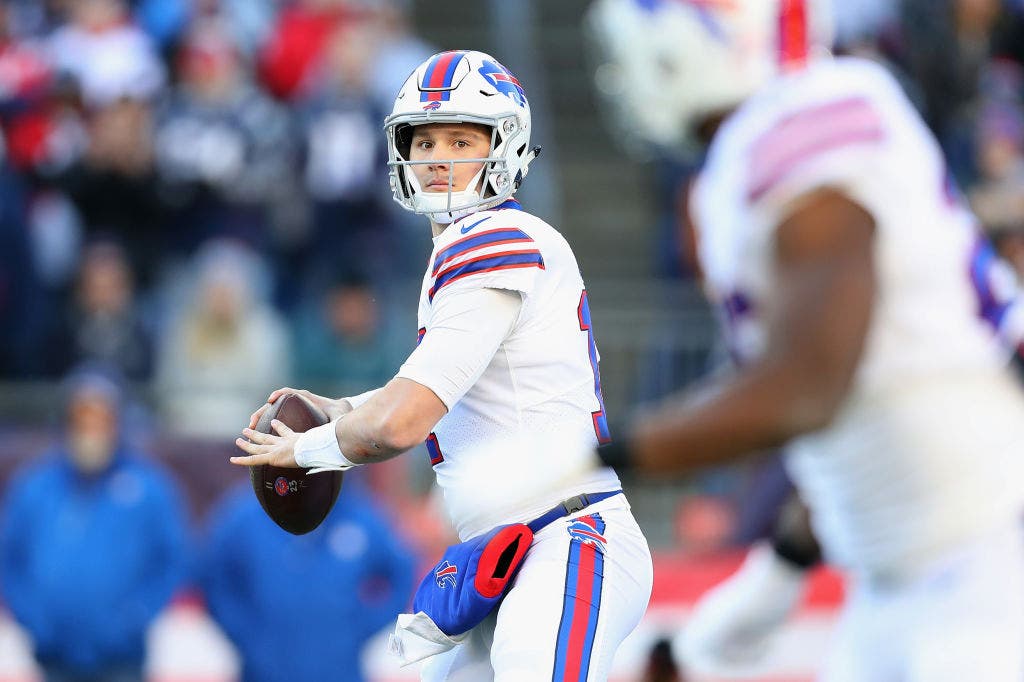
As a rookie in 2018, Josh Allen completed 52.8% of his passes, with 10 touchdowns and 12 interceptions. (Photo by Maddie Meyer/Getty Images)
*** *** ***
Brandon Beane felt as if he and the Bills had just won a massive game.
It was actually during the offseason, but when describing the “relief” he felt that day, April 26, 2018, the team’s general manager could only contextualize it with a sense of victory.
The TV broadcast made that iconic noise signaling the next draft selection.
“With the seventh pick in the 2018 draft, the Buffalo Bills select Josh Allen, quarterback, Wyoming,” commissioner Roger Goodell said.
That was when Beane could take a breath — finally.
“It was like, relief,” Beane told me. “Because it’s honestly like when you won a game. When you lose a game, you just feel beat up mentally, like you played in the game. And when you win a game in this league, most of the time, it’s like relief. It’s not like this great party, you know, unless you win the Super Bowl.”
Before the 2018 draft, Beane had traded up from 21st overall to 12th. So starting from No. 12, the GM knew roughly how the draft board would play out ahead of the Bills’ pick — and how he could move up to get Allen.

The Cleveland Browns weren’t going to trade the No. 1 pick, which turned out to be Baker Mayfield. The Bills had tried to trade with the Giants and No. 2, but they also said no thanks and selected Saquon Barkley.
There seemed to be an opening at No. 5, where the Denver Broncos were set to pick. But John Elway had his eyes on one player he couldn’t pass up, and North Carolina State edge Bradley Chubb was there for the taking. The Indianapolis Colts wouldn’t move out of the No. 6 pick, which meant that, while the Buccaneers were on the clock at No. 7, Beane was in a lengthy discussion with Tampa Bay GM Jason Licht.
Finally, they had a deal. The Bills gave up the No. 12 pick and their two second-round selections (No. 53 and No. 56) for the Bucs’ No. 7 pick and a late seventh-rounder (No. 255).
“Once I heard it announced, ‘The Bills are on the clock,’ it was like, ‘Hallelujah, we did it.’ And we hadn’t even called Josh yet,” Beane said. “At that point, you’re kind of like, ‘Holy cow, this is actually happening.’”
Beane rated Allen as the top quarterback in that draft class, which, in hindsight, was not only correct but also an impressive call in a deep group of signal-callers. Mayfield went first overall to the Browns, Sam Darnold went third to the Jets, Josh Rosen went 10th to the Cardinals and Lamar Jackson went 32nd to the Ravens.

Quarterbacks Baker Mayfield (right) and Lamar Jackson were picked first and last in the first round of the 2018 NFL Draft. (Photo by: 2018 Nick Cammett/Diamond Images/Getty Images)
This would be the make-or-break decision of Beane’s career.
And make no mistake: Taking Allen came with considerable risk. You see what Allen is today. But it’s easy to lose sight of what he was at 21 years old.
Before the draft, NFL Network analyst Mike Mayock said of Allen: “Biggest arm quarterback I’ve seen since JaMarcus Russell.”
It would have been a compliment if it didn’t end with: JaMarcus Russell.
Allen had not been statistically dominant at Wyoming. In his final college season, he threw for 1,812 yards, with 16 touchdowns and six interceptions. In his two seasons as a starter, he completed 56.1% of his passes. Sure, he had the incredible arm and could “make any throw,” but, realistically, how often could he complete those throws?
“He had a hose, man,” said one AFC scout who had been assigned to Allen during the pre-draft process. “If you were an offense that wanted to push the ball, you could do it with him. And it would be no problem. I don’t think there was any throw that he couldn’t at least get in the vicinity, just off pure arm strength, right?
“But the accuracy issues were real.”
Allen became the butt of a joke for the “Pardon My Take” podcast. The hosts created a website, DraftJoshAllen.com, where they made the case that teams should draft the QB … “because he’s tall.” It was a mockery of the draft discussion based on traits and projection — rather than production.
And the jokes didn’t stop when Allen went to the Bills.
This was the organization that had drafted quarterbacks E.J. Manuel and J.P. Losman in round one. And if you haven’t heard of them, that’s because they are among the biggest draft busts in history.
But the Bills had a plan, based on what Beane and coach Sean McDermott saw with Cam Newton in Carolina, where Beane had been the assistant GM and McDermott the defensive coordinator. And Allen’s accuracy issues weren’t a major concern for Beane. In fact, during our conversation, he wouldn’t say one way or the other whether Allen is the most improved prospect of all time.
“I’m not saying you’re wrong,” Beane said. “I think he was a better player than people gave him credit for coming out. … But one of the things that I think is a fallacy out there was the whole accuracy thing.”
Beane had zero reservations about Allen, in part because the Bills had created their own version of adjusted completion percentage. The team’s scouting staff logged all of Allen’s snaps in college and gave him completions when receivers dropped the ball (and gave him an interception when an opponent dropped the ball). The Bills found Allen’s efficiency was much higher and much more comparable to the other QBs in the 2018 draft class.
The stats weren’t telling the whole story. So Beane did everything he could to learn more about Allen during the pre-draft process.
*** *** ***
Roughly a year earlier, during Beane’s interview with Bills ownership for the GM job, he mentioned Allen, among others, as a quarterback he would evaluate to draft. Beane had the QBs ranked — and suffice it to say that, at the time of the interview, Allen was not at the top of the list.
Not yet.
Beane was hired in May 2017, and Allen gradually worked his way past the rest of the quarterbacks in the 2018 draft class in the new GM’s evaluation process. There was the 35-minute meeting the Bills got at the Senior Bowl when Beane said, “We realized he’s not as raw as maybe we thought.” There was the NFL Combine, where Allen was a consummate professional. There was a private workout in Buffalo and a dinner out.
“The one thing about Josh was that he just kept passing every test,” Beane said. “We felt very confident about learning who he was through not only what he said, but through teammates, through coaches, just kind of putting the Josh Allen puzzle piece together.”
Allen was absolutely on the radar of multiple teams, even Cleveland at No. 1 overall.
Hue Jackson, then the Browns’ head coach and now the offensive coordinator at Georgia State, had a few questions about Allen: accuracy, reading coverage and mentality. And then there was the matter of the Browns’ depleted roster. Jackson acknowledged in our recent conversation that Cleveland, which didn’t win a game in 2017, didn’t have a good offensive line. It had problems at receiver.
“Everybody can look back and say that was not [one] of the most talented teams in the National Football League,” he said.

In their first year with the Bills, GM Brandon Beane and coach Sean McDermott saw something special in Wyoming QB Josh Allen. (Photo by Rich Graessle/Icon Sportswire via Getty Images)
And so Allen, a developmental quarterback, made less sense than a more polished QB like Heisman Trophy winner Baker Mayfield.
“Is he gonna be able to put all of this together?” Jackson wondered about Allen. “It’s all of the other things that came with trying to be the quarterback at Cleveland. … Maybe this guy is too nice? … I just wasn’t sure if, when it got rough, if he was in Cleveland, whether he could handle the pressure of it all. ‘Not only do I get drafted first, I’ve got to play like a franchise guy from day one, or else I fail.’ A lot of people can’t handle that pressure.”
There were also scouts around the league who were wary of the young QB’s ability.
“Josh didn’t jump off the tape when you watch him,” one NFL scout said. “Josh had size. He had an arm. He had some of those tools that you’re thinking, ‘OK, that could translate.’ … But as an evaluator at that level, at Wyoming, the expectation is that he absolutely dominates. You should see it and know it right out of the gate — like right off Jump Street. It shouldn’t even be a question.”
When it came time to pick Allen, Beane saw something different than a number of other evaluators around the NFL. Others wondered:
Did Allen have accuracy issues? Issues reading defenses before and after the snap? A mentality problem?
For Beane, the answers were: No, no, no.
*** *** ***
It wasn’t until Allen’s third NFL game that he completed over 60% of his passes. That was also, not coincidentally, his first win.
“You got excited to play him because you knew he was going to take chances. He’d make mistakes,” former New England Patriots All-Pro safety Devin McCourty told me. “In 2018, it was, ‘We can’t wait to play against this guy.'”
In Allen’s second season, he threw for more touchdowns (20) than interceptions (nine). That was also, not coincidentally, his first time making the playoffs.
“[In 2019,] we were not as excited, but like, still making some plays on him,” McCourty said.
It wasn’t until Allen’s third season that he completed over 60% of his passes — and truly broke out as a transcendent talent, with 37 passing touchdowns and just 10 interceptions. That was the first year Allen made the Pro Bowl, won a playoff game and made it to the AFC Championship Game.
It was over the course of that year that Allen’s arm strength turned into arm talent.
The progress was evident to McCourty. This was New England’s first year without Tom Brady. Buffalo had already clinched the AFC East title, but it wasn’t clear yet if the Bills were there to stay — if they were legit. Ahead of their Week 16 matchup, Patriots coach Bill Belichick felt like New England could win with QB Cam Newton — but the Hoodie’s game plan was not focused on Allen.
“Bill comes in [to a team meeting] and he’s like, ‘Everyone’s talking about this streak and how many passing yards. This game, for us, comes down to stopping the run,'” McCourty said. “And you can see every DB’s face in that meeting room looking at each other, like, ‘Are we all watching the same film? The run!?'”
Allen threw for 320 yards and four touchdowns in a 39-9 win. In that game, Allen broke Jim Kelly’s franchise record for passing touchdowns in a single season. And Allen passed Drew Bledsoe’s franchise record with eight games with over 300 passing yards.
“That was when I was like, ‘Alright, this is the guy. This is his division each year,'” McCourty said. “It was no more Brady and the Patriots. Our goal had to be, every year, to be as good as that team and that player.”
And Belichick? How did he miss Allen’s rise?
“Denial,” McCourty said.

*** *** ***
It was a long path for Allen to become an NFL star quarterback. In his first three seasons, he struggled with accuracy. He also struggled with decision-making, which resulted in turnovers (from inadvisable throws) and injuries (from inadvisable contact on runs and sacks).
All the while, the Bills stuck with him. They never wavered.
There were a few turning points in Allen’s career.
The first came after he rebuilt his throwing motion, which steadily improved his accuracy. And that process is so difficult that many scouts still believe that accuracy is largely uncoachable.
“It’s night and day, in terms of the type of thrower I am,” Allen said in 2024. “Where I held the ball, where I released the ball. It looks like a different guy. Sometimes when I click on YouTube, I’ll see a video and I’m like, ‘Who is that throwing the ball?'”
For anyone who plays golf, think about trying to fix an element of your swing. Maybe you get a swing coach (or you watch a YouTube video), and during the offseason, you tweak your swing. Then you get up on that tee box for the first round of the year and guess what happens? Slice. Hard right. You revert to your old swing. After all that.
Now imagine trying to adapt those swing adjustments while four to six 300-pound men are trying to tackle you — with the hazards refusing to stay still down the fairway. Oh, and you have to hit the ball out of the air instead of off the tee.
That’s what makes mechanical adjustments so hard for a quarterback.
It’s not just about making the changes to a throwing motion that you’ve ingrained since you started throwing as a kid. It’s about maintaining those changes when millions of people are watching and a staff of opposing players and coaches (all paid millions of dollars) are working to make sure you fail.
“Josh is a farm kid from the Central Valley in California,” said Chris Hess, Allen’s throwing coach. “Farmers develop. They grow seeds. They understand that not everything comes right away. There’s this work ethic and investment, so you can be able to harvest.
“Josh kind of grew up with that mentality, whether he recognizes it or not. He kind of approaches his own development with a farmer’s mentality, rather than like a hunter or salesman, which means I want it now, right away, which is kind of what the NFL is.”
The process of changing Allen’s throwing motion was lengthy. It took years. Frankly, it’s still ongoing. It started in the weight room where Hess and Allen worked to reinforce a new motor pattern. They worked through a set of exercises and drills to build muscle memory. Through the years, they’ve also had to tap physical therapists to help with muscle, bone and tendon mobility.
Once Allen adjusted, strengthened and reinforced his mechanics, he took it to the field. At this point, Allen and Hess only make the slightest adjustments to the QB’s motion.
“It’ll take some guys three months to do some movement, and he’ll get it in three throws of doing it. It’s just like, ‘I hope you know that’s not normal.’ For him, it’s normal,” Hess told me.
As Allen’s mechanics grew cleaner, something interesting happened in the league as a result of his progress. Teams thought they could build their own Josh Allen. In many ways, Allen was the reason why the Indianapolis Colts could justify drafting Anthony Richardson and why the San Francisco 49ers could justify drafting Trey Lance.

Following Allen’s rise, there was a wave of big-bodied quarterbacks projected to be the next Allen. But their failures have only made Allen’s progress more pronounced. He’s one of a kind, in part because he’s ever-changing.
“I love the way his brain works. He’s a tinkerer,” Hess said. “He’s always looking. He’s willing to search to see if there’s something more there.”
Turns out, there was.
Against the Patriots in Week 4 of the 2019 season, Allen threw three interceptions — in the first half. Indeed, the Patriots were “still making some plays on him,” as McCourty said. When the Bills went into the locker room, former offensive coordinator Brian Daboll absolutely laid into the young quarterback.
“I was sitting there just taking it because I felt like I was playing like crap. And I was playing like crap. And I was just like, ‘Maybe it is me. Maybe I do need to change,’” he said in a conversation with McCourty, now an NFL analyst with NBC Sports.
Allen’s decision-making needed to change. Defenses were beginning to play him in a number of different ways, and he needed to recognize how to beat those coverages. He needed to stick to the game plan.
“He learned more about the game and understanding who our opponent is. How do we win this game? And that can change,” Beane said. “He’s become more patient and willing. ‘If you want to play that way, I’ll play it with you.’ That has been one of the huge things that he’s improved over the years with his decision-making.”
In that 2019 game against New England, Allen suffered a concussion and didn’t finish.
Allen might be one of the most difficult players to tackle in the NFL, but that only means that opposing defenses will hit him harder — and lower — to bring him down. His mobility might be an asset — just like his rocket arm — but defenses will try to use that against him.
“[He gained an] understanding that our offense dramatically changes — and it’s no offense to anybody else — if he’s not in the game,” Beane said. “Whether that’s sliding, whether that’s getting out of bounds. It’s not that we say never run the ball or never take hits. It’s just, you know, being more responsible: When does it make sense to take a hit?”
It came back to situational awareness.
This season has been as tough as any for Allen to find that balance.
He is making bad decisions, without a doubt. But he’s also facing more third- and fourth-quarter situations where, you could argue, he has to make a bad decision — throwing it downfield to covered receivers or running it downfield into contact to make a first down.
The Bills are a run-first team, with one of the best run-blocking offensive lines in the NFL and one of the best running backs in James Cook. But when it comes to supporting their quarterback in the passing game, they are still searching for answers. That’s why, during the 2025 season, they’ve signed veteran receivers Elijah Moore, Mecole Hardman, Gabe Davis and Brandin Cooks.
Despite Allen’s struggles and the Bills’ sometimes-ugly performances, they are headed for the playoffs. Other undersupported quarterbacks — Mahomes, Burrow and Jackson — might not be so lucky when the regular season ends.
It’s a good year for Allen to finally win a Super Bowl. It might be the best year with Mahomes likely out of the postseason mix.
And while there’s some debate in the scouting community about whether Allen is the most improved NFL QB prospect ever, perhaps winning a title would cement his status.
*** *** ***
In November, Allen returned to Laramie, Wyoming, for the first time since his 2018 Pro Day. The occasion was his college jersey retirement, an event that followed the Bills’ Week 12 loss to the Texans in a Thursday night game.
It was staggering to see the man he is today against the backdrop of photos of him in a Wyoming uniform. There are the physical differences. But there’s also the superstar glow — he’s Hollywood star Hailee Steinfeld’s husband, after all. And there’s the fact that he left his former coaches, his former teammates and basically everyone who hugged him in tears.
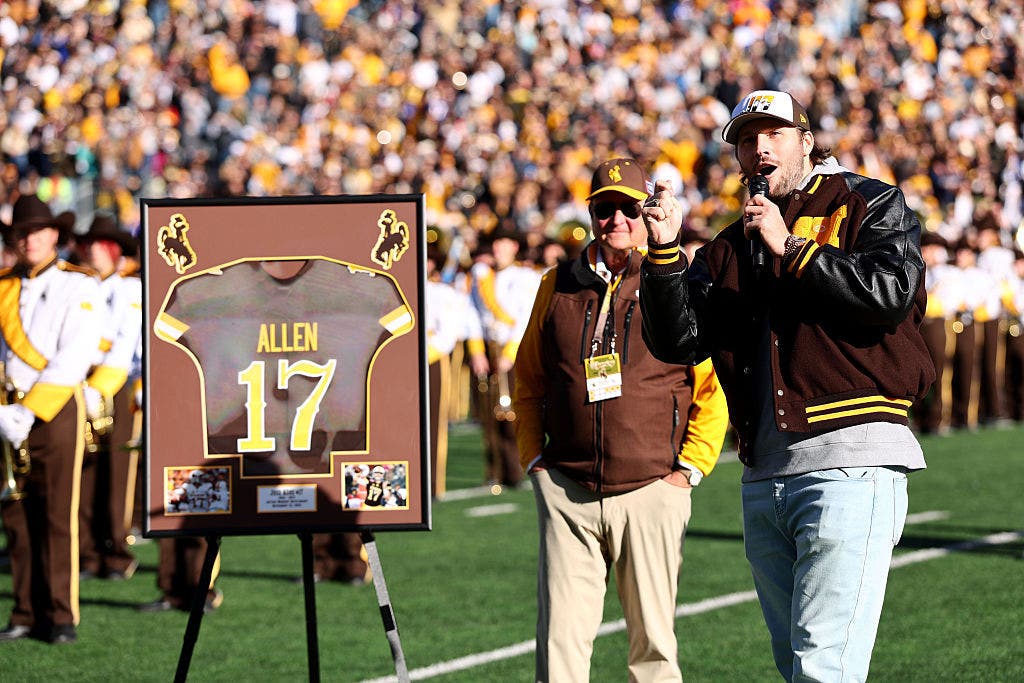
Josh Allen speaks to the crowd after being honored at his Wyoming Football Jersey Retirement Ceremony at War Memorial Stadium on Nov. 22. (Photo by Jamie Schwaberow/Getty Images)
But perhaps the most meaningful moment happened behind closed doors when Allen and his former head coach Craig Bohl spoke to the current Wyoming team.
“This is going to sound a little weird, but I love feeling like I feel today after a loss,” Allen told the players. “It gets me going. It gives me the chills thinking about it, because I f—ing love this game. You’ve got to be a little sick to love this game, because it’ll take a whole lot from you. But it’ll give you a whole lot, too.”
Allen has taken some consequential losses in his career, not just in the box score but in terms of individual defeats: incompletions, interceptions, fumbles, injuries. That sick feeling — and the fact that he loves it — might just be the biggest reason why the guy talking to those college kids barely resembles the kid who once sat in those auditorium chairs.
Before joining FOX Sports as an NFL reporter and columnist, Henry McKenna spent seven years covering the Patriots for USA TODAY Sports Media Group and Boston Globe Media. Follow him on Twitter at @henrycmckenna.
Want great stories delivered right to your inbox? Create or log in to your FOX Sports account, and follow leagues, teams and players to receive a personalized newsletter daily!