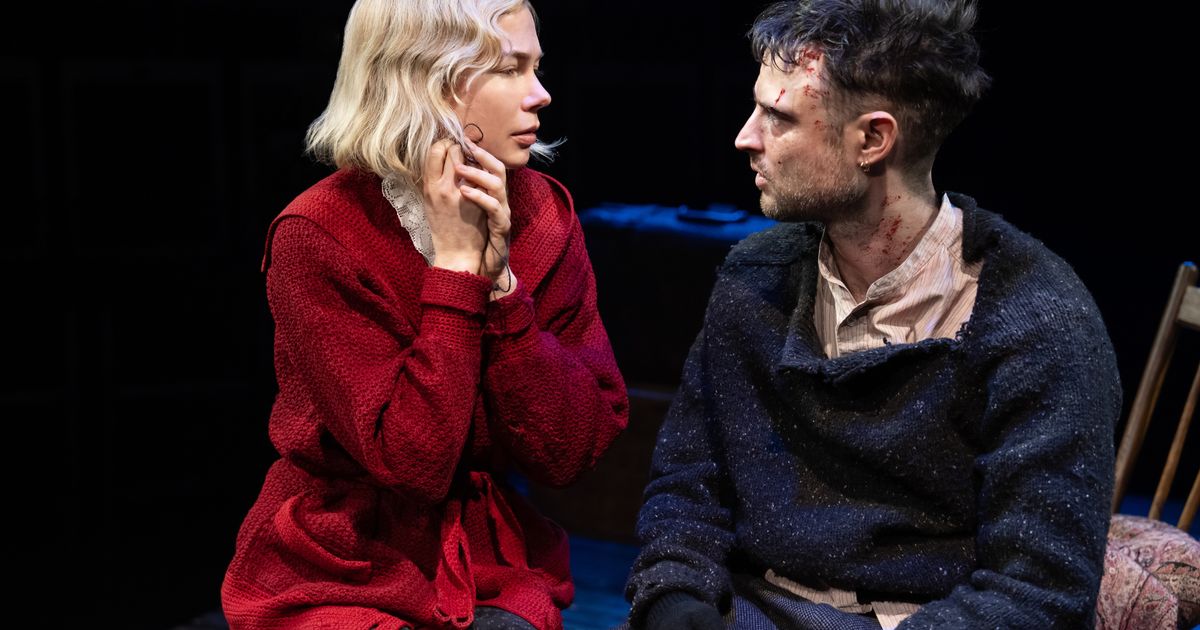

Michelle Williams and Tom Sturridge in Anna Christie, at St. Ann’s Warehouse.
Photo: Julieta Cervantes
When the play that would become Eugene O’Neill’s Anna Christie opened in 1920, it was named not for the woman that would expand to fill its center but for her father. Chris Christopherson (no relation to the singer) stumbled onto the stage in Atlantic City after a tumultuous rehearsal process for which O’Neill was largely absent, its director desperately hacking minutes out of the script and slashing the title to simply Chris while he was at it. Whatever happened in Chris, O’Neill wasn’t having it. By the next year he had rewritten the play from the bottom up, refocusing its spotlight on a character who had begun as little more than a prim cipher, carving away at her marble till he revealed a heroine.
Little wonder that Michelle Williams and the director Thomas Kail (of Hamilton, and Williams’s husband since 2020) found themselves drawn to the play, which has been unfairly eclipsed in recent years by more chest-thumping specimens from O’Neill’s menagerie. (New York has taken multiple Long Day’s Journeys, and at least two Icemen have come and gone since Anna was last in town.) Talking to Vogue, Williams described her fixation on roles like Anna Christie’s sharp-mouthed, deep-feeling protagonist: “It’s a response that is totally inarticulate and flies out of my body and attaches itself to the work like a harpoon. And then, all of a sudden, I’m going in that direction, whether I really want to or not.” O’Neill would approve: His play is, after all, about the sea — or, more accurately, about the inexorable currents that sweep us up like the undertow, the ecstatic callings we’re powerless to resist despite their danger, despite all our efforts to be good.
It’s a passionate, gripping piece of writing, spilling over with its writer’s flair for big, chewy dialects, suffused with briny fog and contraband booze, and, perhaps most surprisingly, sporadically funny and solidly if subtly feminist. That Kail’s production captures its complex, tactile vitality — at once plush and grimy; Eugene was no minimalist — is, whatever the shortcomings, a real triumph. O’Neill is always a heavy lift and, in our era of postmodern super-sophistication, it can also feel like a precarious one: Lines like “Dat ole davil, sea … No man dat live going to beat her, py yingo!” or Anna’s Mae West opener — “Gimme a whiskey – ginger ale on the side. And don’t be stingy, baby” — are easy to tip into caricature; but fail to commit to their music and they won’t sing. O’Neill is like opera for actors, requiring performers who can marry feeling and high style, and this Anna Christie’s got them.
At the apex of the play’s central triangle, Williams is as luminous and precise as a Vermeer painting. Wounded and guarded but still hungry for life, she yearns and flickers without ever going moony or soft. At 45, she’s also superb at embodying a 20-year-old’s at once brighter and blurrier shape — the still-forming personhood, the flashes of whimsy and defiance, the overwhelming wanting. Hardly out of her teens, Anna Christopherson is a Swedish immigrant, brought by her mother to Minnesota as a young child while her father, Chris (Brian d’Arcy James, unfurling in the role as if it were written for him), was constantly away at sea. “Ay tank it’s better Anna live on farm, den she don’t know dat ole davil, sea, she don’t know fader like me,” says Chris to his barfellows when he learns by letter that the daughter he hasn’t seen for fifteen years is on her way to join him in New York. (These days, like an addict trying to swear off the bottle, he keeps closer to shore, captaining a barge instead of conscripting on ocean voyages.) Superstitious, tipsily well-meaning, and full of ideals that his life hasn’t borne out, Chris is an old hand at self-deprecation as self-defense: He wasn’t good enough for Anna, he insists. He did what was best for her.
But poor Anna. The upbringing Chris left her to was less hearty American dream and more bleak midwestern nightmare. Anna arrives at the Manhattan waterfront with a suitcase full of secrets her father can’t know — we learn them because, in a stroke of brilliance, O’Neill gives her a conversation with another woman, a raggedy waterfront eccentric and erstwhile bedmate to Chris called Marthy Owen. The role only appears in the first of the play’s four acts, but the marvelous Mare Winningham — frowsy and wry with impeccable comic timing — reveals it for the rough-hewn jewel that it is. When Anna and Marthy meet, like recognizes like: A survivor sees another woman who’s weathering the long storm. As Marthy hears Anna out, so do we: At 16 she was raped by one of her cousins, after which she ran away and, struggling to survive alone in St. Paul as a governess, eventually turned to prostitution. “Out there I called myself Anna Christie,” she says with a jaded half-smile. Now, she doesn’t want to be Anna Christie anymore. Not unlike her playwright — who almost died twice before he was 25, eventually emerging from a sanatorium determined to write plays — she’s been terribly sick and, in the still-churning wake of both illness and experience, has determined to start her life anew. The question, given her gender and the nature of her so-called shame, is will anyone let her?
It’s not impossible to draw lines across the century between O’Neill’s play and now. Its American narrative is fundamentally one of immigration and displacement, and its men undergo violent confrontations with their own identities — with how much of themselves they’ve hung on rotten notions of masculine potency and feminine purity. Anna Christie long predates our current cultural fluency with “trauma,” but the play is all about what it means to experience it, to carry it, and, as a woman, to be forced to relive it in the hope — possibly both vain and deadly — that it might get a few men to see things differently.
That stuff’s all right there, both on the page and vibrating in the performances. At the same time, there’s a refreshing lack of attention being drawn to it here. Perhaps it’s a function of letting celebrity alone to do the work of getting butts in seats (across from Williams, an absolutely feral Tom Sturridge plays Anna’s love interest, the Irish ship’s stoker Matt Burke), but whatever it is, it feels like a shift in the winds of our preoccupation with relevancy. There’s not even a director’s note in the program — just a company of artists trusting in the richness and strangeness of the story they’ve undertaken. Watching them forgo protestations of their own necessity, I felt braced, even a little giddy — like Anna standing on the deck of Chris’s barge, her shoulders dropping in the mists of Provincetown harbor: “I love this fog! Honest! … It makes me feel clean — out here — ’s if I’d taken a bath.”
Anna’s newfound serenity doesn’t last for long, though. Soon enough, a wild thing emerges out of the fog. Kail has this creature from the sea, the shipwrecked stoker Matt, crawl out from beneath the stacked wooden pallets that form the stage deck, and the entrance is gleefully horror-coded. Sturridge’s hand shoots up from the murk, grasping the air and slapping the planks before his body follows. Like many moments in the play, it’s got a tilted, inarguable humor to it. Through a poetic lens, it’s easy to see Anna and Matt as Shakespeare’s Miranda and Ferdinand, the latter cast up from the sea to fall instantly in love with a woman who seems, to him, goddess-like, whose rough old father fears for her virtue. (D’Arcy James evokes a sodden old Prospero, hardheaded and soft-bellied, devoid of magic but driven on, clumsily, by genuine love.) But the sly joke has two punchlines: Not only do we know the truth of Anna’s past, but Matt is also less the gallant young prince and more Caliban. He’d be horrible in pretty much all ways — his aggression and swagger and barely contained brutality — if he weren’t so absurdly earnest. “A big kid,” Anna calls him. Sturridge crows and growls his lines, rolling his torso and crouching to crawl on his knuckles like a young silverback. His Matt has somehow avoided domestication altogether, and so of course Anna’s armor cracks for him — she who “never could stand being caged up nowheres,” who longs so fiercely for escape and autonomy, be they as far-off and hazy as the cloud castles of some fairy tale.
When I wanted more from this Anna Christie, it was in its exploration of the throughline of Anna’s own yearning, especially in the play’s wonderfully tricky conclusion. O’Neill directs the steamroller of tragedy right at the characters and then — atypically, delightfully — diverts it. It’s an offbeat, gutsy move, one that’s caused plenty of fuss over the years. Critics at the time called the ending “bogus” and “banal,” but what it actually does is keep the door open on the essential question of Anna’s freedom. Where is she left, this enduring spirit, at this turning point in her struggle with two men who love her and whom she, too, loves? The truth is that all this love hasn’t yet created a space for her that isn’t a cage. A profound, decisive gesture is missing at the end of Kail’s production — we’re left without an image to emblematize Anna’s arc, to gather up its reverberations and cast them questioningly into the future. But we are still left with Williams’s performance, and that’s more than enough.
Anna Christie is at St. Ann’s Warehouse through February 1.