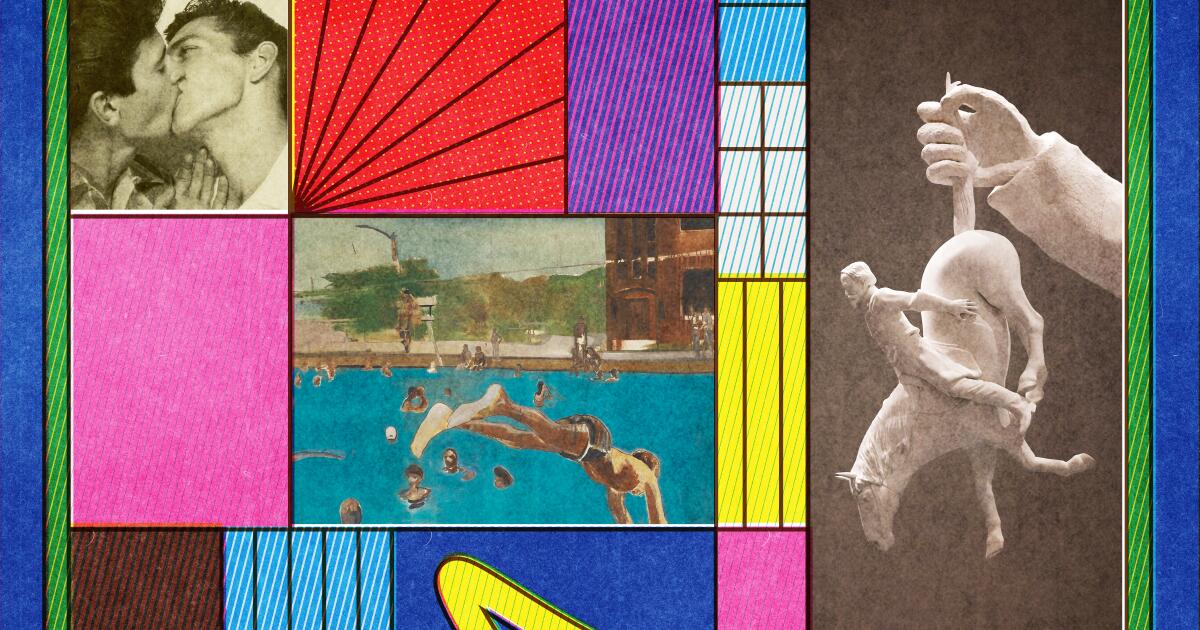

There was no shortage of engrossing art with which to engage in Southern California museums during the past year, although the considerable majority of it had been made only within the past 50 years or so. Art’s global history before the Second World War continues to play a decided second fiddle to contemporary art in special exhibitions.

Our picks for this year’s best in arts and entertainment.
The chief exception: the Getty, where its Brentwood anchor and Pacific Palisades outpost accounted for three of the 10 most engrossing museum exhibitions in 2025, all 10 presented here in order of their opening dates. (Four are still on view.)
Art museums across the country continue to struggle in attendance and fundraising after the double-whammy of the lengthy COVID-19 pandemic shut-down followed by culture war attacks from the Trump administration. That may help explain the unusually lengthy, seven-to-14 month duration of half of these shows.

Gustave Caillebotte, “Floor Scrapers,” 1875, oil on canvas.
(Musée d’Orsay / Patrice Schmidt
)
Gustave Caillebotte: Painting Men. Getty Center
An emphasis on men’s daily lives is very unusual in French Impressionist art. Women are more prominent as subject matter in scores of paintings by marquee names like Monet, Cassatt and Degas. But homosocial life in late-19th century Paris was the fascinating focus of this show, the first Los Angeles museum survey of Gustave Caillebotte’s paintings in 30 years.

A view into a dance gallery is framed by Guadalupe Rosales’ “Concourse/C3” installation.
(Christopher Knight / Los Angeles Times)
Guadalupe Rosales – Tzahualli: Mi Memoria en Tu Reflejo. Palm Springs Art Museum
Vibrant Chicano youth subcultures of 1990s Los Angeles, during the fraught era of Rodney King and the AIDS epidemic, are embedded in the art of one of its enthusiastic participants. Guadalupe Rosales layers her archival work onto pleasure and freedom today, as was seen in this vibrant exhibition, offering a welcome balm during another period of outsized social distress.

Don Bachardy, “Christopher Isherwood,” June 20, 1979; acrylic on paper.
(Don Bachardy Paper / Huntington Library)
Don Bachardy: A Life in Portraits. The Huntington
The nearly 70-year retrospective of portrait drawings in pencil and paint by Los Angeles artist Don Bachardy revealed the works to be like performances: Both artist and sitter participated in putting on a pictorial show. The extended visual encounter between two people, its intimacy inescapable, culminates in the two “actors” autographing their performed picture.

“Probably Shakyamuni, the Historical Buddha,” China, Tang Dynasty, circa 700-800; marble.
(Christopher Knight / Los Angeles Times)
Realms of the Dharma: Buddhist Art Across Asia. LACMA. Through July 12
“Realms of the Dharma” isn’t exactly an exhibition. Instead, it’s a temporary, 14-month installation of Buddhist sculptures, paintings and drawings from the museum’s impressive permanent collection, plus a few additions. It’s worth noting here, though, because almost all of its marvelous pieces were in storage (or traveling) for more than seven years, during the lengthy tear-down of a prior LACMA building and construction of a new one, and much of it will disappear again when the installation closes next summer.

Noah Davis, “40 Acres and a Unicorn,” 2007, acrylic and gouache on canvas.
(Anna Arca)
Noah Davis. UCLA Hammer Museum
A tight survey of 50 works, all made by Noah Davis in the brief span between 2007 and the L.A.-based artist’s untimely death in 2015 at just 32, told a poignant story of rapid artistic growth brutally interrupted. Davis was a painter’s painter, a deeply thoughtful and idiosyncratic Black voice heard by other artists and aficionados, even while still in invigorating development.

Weegee (Arthur Fellig), “The Gay Deceiver, 1939/1950, gelatin silver print. Getty Museum
(Getty Museum)
Queer Lens: A History of Photography. Getty Center
Assembling some 270 photographs from the 19th and 20th centuries, “Queer Lens” looked at work produced after the 1869 invention of the binaries of “heterosexual and homosexual,” just a short generation after the 1839 invention of the camera. Transformations in the expression of gender and sexuality by scores of artists as well-known as Berenice Abbott, Anthony Friedkin, Robert Mapplethorpe, Man Ray and Edmund Teske were tracked along with more than a dozen unknowns.

“Sealstone With a Battle Scene (The Pylos Combat Agate),” Minoan, 1630-1440 BC; banded agate, gold and bronze.
(Jeff Vanderpool)
The Kingdom of Pylos: Warrior-Princes of Ancient Greece. Getty Villa. Through Jan. 12
The star of this look into the ancient, not widely known Mycenaean kingdom of Pylos was a tiny agate, barely 1.3 inches wide, making its public debut outside Europe. The exquisitely carved stone, unearthed by archaeologists in 2017, shows two lean but muscled warriors going at it over the sprawled body of a dead comrade. Perhaps made in Crete, the idealized naturalism of a battle scene rendered in shallow three-dimensional space threw a stylistic monkey-wrench into our established understanding of Greek culture 3,500 years ago.

Ken Gonzales-Day digitally erased Illinois Black lynching victim Charlie Mitchell from an 1897 postcard to focus instead on the perpetrators.
(USC Fisher Museum of Art)
Ken Gonzales-Day: History’s “Nevermade.” USC Fisher Museum of Art. Through March 14
The ways in which identities of race, gender and class are erased in a society dominated by straight white patriarchy animates the first mid-career survey of Los Angeles–based artist Ken Gonzales-Day. The riveting centerpiece is his extensive meditation on the American mass-hysteria embodied by the horrific practice of lynching, in which Gonzales-Day employed digital techniques to erase the brutalized victims (and the ropes) in grisly photographs of the murders. Focus shifts the viewer’s gaze toward the perpetrators — an urgent and timely transference, given the shredding of civil society underway today.

Kara Walker deconstructed a monument to Confederate Gen. Stonewall Jackson for “Unmanned Drone,” as seen at the Brick gallery as part of “Monuments.”
(Etienne Laurent / For The Times)
Monuments. The Geffen Contemporary at MOCA and the Brick. Through May 3
The nearly two-year delay in opening “Monuments,” an exhibition of toppled Confederate and Jim Crow statues that pairs cautionary art history with thoughtful and poetic retorts by a variety of artists, turned out to give the much anticipated undertaking an especially potent punch. As the Trump Administration restores a white supremacist sheen to “Lost Cause” mythology by renaming military installations after Civil War traitors and returning sculptures and paintings of them to prior perches, from which they had been removed, this sober and incisive analysis of what’s at stake is nothing less than crucial.
Peak moment: As a metaphor of white supremacy, Kara Walker’s transformation of the ancient “man on a horse” motif into a monstrous headless horseman — a Euro-American corpse that tortures the living and refuses to die — resonates loudly.

Installation view of sculptures and a painting by Robert Therrien at the Broad.
(Joshua White / Broad museum)
Robert Therrien: This Is a Story. The Broad. Through April 5
The late Los Angeles-based artist Robert Therrien (1947-2019) had a distinctive, even quirky capacity for teasing out a conceptual space between ordinary domestic objects and their mysterious personal meanings. In 120 paintings, drawings, photographs and especially sculptures, this Therrien exhibition offers objects hovering somewhere between immediately recognizable and perplexingly alien, wryly funny and spiritually profound.