
Spoilers follow for IT: Welcome to Derry through episode seven, “The Black Spot.”
Chris Chalk did his research to embody a younger version of “shine” practitioner and eventual Overlook Hotel hero Dick Hallorann — read Stephen King’s It, watched The Shining and Doctor Sleep, consulted a Taschen compendium on Stanley Kubrick’s adaptation. He knew, of course, the narrative lore about the destruction of the Black Spot, a juke joint for Black servicemembers that burned down in Derry, and that the event would be depicted in IT: Welcome to Derry. But he had no idea what to expect before filming or any concept of how series co-creator and director Andy Muschietti would pull it off.
“It was bigger than my brain could imagine,” Chalk says. “When Andy and Joanna Moore, the first AD, started handing out lighting grids and blocking grids, it was such a collaborative blocking process. It took so many people to make that seem easy.”
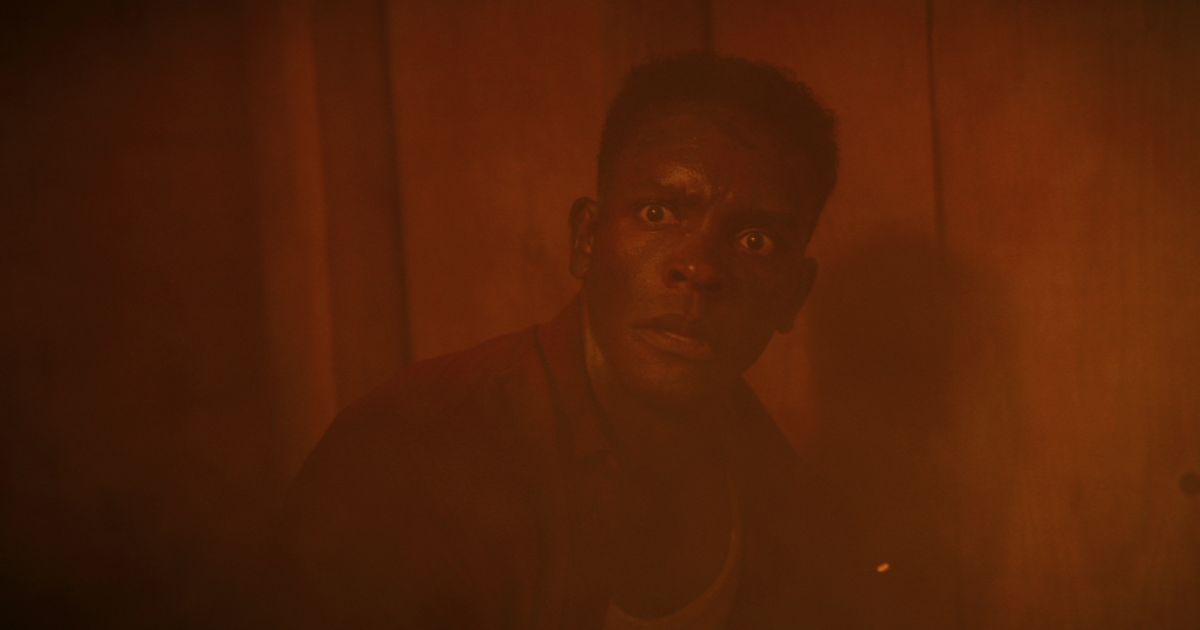
The resulting scene is IT: Welcome to Derry’s most immersive set piece yet, a sequence in which both Pennywise and the fire he manipulated Derry’s many racists to set consume everything in their paths. The Black Spot, once a place for Black servicemembers to drink and dance in private, is burned to the ground. Countless Black people are murdered. Although teen Rich (Arian S. Cartaya) and his classmate and crush, Marge (Matilda Lawler), had both survived brush-ins with Pennywise in previous episodes, Rich dies protecting Marge from the fire. And, in a development with clear implications for the upcoming season finale, the psychic Hallorann’s self-imposed barriers against the supernatural world are cracked open after he encounters Pennywise directly. Although he rallies to smash through the floor under the club’s refrigerator and smuggle out trapped partiers from beneath the flaming nightclub, Hallorann now fully understands the enormous power of the cosmic nightmare he’s up against. With his trap-ghosts-in-a-lockbox methodology destroyed and countless spirits approaching him for his attention, Chalk says this is Hallorann at his most broken
“Episode seven is the peak,” Chalk says. “This is the fun of Dick Hallorann. He thought the slingshot was the peak. Then Dick thought being rejected by the general when he says, “We shouldn’t do this,” was the peak. Then he thought going into the tunnels was the peak, and the box being taken apart was the peak, and seeing Pauly was the peak. Dick, just like the audience, is learning, That’s the power of Pennywise. He is fear.”
We see the Black Spot first as a place of refuge for the Black servicemembers stationed in Derry; they’re having a good time in the nightclub, drinking and dancing. Then when the racists show up, set the place on fire, and start shooting inside, everyone is obviously trying to escape. But Dick has a double challenge in that he is attempting to survive physically but also trying to avoid detection from all the spirits he’s now able to see again. Did you also see the scene as a double challenge for yourself?
From the moment Dick touches the slingshot, he’s surviving. Dick just found joy 15 seconds ago — a sip of joy before these bozos came into the Black Spot. It’s my responsibility to make sure that joy resonates really high so that when it’s taken away and he’s fully devastated, we got something for the audience to look at and play with.
We rehearsed a ton before we filmed it, and it’s less about being worried, concerned, or challenged and more so about, Thank God I went to school for theater. It was like, I’m home. This is just blocking and then doing my thing. You gotta loosen those muscles and remember each beat. We really did look out for each other, Stephen Rider and I in particular — we would whisper, “All right, where we at in this? Okay, got it.” Stéphanie Girard-Hamelin, the video coordinator, did the previs as we filmed rehearsals. In seconds, she’d pieced together one thing with the last thing, and she’d be able to give Andy this super-rough edit that we could all look at and go back and go, “Got it, my arm’s in the wrong place.” It was such an open process.
What do you remember from filming it?
We would layer people in. Lead actors would start, then they’d add background, then they’d add the dance — because the dance is separate from background — and then they’d add stunts. Trying to pick who would do what was a fun process, because some of it was just arbitrary: “Okay, you’re the guy right there? You gotta die next.” I remember us being really, really impressed with stuntie. There was so much glass breaking, and fire, and volume, and yet every time they were on it.
How much of the fire was practical?
What you see is fire. [Laughs.] Legs were on fire. The pool table was definitely on fire — a big fire, too. I remember Carlos Pinder being back there, and I was like, “Whoa, bro, good luck.” Candy glass was definitely breaking as Richard Walters and Shane Marriott got killed. Candy glass broke when Dorian Grey goes out the window. It felt like theater because we were so collectively having the experience. Thank goodness there was fire there, because it didn’t have to be like, “Cue fire,” and we all pretend it’s there. It’s a proper fire.
The other thing I want to say is, the adults that are doing it — we’re adults. But the kid actors? They’re doing it. They’re professional actors, I know. But they’re babies, and you can’t tell a damn difference. It’s not something I could have done when I was their age. They blow my mind when I watch the show and go, “I know that was ten to 20 takes. I know that’s four feet of water. I know how hard it was for me, and you’re 12?” Come on, man. We got to get these babies they flowers.
The kids are horrified in this episode, of course. And for me, you are communicating such a level of fear and terror that is scarier to me than Pennywise itself. How did you build that?
The way I build a scene, build a character, is to do all the research. If I know my character and the scene better than I know myself, I did it. Plotting out an idea of what I think it might go like on the day, that’s just useless. It’s not going to be what happens. But if I can know my arc when I get there on the day, I won’t need anything. Just trust that Andy’s going to give you everything, and Andy will give you everything you need if you ask him. We had practical things almost every single time. So the fear then is just, How afraid is Chris Chalk willing to let Dick be in this moment? And can he go further and can he go further? I’m going to give you everything I got, and then good luck with the edit.
Did you feel like this episode was the height of Dick’s fear?
Seven is definitely the peak fear because everything’s open and nobody cares, which is his fear — that he’d be busted wide open and nobody would take care of him. That’s his experience of it, whether it’s true or not: I’m alone, booty-butt naked, and everybody’s watching me, but ain’t nobody picking me up. Any really bad day feels like that, except now you add a clown on top of it and seeing dead people everywhere. That concept alone is enough to spin me out. Can you imagine? Forget about it.
And these are all actual actors you are interacting with as the spirits.
It’s so helpful, especially to see their makeup — or in some of their cases, it was makeup and a piece of green tape, because that’s where they were going to put a special effect. Morningstar Angeline is a rock star as Sesqui. Even the day players playing ghouls and ghosts — everybody was like, “We’re going to go all out.” And I am so grateful for their commitment, because then it allows me to do my job, and be afraid, and really take in the fact that these things are touching me. These things are whispering to me. These things stink, they’re wet, they’re damp, and I can read their memories inside of them. Oh, it’s just terror.
This is the second confrontation with Pennywise. In this episode, he’s really taunting you and going for it.
He’s ganged up in this one. [Laughs.]
Tell me about working with Bill. How did you two interact?
It is always nice to work with people who are at peak confidence inside of their character, and Bill is beyond peak confidence in Pennywise. There’s not an ounce of self-consciousness or insecurity in what he does, which then leads us all to go, “Me too.” Once he’s on set and he’s in character, he’s ready to go. When it transitions from the tight version of the Black Spot to the Pennywise version of the Black Spot, they put us in this space and they’re shooting ash. We all were like, “There’s no way this can be safe.” [Laughs.] You got this ash, you got this tight space, you’ve got these lights that are cutting at these ghouls and ghosts, you’ve got haze everywhere. It was very easy to be terrified. Andy is like, “You’re supposed to be scared. I’ll make sure you do it.”
I have a question about a previous episode. I was surprised by Dick rooting around in Taniel’s mind to find information about what the pillars do and how they’re trapping Pennywise within the confines of Derry, and I thought, Would the Dick that I remember do that? I struggled with it. I read an interview where you said the point of that interaction is that it tells us how afraid Dick is, and because of his fear, he’s willing to do this. Can you tell me a little bit more about that scene in particular, and how you rationalized it within Dick’s arc?
Dick’s not nice, dude. I’m sorry. You know what I’m saying? Like, the Dick you know is a 60-year-old magical Negro who is in full service because he’s been destroyed so much, and he’s matured so incredibly much. He understands his power. He loves kids already. And he’s already survived a tragedy — think about everything that happened at the Overlook before. But he’s also allowed to be a full human being who does not have to satisfy kindness. That said, what else is he going to do? He’s still a Black man. Dick could have come right in that room and dug in his head, but he said, “My guy, I don’t know you, but you should do this.” And Taniel spits in my face. I think people aren’t really paying attention to what’s happening in the scene. I said, “Please tell the truth,” and he spit in my face. Fuck that guy. Dick is also a human. He’s not a concept. He’s a human who just got spit in the face after saying, “We’re both about to endure a lot of pain.” He did what he had to do to survive.
There’s a level of pragmatism to Dick throughout the season, right? He knows he’s being used by the U.S. military, but at a certain point, what are his choices or his options? That scene helped me realize that.
Dick perceives himself as having power, but he doesn’t have any. He’s a Black man in Derry, Maine, forced to be in the military in Pennywise’s town. How is Dick Halloran in charge? Come on, y’all. How could he possibly be the dude in charge of that machine, that chaos pie? He’s so low down on the power totem pole. He likes to pretend he is in charge, but ultimately, under no circumstance is he the boss of this moment.
A “previs,” or previsualization, is an edited-together rough draft of an action sequence that includes choreography, blocking, and camera movements and helps cast and crew prepare to film the final version.