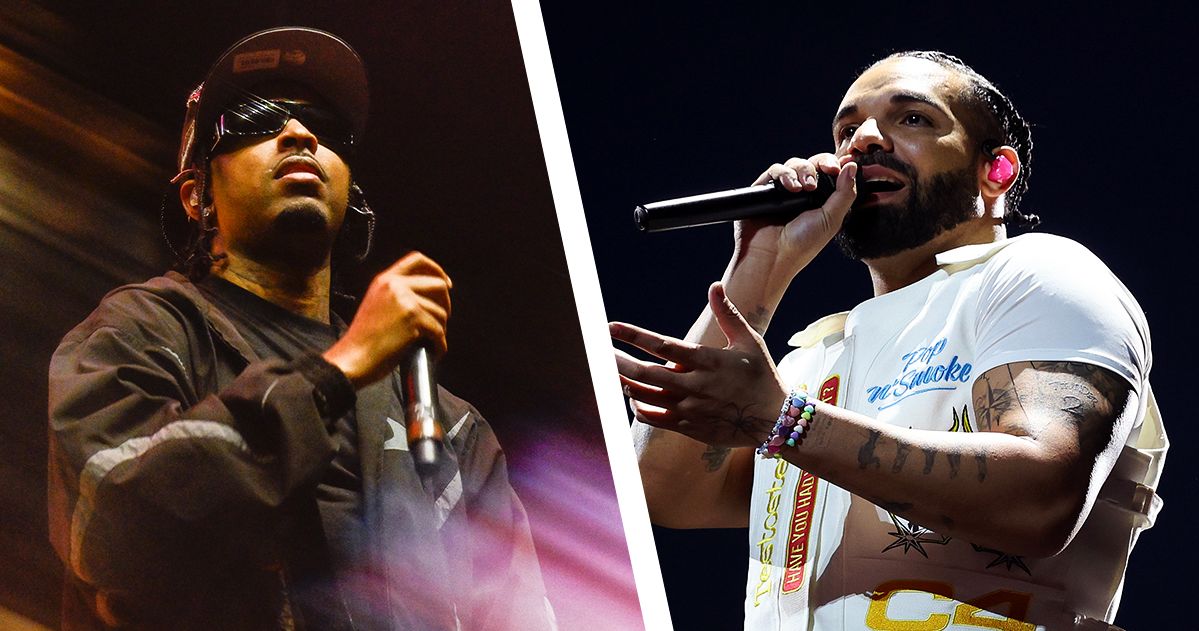

Drake gets around 21 Savage and often takes the posture of, I think you should know my friend here is equipped with bazookas.
Photo-Illustration: Vulture; Photos: Getty Images (Astrida Valigorsky, Simone Joyner)
Announced just a few days prior to its release, 21 Savage’s new album, What Happened to the Streets, documents the subtle maturation of an unblinking Atlanta rapper whose deadpanned threats are a prickly veneer around a grief-stricken survivor mentality. Tracks like the somber “Big Stepper” delve into the pain under the pomp, detailing struggles animating the put-downs we expect to encounter in this work. But the news you’re most likely to hear about the album revolves around Drake, who delivers his only guest appearance outside his OVO camp of the year in the gritty, skeletal “Mr Recoup.” It’s the lesser of the Drake jams using the naming convention, a lankly little brother to Savage Mode II’s yearning “Mr. Right Now” and Mary J. Blige’s maudlin My Life II “Mr. Wrong.” Like their collaborative 2022 album, Her Loss, the latest from the Toronto/Atlanta duo bets the farm on the odd-couple pairing of a guy deeply scarred by gun violence and a guy who once played one on TV. There is a quirky creative chemistry between the two rappers that’s more like the bond between anime protagonist and giant robot than a meeting of big spenders; Drake gets around Savage and often takes the posture of, I think you should know my friend here is equipped with bazookas.
A single line of gun talk in Drake’s “Recoup” rhymes feels like playing to the room, just passing the mic to someone with much more to say on the subject. There’s an emotional canyon separating Drake’s “They can’t find the shooter, bitch, ’cause it’s us” and the Savage verse that picks up after it: “Niggas shot my brother, now I don’t know who to trust.” One minute, gunplay is a tool in an arsenal of bluster and the next, it’s a decision holding mortal consequences. Even Savage’s jokes about menacing opps riding mass transit tacitly acknowledge risk. Drake raps about guns with the glee of getting away with gunplay while his rhyme partner veers on a dime from trauma to gallows humor. The pitfalls follow Savage; he maintains agency but doesn’t sound entirely free. His guest feels almost ornamental. And to be fair, Drake insists he’s here only because he liked the beat, a suffocating but funky meld of harmonic synth bass and ominous piano from Kid Hazel and LB. (The undesirable crunch on his vocals may lead some to wonder whether he really showed up at all in this era of speculation about rappers using AI models of their own voices.)
You can argue that “Recoup” is a slight song displaying the gazillionaire offering accessibility in exchange for priceless Atlanta street-rap authenticity particles, just as Kendrick Lamar’s “Not Like Us” complained. (And it turns out that Savage wisely advised against going after the ex-TDE artist.) But in rap, where what looks like friendship can shake out to be performative business synergy, Drake and Savage seem to genuinely and fiercely respect one another. Savage doesn’t need this guy on a song to chart, and no tough talk Drake tried this year has succeeded in convincing people outside his fandom of the bloodlust in someone who sued his label over a diss track. Whatever magic glue holds the two together, the guest verses needed more time marinating and less of whatever’s frying them around the edges in the mix.