The image of “Sorry, Baby” that I’ve held in my head since its inception is this person at their window, looking out, both terrified of what is out there and, at the same time, desperate to join that outside world. This person wants two opposing things at once: to move at a glacial pace, to never see another person again, and to reenter the world, to laugh, to reimmerse. So, instead of doing either, Agnes stands at the window, and as time moves on around her, she is inside, frozen.
There was a time in my life when I was looking for a film about going through a trauma that held my hand while I was watching it. I didn’t want the film to scare me with violent images or harsh words that shocked my system and shut me down — I wanted the film to hug me tight without shying away from the pain of it all. I needed the film to care for me, the person who’d been through the difficult thing. I didn’t need a film that existed to teach people how bad it is to go through a bad thing, I needed a film that existed to make me feel less alone.
I spent years thinking, how do you make a film that is marked by its absence of violence? The scene everyone is dreading and/or waiting for doesn’t exist, so what exists in its place? What is this about, if it’s not about violence?

Victor in “Sorry, Baby.”
(Philip Keith / A24)
“Sorry, Baby” is a love letter to the intimate friendship that can save your life when things are mind-bendingly painful. It’s a film about one person’s attempt at healing over five years, and the small moments of joy that act as rebellion in the aftermath of a trauma that feels like it’s trying to keep you lonely and outside of the world. So the structure became about the journey of the two friends’ relationship — the beginning a joyful reunion, the middle a pivotal moment of care that brings the two friends eternally close, the end Agnes’ evolution into someone who can now be there for Lydie in her own, new way.
I think the act of writing is, in many ways, the love of my life. I see it as a deeply intimate, devastating, life-affirming, life-depleting, psychotic, meditative, euphoric, addictive struggle of building something where before there was nothing. To write is to make something exist in what was before a blank space, and that is a miracle! That something can exist that didn’t exist, that’s fully, unimaginably cool. And it’s so deeply painful because whatever you write inevitably disappoints you and makes you feel depressed. If you keep doing it, it will eventually make you slightly less disappointed and less depressed, but you don’t really remember that ever, so you’re constantly in pain, but also constantly a part of a miraculous act that kind of has nothing to do with you. To be a writer is not for the faint of heart. The process of making something is so painful that it only makes sense to do it if you would die without it.

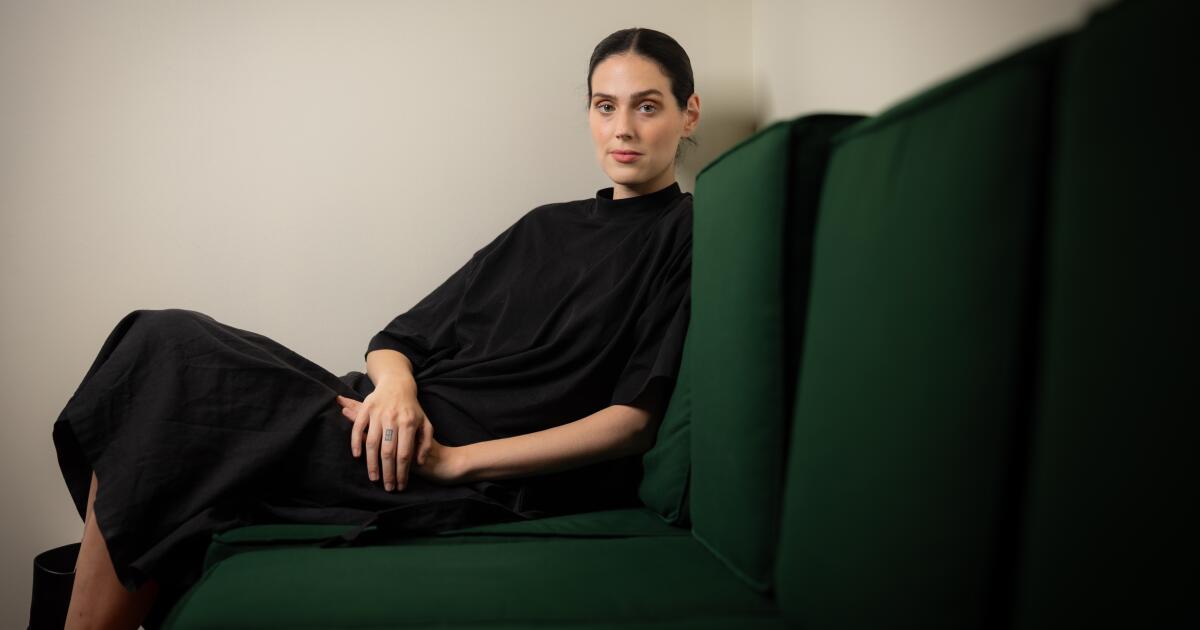
Eva Victor.
(Jason Armond / Los Angeles Times)
No one asked me to write “Sorry, Baby.” It was my secret rebellion after other experiences had made me question if I could write. I felt diluted and confused and idiotic. So I hid away in a house in Maine in the winter with my cat and wrote and wrote and wrote this script. For myself. For my best friend. For no one? For the whole entire world? Sometimes I would get a coffee and go on a walk that turned my coffee from hot to cold within three minutes and then I’d go home and take a hot shower and write more.
Maybe it’s because this film is now out in the world, but I think back on this time with the utmost nostalgia. But then, if I close my eyes and remember how my body felt during this time, I was in hell — my chest was on fire and the only thing I wanted was for this story to exist outside of myself. I needed to exorcise this thing so it could join the world!
Now that it’s exorcised and in the world, I miss my walks, my coffees, my blank page, my fire-filled chest. I guess now that I’m no longer standing at the window, desperate to join the world, now that I’ve thrown my body into the pane and shattered its glass and made it outside with “Sorry, Baby” in my scraped-up hands, I think back on the person who was stuck behind the closed window with such fondness. Hello to you. I miss you! We made it outside! I miss being inside with you …
But that’s the special thing, isn’t it? There’s always more to write, there’s more privacy to be found, there are always more blank pages. And the most miraculous part is you don’t have to wait for someone to let you do it. You can write wherever, whenever, and without permission, and forever.