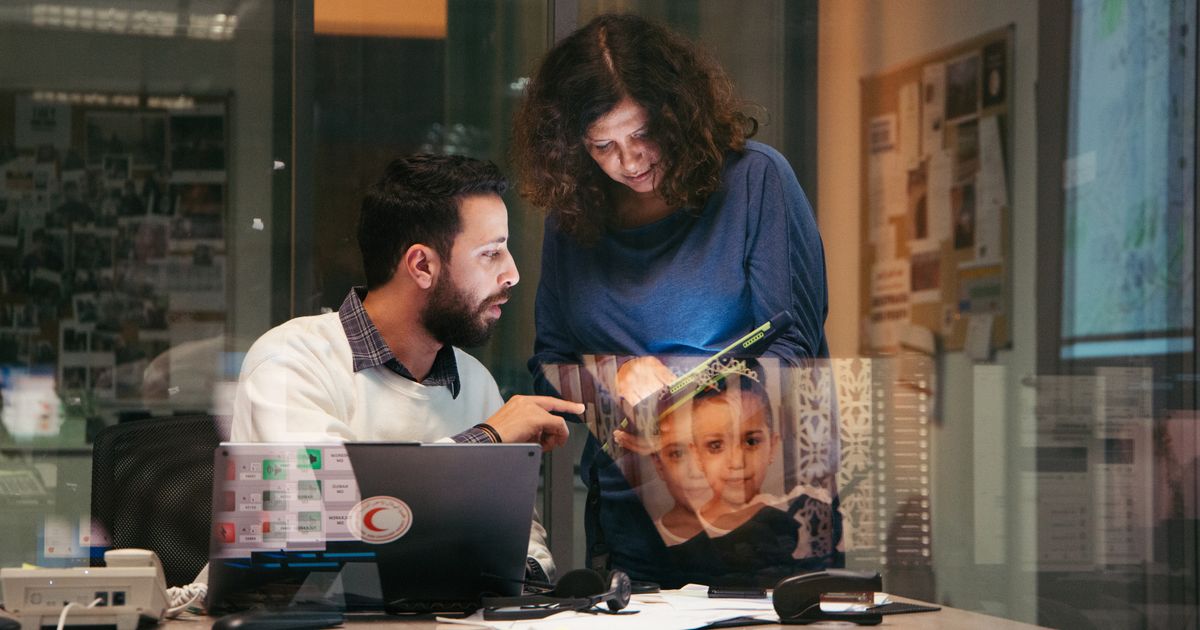

Motaz Malhees and Kaouther Ben Hania on the set of the film.
Photo: Juan Sarmiento G.
The circumstances of Hind Rajab’s death are well documented but bear repeating. On the morning of January 29, 2024, her family evacuates their homes in Tel al-Hawa in Gaza City. Her mother, Wesam Hamada, thinks it would be easier if Hind leaves with her aunt, uncle, and cousins, who will be taking their black Kia, while she will go by foot carrying her baby brother. During the drive, a tank shells the car, killing most of the occupants. Hind’s 15-year-old cousin, Layan, tells a dispatcher, Omar, at the Palestine Red Crescent Society, “They are shooting at us — the tank is right next to me,” before the line cuts with a fusillade of artillery.
When Omar calls back, the 5-year-old Hind picks up. Her voice is tiny and direct. She says everyone else is dead. “Will you come and get me?” she asks Rana, one of the other dispatchers. They alternate speaking with her as they wait for approval from the Israeli military to send an ambulance. The paramedics are an eight-minute drive away, but the process takes hours. Hind doesn’t understand why — and, really, it’s senseless. But they must send an ambulance along a route preapproved by an arm of Israel’s Ministry of Defense. They get the green light after sunset. As the ambulance approaches the car with Hind, a tank fires on them. Twelve days later, Hind, her family, and the paramedics, Youssef Zaïno and Ahmed al-Madhoun, are found dead in an apparent attack by Israeli forces, according to forensic analysis by the Washington Post and other investigative organizations. (Israel had denied that its troops were in the area.)
The Tunisian filmmaker Kaouther Ben Hania first heard Hind’s voice while she was waiting for a flight at LAX in February 2024. The Red Crescent had released snippets of the call in the days after it lost contact with its colleagues and before it would be able to discover their bodies. Ben Hania had been on the road campaigning for her film Four Daughters, which had been nominated for Best Documentary at the Oscars. After the awards-show circuit was over, she was preparing to shoot her next feature, Mimesis, a film about beauty, poetry, and Islamic art that she had been working on since 2014. But she heard Hind’s plea as if it were directed toward her. “I thought she was asking me to rescue her because her voice was so immediate and strong,” Ben Hania remembers. What was the artist’s responsibility in a time of genocide? She called her longtime producer, Nadim Cheikhrouha, and told him Mimesis would have to wait again. “My first thought was, That film is cursed,” he says. “But when she told me she wanted to do something about what is happening, I thought, I totally understand.”
The contours of Hind’s death grew into an international outrage, with Columbia student protesters renaming a campus building Hind’s Hall during a sit-in that spring; Macklemore wrote a song. And within ten months, Ben Hania wrote and directed The Voice of Hind Rajab, a lean 89-minute film told from the vantage of the Palestine Red Crescent Society workers. As with much of Ben Hania’s work, the film is a formal gambit, grafting elements of documentary onto a narrative feature: She uses the actual audio from the calls. Hind’s voice is her real voice, as are those of Layan and the paramedics. She cast Palestinian actors who bore a striking resemblance to the Red Crescent staffers: Motaz Malhees as Omar, who initially takes the call; Saja Kilani as Rana, his supervisor who recites the Quran to Hind; Clara Khoury as Nisreen, the mental-health counselor who leads Hind in breathing exercises; and Amer Hlehel as Mahdi, who works on coordination with Israel’s defense ministry to determine when the route is safe for passage. The first time they would hear Hind’s voice in full would be on set.
Watching the film is an emotionally raw experience. The Red Crescent workers, headquartered in Ramallah in the West Bank, are a straightforward analogue for the viewer, who has watched a livestream genocide from their phone. The choice to use Hind’s voice in the film is brilliant and awful. It is so alive it has the effect of pulling you into an immediate present where she could still survive. “I wanted the audience to go back to this moment when it was possible to save her,” says Ben Hania. Hearing the sound of her voice has a physical effect; it moves through your body. While watching, there were moments when I had inadvertently wrapped my arms around my torso like a brace. I thought I might have a panic attack, and I had to remember to breathe.
As a subject, Hind is unimpeachable, which may be why so many of the Hollywood elite, a famously risk-averse group, signed on to the film as executive producers. Odessa Rae (Navalny) and James Wilson (Under the Skin), who came on during financing and development, were able to bring their contacts into the fold. Wilson’s longtime collaborator Jonathan Glazer, one of the rare voices to criticize Israel as he did in his Oscars speech for The Zone of Interest, was a natural choice. Others signed on after a final cut of the film had been made: Joaquin Phoenix, Rooney Mara, and Alfonso Cuarón; the heads of Plan B, Dede Gardner, Jeremy Kleiner, and Brad Pitt.
The movie’s premiere at the Venice International Film Festival in September hit a nerve. Press screenings — normally reserved affairs — ended with tears and applause, as did the official premiere at the Sala Grande, which broke the record for the longest standing ovation ever at 23 minutes. Meanwhile, rumors spread of a contentious split within the jury about whether the film should win the Golden Lion; detractors felt the use of Hind’s voice was a form of emotional manipulation. Eventually, the jury settled on Jim Jarmusch’s more modest film Father Mother Sister Brother, giving The Voice of Hind Rajab the Silver Lion.


From top: Motaz Malhees and Saja Kilani.
Photo: Courtesy of Willa
Ben Hania’s work has long existed at what she calls the “frontier between documentary and fiction,” a genre that encompasses Joshua Oppenheimer’s The Act of Killing and, more recently, Nathan Fielder’s The Rehearsal. Her second feature film, 2013’s Le Challat de Tunis (Blade of Tunis), is a guerrilla-style mockumentary in which she, the filmmaker, attempts to trace an urban legend of a man who would drive around on a motorbike slashing the backsides of women with a knife as an extreme form of modesty policing. As she talks to some neighborhood men on her quest, one of them says he could play him for her. It gives her the idea to stage auditions, and various men arrive at the casting call to do their best imitation. The session is interrupted, supposedly, by the actual slasher. She follows him only to learn that while he was a suspect, the police had let him go. There was another culprit and likely multiple copycats, who were never caught. The auditions had expressed their own truth, a kind of nightmarish “I am Spartacus” reality, in which any man could be the slasher.
In her last film, Four Daughters, her real-life subject is a Tunisian family of five — a mother and her four daughters — that breaks apart when the two eldest abscond to Libya to join ISIS. Ben Hania’s interest is in how the women got there, searching for the locus through interviews with the mother and younger children. She restages their memories of conversations and fights by hiring actors to play various characters, including the mother and the sisters who left. There is a moment when the real-life mother watches an actor perform a scene of physical abuse that she meted out against her daughter with a sense of regret.
For The Voice of Hind Rajab, the first thing Ben Hania did was contact Hind’s mother, Wesam Hamada. “I told myself if she didn’t want me to do this movie, I would not do it,” she says. Hamada gave her blessing, as did the Palestine Red Crescent Society. She got the audiotapes, hours of conversations with Hind, Layan, and the paramedics. She interviewed the workers at the Red Crescent, learning about their lives and jobs and what happened that day. The Red Crescent permitted her to copy its logo. From the outset, she decided any profit from the film would be split between Hind’s mother and the Red Crescent.
Ben Hania finished a first draft in August. Hind’s audio was differentiated in green font. The dramatized sections, showing the colleagues arguing over whether to abandon protocol to save her, came from her interviews. An early note from Cheikhrouha asked why the Red Crescent couldn’t just send an ambulance out to save Hind. A few days passed, and Ben Hania returned with an expository section in which Mahdi, a senior member of the Red Crescent, draws on the glass wall of his office to explain the byzantine process that requires working with COGAT (Coordinator of Government Activities in the Territories), a unit that coordinates with the Israel Defense Forces, to allow safe passage for the ambulance.
They began filming in November. They had enough money for the first week and in the meantime would secure more for the second. “I remember telling Kaouther, ‘If we decide to do it, we have to do it,’” Cheikhrouha says. “This film is going to make me bankrupt, and I thought, Fuck it. It’s the end of the world anyway.” He applied the same spirit to conversations with private financiers. “I experienced something on this film, which was, I don’t want to convince people — even investors,” he says. “It became: If you are happy, come. If you hesitate, don’t come. When you have people coming for the right reason, everything is simple.”
Ben Hania reached out to Palestinian actors she was interested in, like Clara Khoury, who plays the counselor, Nisreen, and asked them to submit self-taped auditions. She didn’t tell them what the film was about. Instead, she asked most of them to improvise short monologues based off a prompt. Khoury did a take in which she was talking to a mother on the phone, reassuring her that her daughter was in good hands. Saja Kilani, who plays Rana, riffed on a scenario in which she helped someone give birth on the phone. Only afterward did Ben Hania tell them the film was about Hind.
Some hesitated. “I was like, ‘Is it okay to make a movie about the genocide while there is genocide happening?’” says Malhees, who grew up in a town west of Jenin. “I was living the genocide for almost one and a half years, and I was asking, What is the purpose of art? ” says Amer Hlehel, a playwright and actor. Whatever misgivings they had evaporated with the script. The film was about the nature of the helplessness they all felt, and doing it became a way to combat that feeling. “I was almost sure I would say ‘no’ to the film,” says Hlehel. “And then I read the script, and all my feelings that I’m useless, I’m needless, and that nobody needs cinema or theater at a time that people are being killed — it felt that Kaouther threw me a life jacket, artistically. The film was about us, the outsiders, not Gaza. That was, for me, a game changer.”
Three of the actors — Hlehel, Khoury, and Malhees — were part of the same theater circles in Palestine. Each of them developed a close relationship to the person they were playing. Malhees learned that the real Omar is a painter and poet. The call with Hind is one of many he has taken, but after her death, he had trouble holding his newborn at home. Playing real people raised the artistic stakes. “Rana gave me advice that helped me a lot in my creative process,” says Kilani. “‘I don’t want you to copy my voice. I want you to just listen to Hind and let that guide you.’”
The actors rehearsed with one another, but not with Hind’s voice. While they had heard the clips that had traveled online, none of them had listened to the conversations in full. “We asked Kaouther, ‘Let’s sit down and hear it,’” says Malhees. “She said, ‘No, because it’s going to destroy you to hear it. You know the script. Just listen to it on action.’ And later on, I understood why.”
They shot chronologically and tried to limit the number of takes. One went on for 35 minutes. “In general, I’m a perfectionist. I’m very picky, but when there is a boom mic in the frame, I couldn’t say, ‘Cut! Let’s do it again,’ because I’m seeing the emotion that they are in,” says Ben Hania. “They are professional actors. They could have done it, but I didn’t feel it was right.” During the first few days on set in the media offices of Tunivisions in Tunis, they blocked out the scenes. Juan Sarmiento G., the cinematographer, shot everything with a handheld camera. The camerawork was fluid and close, like an intimate witness. The production sound mixer had cued up separate audio files for each of Hind’s lines so the conversations with the actors would be responsive. The actors wore earpieces through which they could hear her. They knew their lines, but nothing could prepare them for the first moment of hearing Hind’s, or anyone else’s, voice. “I felt like I died a thousand times. I believed I can rescue her, which is silly to say, but that’s what I believed,” says Malhees. “It’s not about acting and doing a film anymore,” says Hlehel. “Listening to that, you just react. It’s real. It’s happening. It happened.”
For Malhees, it brought up old traumas. One of his core memories occurred during the Second Intifada, when his friend Amir was shot in the head. He stopped talking for months afterward. They brought imams to read the Quran over him. When he was around 12 years old, he wrote and performed a short play called The Land about what happened. “I never really sat down and discussed my childhood with myself,” he says. “The movie brought me to my mirror.” Malhees’s character, Omar, is the first to speak with Hind’s cousin, Layan. The connection is patchy, but he can make out that she’s saying a tank is approaching her. “I’m supposed to have dialogue, and I was just in shock,” he says. “When they cut, Kaouther asked me, ‘Are you all right?’ I forgot I was on set. I felt like she got killed. I heard it.”
The cinematographer, Sarmiento G., is Colombian-born and doesn’t speak Arabic, and he thought the linguistic distance might create an emotional barrier to his connection to Hind. One day while filming a scene featuring Omar playing a first-person-shooter game on his phone, “something opened deep within me that was difficult to close,” he says. “This is all of us in western society; we take our phones out and anesthetize ourselves. That realization — I started crying and couldn’t stop, so we had to break for half an hour before we could start over.”
Despite the splashy opening at Venice, critical praise, and Hollywood backers, The Voice of Hind Rajab wasn’t able to land a major U.S. distributor. An executive would see the film, love it, have the rest of their team see it, and then pass. Some of them said they didn’t have the “bandwidth.” (“I’ve realized bandwidth is the new code word,” says Odessa Rae.) “All of them passed. Everyone,” says Ben Hania. “America is crazy. And for me, it’s very important that American people see this movie.”
They received an offer from Watermelon Pictures, a distributor focused on Palestinian and Arab films, which was releasing two other Palestinian films this year: Cherien Dabis’s All That’s Left of You (Jordan’s submission for Foreign Film at the Oscars) and Annemarie Jacir’s Palestine 36, starring Jeremy Irons and Hiam Abbass (Palestine’s submission). In the end, while Watermelon Pictures helped finance the film, they opted for Willa, headed by Elizabeth Woodward. “It’s better to be the big film of a smaller company than the small film of a bigger company,” says Cheikhrouha. Willa, which co-distributed its first film, You Resemble Me, in 2021, would be able to focus on Hind Rajab.
The film’s exit from the festival bubble invariably means scrutiny from a wider public. Its early dissenters had questioned the ethics of using Hind’s voice, while others contend that an actor playing the part would be exponentially worse. In the most recent issue of Sight and Sound, the critic Joseph Fahim argues that “the shock of hearing the real voice of the dead child subsides” through “overuse,” and that this choice “ultimately denies Hind individuality.” Indeed, the film is about the specific mechanisms of red tape and military force that killed Hind and is, in turn, a microcosm of the genocide in which an estimated 64,000 children have been killed or maimed.
For the Red Crescent workers who lived that day, the movie provided some measure of catharsis. “For a year and a half, I refused to reopen the wound of Hind Rajab within me, seeking healing as my colleagues advised,” Nisreen, the counselor, texted Khoury. “Today, I feel a sense of calm knowing the whole world will hear her voice and the voices of the two martyred paramedics.” In late November, the entire cast and crew met Wesam Hamada and the Red Crescent workers in person for the first time at the opening night of the Doha Film Festival. Malhees, who dreamed often of Hind, saw that her mother could still smile. He recalls Hamada saying, “Do you know why I’m smiling? I’m always thinking about pinching Hind’s cheeks. Because that’s what I used to do to her. And one time, Hind came to me in a dream and told me, ‘Here’s my cheeks if you want to squeeze them.’”