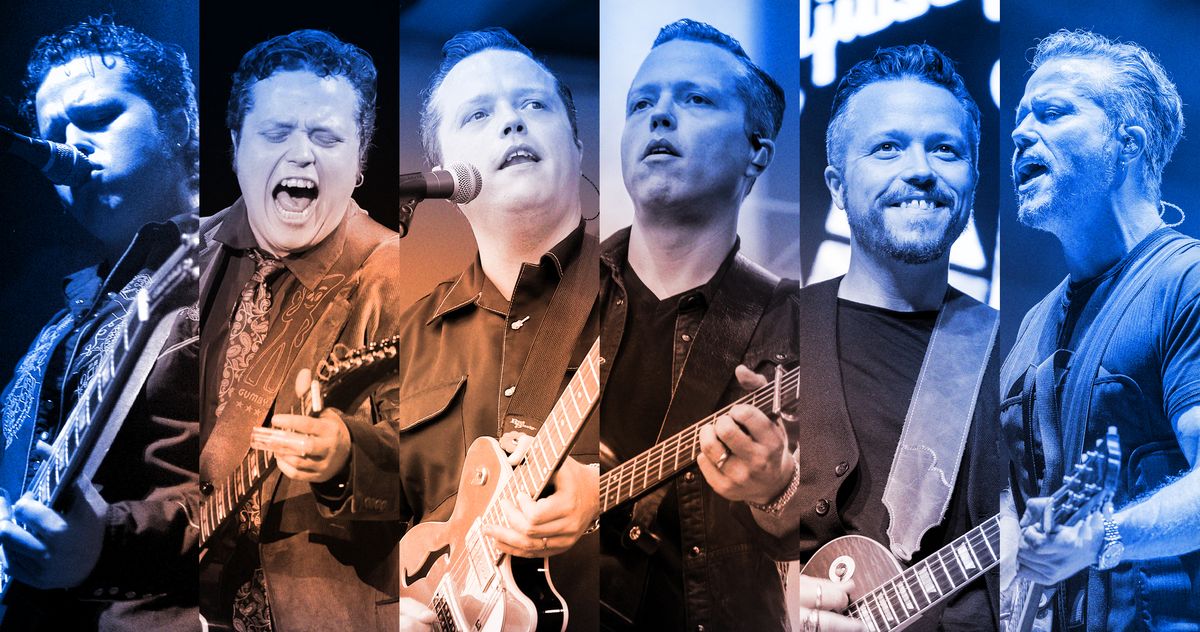

“I was very lucky that every step of the way, there were people who thought, This kid is so weird — why is he listening to this music? And then they would help out and give me something else to listen to.”
Photo-Illustration: Vulture; Photos: Getty Images (Rick Diamond, Douglas Mason, Danielle Del Valle), WireImage (Chris McKay, Douglas Mason), Jeff Kravitz/FilmMagic
Jason Isbell approached a creative way station with his 2025 album Foxes in the Snow, in which the singer-songwriter reimagined the divorce record and the chaos that unspools in the aftermath of a separation. His spare and gentle efforts were rewarded by the Grammys with three nominations: Best Folk Album, Best American Roots Song for “Foxes in the Snow,” and Best American Roots Performance for “Crimson and Clay.” Isbell will extensively tour the album across the country next year, and he also found time amid the holiday season to reunite with his original band, Drive-By Truckers, to celebrate their 2003 opus Decoration Day.
As our latest “Music History” guest, Isbell swept us up in his fascinating career journey, which began with his brain rewiring upon hearing Derek and the Dominos’ “Layla” and most recently crescendoed with him acting alongside a dog-hair-covered Robert De Niro.
My grandparents, aunts, and uncles made music, but my parents didn’t play anything. It skipped a generation. The first time I started playing music was as a very small child. There are pictures of my granddad holding me in his lap with a mandolin. He started me on a mandolin first because my hands were too small for a guitar. I remember learning a little bit of mandolin at 6 years old and then when I was about 7, he started teaching me guitar. For my first electric-guitar experience, my uncle had this Electra Les Paul copy with built-in effects. I still have it. It’s a very heavy, very brash version of a custom Les Paul. He gave me that guitar when I was 8 or 9 years old because he got a new pointy-pick, heavy-metal, hair-metal guitar. I was so excited and overwhelmed. I slept with it in the bed.
The first thing I learned was “Simple Man,” by Leonard Skynyrd. I grew up in Alabama, so Skynyrd was huge. If you were learning how to play the guitar, those were the songs you learned. “Simple Man” had an Ed King riff, and I now have Ed’s Les Paul. Back then, I strummed it instead of picking the pattern out, and it’s supposed to be picked out. My uncle was like, “That’s not how it goes.” I argued with him a little bit. I was like, “No, that’s fine. That’s close enough.” So my dad pulled me aside and said, “If you’re going to learn how to play guitar, you’re going to do it right. Your uncle’s not making any money to teach you how to do this.” So after that, I thought, Okay, I’m going to take my time. If I’m going to learn how to play something, I’m going to figure it out the right way.
My grandfather. He was a Holiness Pentecostal preacher in Alabama. This is going to sound ridiculous, but he learned how to write and read from my grandmother after they got married so he could work on his sermons for church. When I was a kid, I would go through his notebooks and I could see him learning how to write and how to take his notes for a sermon. I mean, we’re not talking about some sort of Charles Dickens universe. This was in the ’80s. My parents were 17 and 19 when I was born, so I spent the majority of my time with my grandparents when I wasn’t in school. He taught me tons of stuff. He had farm animals and built the house that they lived in. He knew how to do a myriad of things. The one that really stuck with me was playing music. It was these gospel, bluegrass, and hillbilly songs — that flat-picked guitar rhythm. I was his only grandchild at the time, so it was just me and him.
I remember hearing “Layla,” by Derek and the Dominos, on the radio. I had no idea it was connected to Eric Clapton. I heard it on WKDF classic-rock radio out of Nashville. We had a translator station in Decatur, Alabama, so we could pick it up even though we were 110 miles away. I called long distance to request they play that song again after I heard it. I sat by the cassette player — I had the double cassette deck from Sears — and I sat next to it with my hand on the “record” button all night so I could copy it. And they didn’t play it! I called the radio station back. I was probably 9 years old. I was like, “I’ve been up all night waiting for this song. You didn’t play it.” And the guy said, “Oh my God, kid, I’m sorry. I forgot. I’ll play it now.” So he played it, I recorded it, and he said on the radio, “That was Eric Clapton’s band, Derek and the Dominoes.” I told my parents and they took me to the record store. They bought me the remastered box set of that on cassette. I came home and just started eating that thing every day. I listened over and over and over, and that led me backward to blues musicians.
My grandfather soon took me to the record store to get Robert Johnson recordings. Him being a preacher, there were some songs of Robert’s that were suggestive. So he overdubbed and gave me cassette copies of all the songs that weren’t vulgar. He said, “You can listen to these when you’re old enough. I can’t be giving this kid this music.” He didn’t know that I was listening to it anyway. When I was 14 or 15, he finally said, “Okay, I think you’re old enough for this now.” And I got the stuff that said “squeeze my lemon” or whatever. I became genuinely obsessed with him. I remember asking my music teacher in this rural white Alabama elementary school about Robert Johnson, and the teacher, who was this really cool old hippie dude, was like, “What the hell are you talking about? Why is a third-grader in Alabama asking me about a blues musician from the ’20s?” He and I got to be really good friends that way, and he would call me out of class, make mixtapes, and always let me listen to the Rolling Stones. I was very lucky that every step of the way, there were people who thought, This kid is so weird — why is he listening to this music? And then they would help out and give me something else to listen to.
If we’re counting “horny” as an emotion? I was in love with Janet Jackson when I was a child. The first record that I ever bought for myself was Janet Jackson’s Rhythm Nation 1814. I loved it. Then I figured out there were Sly Stone samples. So I went back to Sly Stone, a masterpiece of new jack swing. But I felt very emotional with Janet. But then with other emotions, Peter Gabriel’s “In Your Eyes” hit me really hard when I was like 10. I was very emo. A little 10-year-old kid crying to Peter Gabriel looking out the window while it’s raining. I totally got this 60-year-old British man’s heart.
I didn’t quite understand the combination of melody and lyric. Eventually, at some point in my teens, I thought, What if I just play something that sounds good on the guitar and then write lyrics over the top of that? For the first thing I wrote, I took some sheet music from the jazz band in high school to a Duke Ellington song they were playing and wrote my own lyrics to it. I was probably 13 years old. It was all about measurements. It was a very horny song for a 13 year old. There was a 36 and a 24 in there. It was around the time of the rapper from Seattle who liked big butts, Sir Mix-a-Lot. I probably heard those measurements in that song and translated them not knowing what that meant at all, but it was raunchy. I remember working on it in the backseat of the car and my parents were like, “What is that?” And I was like, “Oh, it’s an original song I’m working on.” I think they were impressed but also were freaked out a little bit. I was just impersonating the things I was hearing and didn’t know half of what I was talking about.
My daughter came to me last week with a song she’s writing for the first time. We worked on it on Zoom for a little while. She has some natural ability from me and her mom. I’ve been telling her lately it’s important to find something you really enjoy doing. You don’t have to worry about how to make a job out of it. The thing you have to do is find something that you really want to spend your time doing and then you’ll always have that. And with a little bit of luck, you can turn that into your career. I always feel terrible for people who are in their 40s or 50s and don’t know what makes them happy. I mean, I’ve done a lot of stupid stuff. I made a lot of big mistakes. But I’ve never thought to myself, I don’t know what I want out of life. That has never occurred to me. Isn’t that great? I know exactly what I want. I want to get on the bus and I want to go play Radio City.
It was at a place called Mama Josie’s — a roadhouse on the Alabama-Tennessee state line. I think I made $7. We split the door between the band members. I was playing with Chris Tompkins, who was my best friend in high school, and we’re still very close. He now lives right down the street from me in Nashville. He’s written 16 or 17 No. 1 country songs, like “Before He Cheats” for Carrie Underwood. But once upon a time, we were in our first band together and making seven bucks a piece at Mama Josie’s Roadhouse. It was a BYOB bar because the liquor laws were so weird in that part of the country. Sometimes you had to bring your own alcohol and sometimes you had to sell more food than alcohol, and people would be coming by checking receipts. There weren’t really venues. We would play in restaurants, club bars, and social clubs, all around the state line. I used that $7 to buy guitar strings — Ernie Ball Slinky 10’s. The same ones I still use.
I signed with Drive-By Truckers when I joined that band. They had just put out Southern Rock Opera and it got picked up by Lost Highway Records. Willie Nelson, Lucinda Williams, and a lot of great artists were on that label at the time. I was very excited. We played at a venue in Nashville called the Mercy Lounge, which was right next to the railroad tracks. We were drinking Champagne in the dressing room and we’d throw the glasses out the window against the train when it came by. It’s not something I would do now, but it was a good rock-and-roll time then. It didn’t turn out to be the best deal because we didn’t have priority at Lost Highway. Universal was restructuring, as Universal loves to do. But Luke Lewis, one of two people who ran Lost Highway, liked us a lot and cared about music. He got promoted, allowed us to renege in a clause, and got us out of that deal. So we made a record for Lost Highway and then bought that record back.
To tell you the truth, I’ve never had a record deal that worked out well for me. About 13 years ago, I started my own label that only puts out my records. That’s worked out really well because I have the right people who can make sure everything goes the way it’s supposed to go. I never cared for a record-label deal. It didn’t help me. I would love to be able to tell everybody, Don’t sign a record-label deal, but that’s not always good advice. Some people are out there on their own and don’t have any help. With my experiences in the Truckers, I learned so much about how business isn’t a lottery ticket. It’s not either you succeed or you fail. There’s so much in the middle and you can decide what it means to succeed.
When I started my record label, I was being courted by major labels and one of them — I won’t say which one, but you can probably tell — we went into their office and they were showing me pictures on the wall of former artists, and I was having to correct them. That’s not Aretha Franklin, that’s Etta James. Being from Muscle Shoals, that particular unnamed record label was a pretty big deal in the ’60s and ’70s. We’re not looking for a bunch of money upfront, so why would we sign? It just never made sense.
That happened with the Truckers. I remember when the Rolling Stone review for Southern Rock Opera came out; it was the first completely independent record that had gotten that high of a review. I was excited, but I hadn’t played on that record. So I was excited on their behalf. But we played in Los Angeles on that tour at the Troubadour, and somebody wrote the next day that my playing had reminded them of Richard Lloyd, which made me very excited, because at home in Alabama I had no access to any true alternative left-of-the-dial weirdo shit. We just listened to what was on mainstream radio. There was no Neutral Milk Hotel, Television, or Pylon until I got in the van with those guys. So I was really excited that I had been compared to Richard Lloyd in a review. That was really fun.
There was one thing before we left to go on tour. We had a photo shoot — and I’ve looked for these pictures and can’t find them — I think for Spin. I had pretty much joined the band that day. We were leaving the next day to go on tour. It was right around Thanksgiving 2001, and they wanted us to shoot on this bridge, like a railroad bridge over a river. They talked me into getting in the river, and it was freezing cold. So I got in the water up to my chest and then Mike Cooley turned around to go pee on me, so they would get a picture of him pissing off the back of the bridge. We were feral. I’m telling you, we were feral people. But this is not acceptable behavior, and I got mad. I’m already down here freezing — you’re not pissing on me. There were a lot of arguments at first, over who needed to shower and who had been the longest without bathing. Who was going to drive and who was going to navigate. We didn’t have GPS, so we had a stack of maps and atlases between the driver’s seat and the passenger seat. Somebody had to sit in the passenger seat with the map open and somebody had to drive.
Also, the first time I heard In the Aeroplane Over the Sea, I hated it, and it caused an argument. Our drummer loved it, and I remember saying it sounded like somebody was raising a festival stage because the horns were so screechy. I was like, “This is the worst thing I’ve ever heard. I don’t know why you guys would like this.” Then a few months later, for some reason, it just hit me. I was like, What was that record that I hated so much? We put it back on, and I fell in love with it. I still listen to it all the time, but being a little redneck kid, I was like, What is this? This doesn’t sound like Skynyrd.
This past Thursday at 3 p.m. Gosh, it was when we went on salary with the Truckers. It was $1,200 a month. That was big. Well, I’ll go back even farther. The first time I thought I made it was when I signed a publishing deal before I joined the Truckers, when I was 21 years old, with Fame Studios in Muscle Shoals. They were giving me an $800-a-month draw, so $200 a week. I really thought, Okay, now it’s done. There’s no looking back. $800 a month in the ’90s in Alabama was a pretty good chunk of change. My rent was $300 a month. That was the moment when I didn’t have to go to work at Walmart or wait tables — the two jobs I had before.
I never got comfortable with late-night television. Too many people who are too close to me. I’m used to open fields with cows. I was afraid that I would mess it all up, we would have to tape it again, and it would cost a bunch of money because of the union. My first appearance was with the Truckers on The Late Late Show With Craig Kilborn. Remember Craig Kilborn? He wasn’t nice. I remember he came backstage and said, “Are you guys the band? You guys must be the band.” We looked rough. We were like, “Yeah, we’re the band. Thank you for having us.” He goes, “Are you good?” That was his lead-in. And I was an asshole and said, “We could use a few more of these little turkey sandwiches, if you’ve got ’em.” He laughed and said, “Oh, this one’s quick.” That broke the ice a little bit, but I was just terrified.

Isbell accepting his first-ever Grammy at the 2016 ceremony.
Photo: Robyn Beck/AFP via Getty Images
It doesn’t get bigger than the first one. “Grammy-winning so-and-so” sounds great. Nobody cares as long as you have one. Then they have something to say at the county fair when you’re 65 and doing the revue of all your old songs. I never expected to get that close to the mainstream or get recognized in that kind of way. I was all dressed up and seeing actual celebrities. I remember they handed me the Grammy for Best Americana Album and then as soon as I walked offstage, I won another one for Best American Roots Song. So they just handed me the same one back. They’re like prop Grammys. They mail the real ones to you later.
I was very nervous during the acceptance speech, so, of course, I forgot most of everybody to thank. But yeah, it was really fun. Danny Clinch was backstage taking pictures of people. I’ve known Danny for a long time. So winning the Grammy and then getting a picture taken by Danny was a very significant moment. I attended the Grammys one year and got stuck behind Saweetie for seven minutes while they went back and forth to a commercial break. I was like, Where else do I get to stand there with Saweetie? She had crystals everywhere and smelled amazing.
I loved John Prine so much and miss him every day. The first time I met him was at Gary Nicholson’s house. Donnie Fritts, nicknamed the Leaning Man From Alabama, was making a record. I came over to sing on a track, and I met John. He had bought Southeastern at the record store a few days before that. I later found out he came home to his wife, Fiona, freaked out, and told her, “You’ve got to listen to this record.” So that was a big deal for me. We hit it off from the start, just talking about songwriting and traveling. We wound up spending a whole lot of time together over the next few years. He was the first person I ever saw look at the clock onstage and be upset because it was almost time for the show to end — especially at his age and the physical condition he was in after having cancer. I remember being next to John and him looking at the clock and saying, “Goddamn it, I don’t want to quit yet.”

Isbell as Bill Smith in Killers of the Flower Moon (2023).
Photo: Apple TV+
I don’t know I’ve ever been more afraid of anything that wasn’t a threat to my life than I was to go on the set of a Martin Scorsese movie. When I got sober — it’s been 14 years now — I started gradually trying to work things into my life that were scary for me. It’s gotten easier as I’ve gotten older because things get scarier. The first day I went in, I got a haircut, had a wardrobe fitting, and went to see the dialect coach Tim Monich, who’s legendary. Could you imagine being the dialect coach on Gangs in New York? He said, “You should just talk the way you normally talk.” Then I get to the set, and there’s a scene where my first wife has passed and it’s her wake. There are a bunch of Osage family members and tribal members. Leonardo DiCaprio’s character comes in, and I have to kick him out of the house because he’s wearing this crazy cowboy costume. It’s very uncomfortable. I remember being so scared, and this was just a rehearsal. I didn’t realize it was going to be me, Leo, Robert De Niro, and Marty.
De Niro was covered with dog hair. He was wearing a jumpsuit and had dog hair all over. It turns out that he travels with a dozen dogs. When I spoke to him the first time off-camera, I don’t think he understood that this is how I actually talk. He looked at me like, What the fuck? It took a few days for him to realize that this is my actual speaking voice and accent. When I went to say my lines in rehearsal, nothing came. It just squeaked out. One of the other actors patted me on the back and was like, “Man, that was so good. You sounded so upset and restrained.” And I was like, Oh, I see. You don’t have to do this intentionally. Terrifying day. There’s one scene with me and Leo where we’re in each other’s faces and really talking shit. That went on for hours. Once that was done, I felt almost comfortable. Or at least felt like there was a reason for me to be there. Up until that point, I had to tell myself, Marty’s not going to let me ruin his $200 million movie. But after that scene, I thought, I think that I can get away with it. And it was fun.