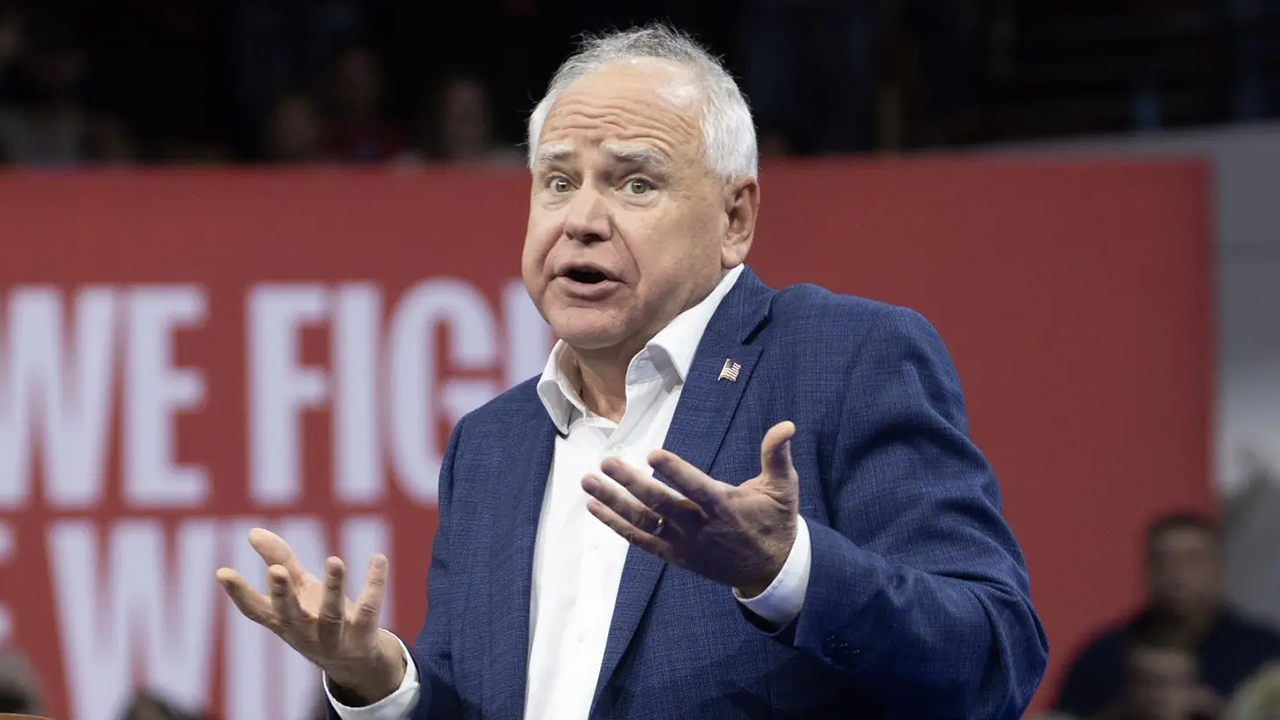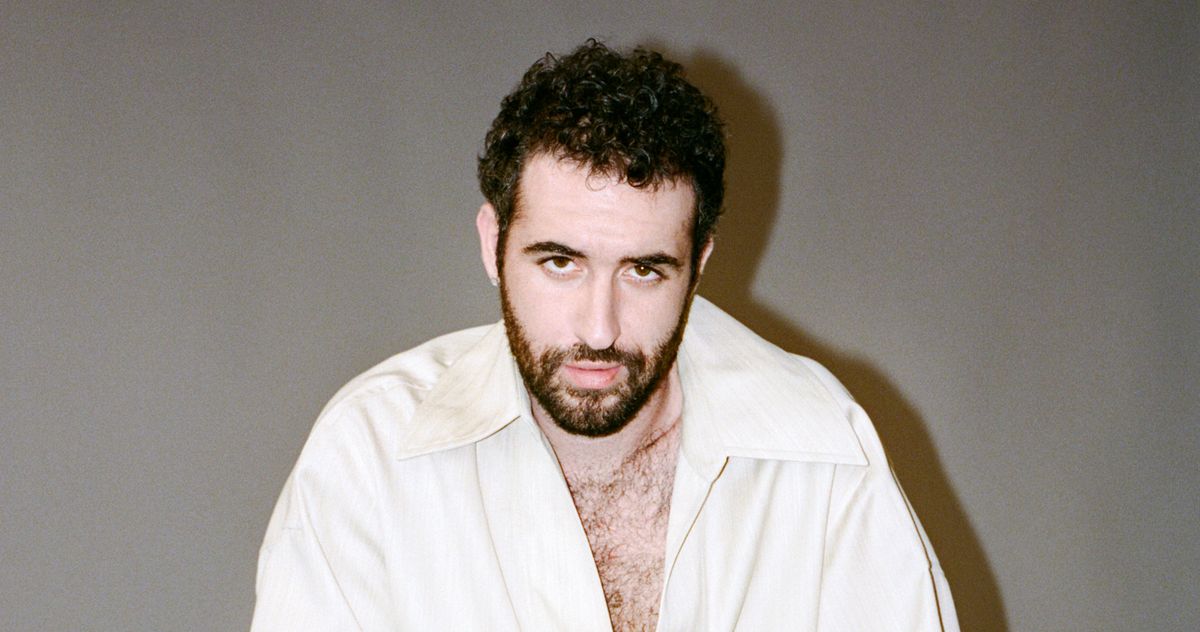

Jordan Firstman’s chronic irreverence is out of place at a funeral, which is exactly why Rachel Sennott’s HBO comedy I Love LA drops him into one. In Sunday’s episode, “Game Night,” Firstman’s Charlie attends the wake of a former client but is forced into the “second overflow” section because it’s so crowded. Flustered and fabulous in his designer shades, he promptly runs into an ex-situationship, Andrew, and things get awkward: Andrew points out his new boyfriend, and Charlie responds, “Oh, sideburns. Nice.” Then, when Andrew reveals he’s moving to New York, Charlie pretends not to care. “Great city,” he says, barely disguising his despondency. “A big, new adventure.” The encounter sends Charlie into a tailspin. “Don’t come and hug my friends, I’m tryna … it’s a funeral,” he mutters to himself, flipping imaginary hair in protest. “Let’s focus on the positive,” he tells them, trying to play it cool. “Let’s watch the funeral.”
Irritable, sexual, and boisterous, Charlie is a classic Firstman character, a persona the comedian has embodied since his impersonation of “banana bread’s publicist” went viral during the pandemic. He would go on to play a manic, drug-addled version of himself in the acclaimed Sebastián Silva film Rotting in the Sun, then a ditzy romantic interest in FX’s sitcom English Teacher. Firstman describes I Love LA’s Charlie as a cross between Samantha Jones from Sex and the City (horny, blunt) and Ari Gold from Entourage because he gets shit done. There’s an authenticity to him, too — it’s not a performance calibrated for sexiness or to make audiences who don’t understand city gays more comfortable. Charlie is just as stylish, quick-witted, and annoying as the real gays filling out Akbar.
The role is a crowning achievement for the terminally controversial Firstman. He’s been endlessly heralded and critiqued by the very online ecosystem that made him famous. When he was called out for old racist tweets, he apologized, saying, “I have grown a million lifetimes since and I do not stand by them in any way”; his SubwayTakes video “stirred up controversy,” per Gayety, because he claimed that straight men dress better than gay ones. In every bout of backlash, there was a strain of criticism from the gay community that felt less like good-faith critique and more like it was an outlet to hate on someone they were already annoyed with. “I’m noticing a change,” he says now, not sounding fully convinced. “Honestly, being a gay Jordan Firstman hater is kind of basic at this point.”
Can you tell me the story of getting this part?
I have known Rachel since 2016 or ’17. She was the Cat Cohen protégé in the city, and Ayo Edebiri and I had been writing on Big Mouth together. Rachel and I met through karaoke one night. Ayo and I were singing “Wuthering Heights,” by Kate Bush, and, right before the last chorus, Rachel thought she was queuing up her next song but just skipped us. It was bad. We got really mad at her, and I would say we were 40 percent joking. Rachel started crying, which is the most Rachel thing ever.
Then she moved to L.A. in 2020, and we started hanging out more. We became really close, probably three years ago, when we were both in Atlanta and she was shooting Saturday Night and I was shooting English Teacher. Then she sold the show to HBO, wrote the first draft of the pilot, and sent it to me for notes. Charlie felt … familiar, I’ll say. But she didn’t say anything to me, so I’m like, What is happening? Why is she sending this to me? She had written it with me in mind, but she did not want me to feel that way. I remember sending her a text being like, “Charlie feels familiar!” And she literally goes, “Yeah, you’re definitely on the list!” She knew I was going to have to go through so much with HBO. They were deeply involved in every step and really took time to make sure everything was perfect.
When I auditioned, I was like, “I will get this part. I really want it.” I went in guns blazing and improvised a lot on my self-tape. Then I still had to go through three or four rounds of callbacks. We had dinner with Owen Thiele, and she went to the bathroom, and I was like, “Owen, just ask her if it’s me.” She came back and I was like, “I’m going to go to the bathroom right now!” He’s like, “Okay, babe, you can tell me. Is it Jordan?” And she still wouldn’t say anything.
How much of Charlie is based on you?
There’s parts of the story I relate to. My judgmental side is there. But Rachel showed the softer and more sensitive side of me. I’m a very sensitive person, but I came up online and people have thoughts about me. I’m sure you’ve had thoughts about me. You’re a gay guy in New York who probably tweets.
I’ve never tweeted about you.
Okay. But with any gay guy online, people put a lot on you and it’s scary. There is the real me that isn’t seen, and Rachel wanted to show that.
In Rotting in the Sun, you played yourself. How do you approach that differently than playing Charlie?
It’s very simple: In Rotting in the Sun, I’m crazy. In this, I’m not crazy. I’m cunty and hardened and I get what I want. In English Teacher, I’m floaty and head in the clouds and dumb. I wanted Charlie to be really funny. It’s a very traditional comedic performance.
I don’t think too much about where I end and where I begin. I need to stop reading stuff online. Right now everyone is obsessed with saying “they only play themselves” about anyone with a style. I’m like, “Do you want me to play an 18th-century French soldier?” There’s a lineage of comedic performers who do this. Adam Sandler is playing a version of himself. This is such a normal thing for comedic performers.
They don’t get that because there are basically no hard comedies now, right?
They don’t know.
In this most recent episode, we start to see the cracks in Charlie, beginning at the funeral. What is his headspace at the start of the episode?
Charlie lives in this space that he’s very comfortable with, which is detached and self-serving. Another side wants to come out. When you get locked into a friend group in L.A., you don’t get opportunities to meet people unlike yourself. You get tied into this personality that’s just what you’ve become. I remember playing the beginning when we’re walking to the funeral. I said, “I’m fine. People be dying every day.” You can tell things are going wrong. The episode before, you see him experiment with kindness and it feels good for him. Charlie didn’t know being a nice guy was an option. Then, he’s confronted by this yearslong situationship. It’s a lot of what could have been. He’s seeing this old life and how he’s grown. Even when he looks at the sex tape, he’s so much softer then.
It ties into this gay thing, where a lot of us are at this place where it’s not fun to hate on everything but we don’t know another option. People around us are doing it, and we’re on all these group threads shit-talking whatever new TV show and only being positive about Zara Larsson.
You say, “We were fucking babies there” when you watch the tape.
A lot is coming up for him. He’s mourning what could have been with this guy, Andrew, who we also don’t know that much about. But I made decisions about what that relationship is.
Like what?
I think he’s not in the business and lives a pleasant gay L.A. life. He has a garden and probably works in the arts. There’s another archetype in gay L.A. that’s more design-y — I have this friend who does landscape design and I thought of him. Andrew could have been a grounding force in Charlie’s life, and now he sees Andrew settling with another guy, moving to New York and starting a new chapter. He feels like he’s been stuck in the same chapter for a long time. Throughout this season, Charlie is put through the ringer. It’s just constant humiliation.
Writers often create situations in which characters of yours are humiliated. Why do you think that is?
I’m old enough to know what makes people want to see me get taken down. It’s the cockiness. The people that want to write for me see the confidence and the insecurity, and that is a really interesting friction to play with for a writer. This and Rotting in the Sun are the two projects that are written for me the best because they see that. It comes back to the public perception of me — I’m not going to be posting about my insecurity. It’s just not the vibe.
I think it would play as “performed vulnerability” if you did post about it.
It would be totally performative. But I struggle. The people who know my life know the ways in which I’m a Jew who struggles. I have parts of my personality that are contradictory. The confidence in me is real as well; it’s not just bravado masking insecurity. Both are true.
I wanted to talk about the sex tape, because I was amazed. It’s legitimately casual, and that’s such a contrast to something like Heated Rivalry, which is so posed.
Yeah, we’re going for it. It’s gay. I’m sorry, I watched those first two episodes of Heated Rivalry and it’s just not gay. It’s not how gay people fuck. There’s so few things that actually show gay sex. In the first sex scene, when we both say “that part” after cumming, that’s one of my favorite moments. That is a real thing that is from my life. Me and this guy were obsessed with saying “that part” for a moment and we both came and just instinctively said it and then laughed a lot. That’s gay to me. A straight guy could not write that. They don’t know what the camaraderie of gay sex is. So, yeah, I think I definitely led the charge with that.
It was a big conversation whether Charlie was a top or a bottom. He is good at his job and he won’t take no for an answer and he will plow through until he gets what he wants. Usually, guys with power like to be submissive and are bottoms. And I think it’s kind of iconic to have a lead on a show be a bottom.
I assumed he’s vers.
I think he’s an oral vers. Who doesn’t like getting head? But I think he’s a bottom. The sex-tape scene was interesting because we had no time and I knew I wanted it to be a special thing. Me and that actor already had really, really interesting chemistry. Something was very loaded between us both sexually, and there was tension in ways that were emotional and physical.
Is he gay?
No. I’m outing him as not gay. But when there’s chemistry, there’s chemistry. We had already shot that first sex scene. There, the dynamic is “come joke, deep eye contact, connection, I have to look at my phone, ‘Do you want to see this guy I’m dating tonight?’” Within five seconds, there’s so many layers. So when we did the sex tape, I wanted none of that history or tension. It was nice and hot and exciting. There was an intimacy coordinator and the director, but we only had ten minutes and they gave me the video camera. I go, “Please trust me. Can you guys just leave us in the room alone? I promise no one’s going to be uncomfortable. We’re both down to do this.” They were kind enough to stay in the other room, because they couldn’t watch a monitor either. It was just a video camera. All they heard was moaning and slapping. There was a lot that isn’t in there. Nothing went past the line, but we definitely had fun.
You had real, non-simulated sex on-camera for Rotting in the Sun. Did that change how you approached this?
It made me more comfortable. I also just know how to show sex. I’ve always written about sex. Sex is a very important topic in my work. That story line got cut down a little, but it meant a lot to me. I spent a lot of time talking with Rachel about what I wanted it to mean.
I’m the oldest in the group, and there is something that happens when you spend ten years in L.A. and you think about 2015 in L.A. and Akbar. It’s like, What a different life. Now I’m in this other place, and I hang out with famous girls. There was overlap in my life, and I was bringing that to that story line.
It seems like you’re struggling with the online response to the show. How has that been?
I’ve gone to hypnosis to try to not care. I blew up during the pandemic through Instagram videos. I got a lot of followers really fast and immediately saw gays have a negative point of view about me. It’s really hard. This is year five of me talking about this in press, and it hasn’t gotten easier. I will say, I’m noticing this is the least I’ve seen people talk shit about me. That’s definitely nice.
But it’s not the least you’ve cared.
But I’m noticing a change. Honestly, being a gay Jordan Firstman hater is kind of basic at this point. We’ve seen it.
The more interesting take is to like Jordan Firstman?
Yeah.
But does that help you internally, or …?
My struggle is that I would love to be one of these gay guys who doesn’t care about the gay community and just acts. But my work is about it. I care about telling stories that are reflective of what I see going on around me. I am around these spaces.
Do people come up to you and reflect the online discourse back at you in person?
They’ll bully you online and then be like, “Can we get a picture?” It hurts because I’ve done so much good work for gay people. I’ve tried to reflect the gay experience back in my art. I feel like it’s not appreciated and I’m punished for it.
Do you think they’re jealous?
A lot of gay people are not in touch with their inner life. It might not even be jealousy. It might just be uncomfortability at being reflected.
I thought Rotting was probably the best gay movie of the decade in terms of feeling honest about what gay life is like.
But they want to see Heated Rivalry. I go to art to be confronted and to think, but a lot of people just want entertainment or to see two straight hockey players pretending to be gay and fucking.
They haven’t spoken about their sexuality, so either one could be gay.
Then you know what? I am one of those bitches who says, “Then say it.” A gay guy would say it. I don’t respect you because you care too much about your career and what’s going to happen if people think you’re gay.
Who do you consider your audience?
It really changes. I have different ones for different things. Girls still come up to me about banana bread’s publicist. Girls also like me on this show, because Rachel wrote me through a female lens. Charlie is that gay friend a lot of girls want, who just tells it like it is and is funny. There’s also an appreciation from arty gay guys who get what I’m doing. Then there’s the basic gays that like, “I Wanna to See My Friends’ Dicks.” But also, if you think too hard about your audience — which I obviously do — it’s a never-ending spiral.
How do you hope Charlie grows in season two?
I really love him in episode eight. I love how grounded he feels. But I also love myself in episodes three and four, too. I like being cunty and a shitty guy. I would love these ups and downs to keep happening. I want to go a little crazier in season two and have a meltdown to some degree. I have a light ego death in this one, but I want to have a major ego death in season two.
Also, Rachel shows my private gay life and how little of that I show to my friends. Even when they ask me about Andrew, the girls know nothing about him. That’s a very real thing for gay guys that have a lot of girlfriends. They only want to hear about your life to a certain degree.
Is it that they only want to hear a little, or that you assume that of them?
It comes down to this Velvet Rage–y thing of wanting to be accepted. If they knew what we got up to on weekends or they knew what we were actually doing, it would gross them out. It’s real or too sad. You want to keep the friendships light. You can tell them “God, I got spit-roasted in the dark room this week,” and they’re like, “Haha, you slut.” And then you’re like, “And then I did so much 3MMC that I cried for four days.” They don’t want to hear that part. I want to see more of his private gay life. I would like to see what Maia’s response would be to Charlie’s inner life. You can tell they’re really close, but I want to see all the relationships deepen.