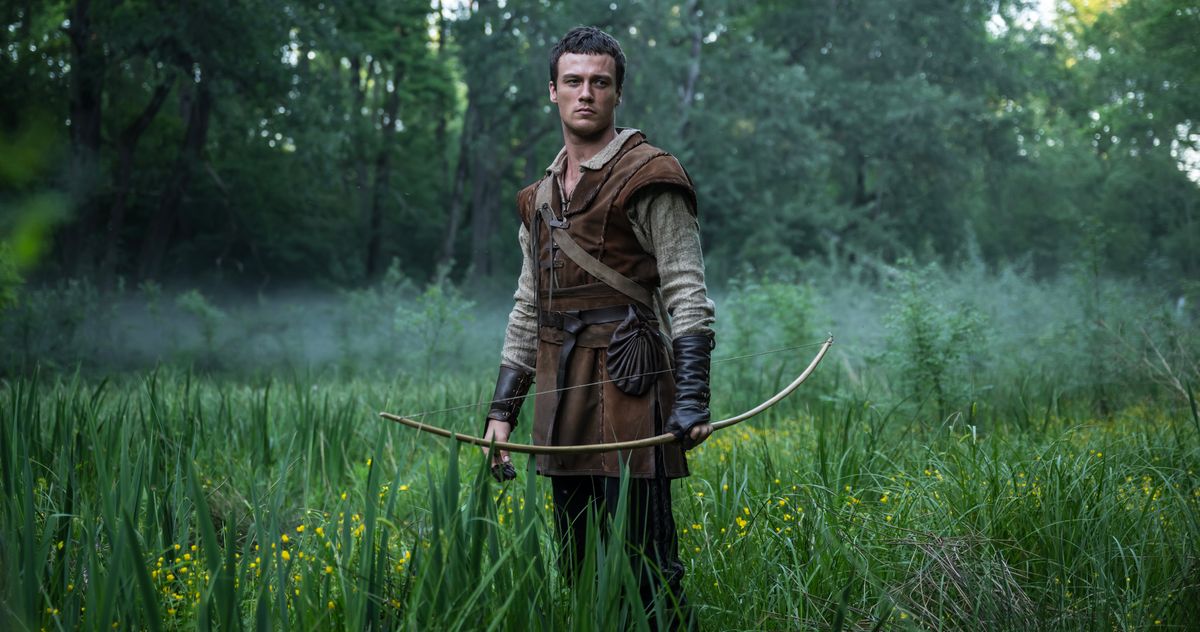

Robin Hood replaces the legendary outlaw’s intrinsic altruism with a persistent adolescent selfishness.
Photo: Aleksandar Letic/MGM+
Spoilers follow for the MGM+ series Robin Hood through the sixth episode, “Bound by Love, Divided by Lies.”
If I were being conspiratorial, I might say MGM+’s Robin Hood series was created by someone who hates poor people. This latest adaptation of the legendary story of the thief who robbed from the rich for the express purpose of wealth redistribution feels intended to undermine the idea that a folk hero would rise against the one percent, not out of personal motivation but because it’s the righteous thing to do. In Robin Hood, co-created by Jonathan English and John Glenn, everything about the titular hero, from his name to his ideology, is impressed upon him by others; he has no belief system of his own guiding his pew-pew arrows or complicated ambushes. Even worse, as the series progresses through a convoluted and wholly unnecessary origin story, Robin Hood becomes a Trojan horse for the surprisingly monarchist-friendly sentiment that rears up in the series’ agonizing sixth episode, in which the archer agrees to tweak his rebellion to support a girlboss-y Queen Eleanor. A Robin Hood who capitulates to the ruling classes is so profoundly wrong for 2025 that it has my paranoid brain wondering if Prime Video, which owns MGM+, is still trying to balance the scales for airing the anti-capitalist I’m a Virgo.
In our age of politicians craving the power of kings, an ever-widening gap between social classes, and history’s first possible trillionaire making his money off anti-union labor, Robin Hood is a natural fit, an entity whose moral judgment aligns perfectly with our widespread affordability crisis. Pop culture can only do so much, but it can also do a lot; a series that was incisive in its understanding the Robin Hood legend might have provided some catharsis. The character’s enduring appeal isn’t only because of how foxy Disney’s version was, you know? Just as essential to the character as the well-known story beats — an aristocratic scion becomes the outlaw champion of the underclass; crosses paths with King Richard and his ambitious younger brother, Prince John, rebels against the Sheriff of Nottingham; and loves Marian — is his dual sense of certainty and fortitude. He is aware the system is overtaxing regular people to finance the whims of nobility and is determined to reverse that abuse. It’s a straightforward narrative that has endured for so long because of its clean simplicity and broad relatability. In our eat-the-rich environment, taking from those who have too much to aid those who have too little is practically a clarion call. Who could argue with that?
Well, this latest adaptation could, which spins the aforementioned plot points in staggeringly irritating ways. In the 12th century, the Normans have defeated the Saxons and seized their property, outlawed their religion, and replaced their leaders. Hugh of Locksley (Tom Mison) is one of those ousted aristocrats, and his castle and lands are given to the cruel Huntingdon (Steven Waddington). The newly installed sheriff of Nottingham (Sean Bean) appoints Hugh to be Sherwood Forest’s forester and tasks him with punishing poachers, not from the angle of conservationism but subordination — everything in the forest belongs to King Henry, not to the occupied Saxons. When the sheriff hangs Hugh after a convoluted plot involving an ever-scheming Huntingdon, and Hugh’s wife dies from grief, their son, Robert (Jack Patten), is left unsure of his place in the world. He becomes obsessed with getting fatal revenge against the sheriff, which shocks his remaining family and his lover, Marian (Lauren McQueen), Huntingdon’s daughter, who despite loathing her father is still a Norman.
Robert then — and I have to emphasize how exhausting this is — basically stumbles into the Robin Hood identity. The only active thing the character does is pine over Marian; otherwise, he’s someone to whom things happen. He’s revealed to have a chosen-one fate connected to the Saxons’ deity, Godda, a destiny used to absolve Robert of deciding for himself that the world’s inequity is wrong. Other key aspects of his identity, like the idea to steal from the archbishop and share the gold, are given to Robert by Little John (Marcus Fraser) and Friar Tuck (Angus Castle-Doughty).
We’re stuck in a never-ending era of “let’s remix this familiar IP” television, and within that, Robin Hood is determined to overcomplicate the titular character. Hugh is broken by the injustice of being stripped of his title; Robert is presented as a natural leader because he grew up with the education required to send him to royal court. The show keeps quibbling over foundational aspects of Robin Hood lore, like whether it’s right to respond to violence with violence, seemingly just to fill the season’s ten-episode order. Major chunks of each episode are devoted to Game of Thrones–style palace intrigue, with Queen Eleanor (Connie Nielsen) conscripting Marian into spy service. And although neither King Henry nor Prince Richard have been introduced, Eleanor’s furious schemes against her husband and in support of her elder son take up major screen time — which is where Robin Hood comes in, in the series’ most off-target development yet.
By the sixth episode, “Bound by Love, Divided by Lies,” news of Robin Hood’s guerrilla tactics against the sheriff have reached Eleanor in London. She believes she can weaken the king’s rule by suggesting the sheriff can’t handle the rebels, and if she makes enough of a stink, she can engineer King Henry’s demise and elevate Richard to the throne. To do all this, she sets a secret meeting with Robin Hood, a rendezvous the series presents like a wise professor and a wunderkind student sparring during office hours, with Eleanor smiling benevolently on this young upstart, and Robin surprising her by speaking nearly perfect French.
The scene aligns itself with Eleanor and stays in that perspective throughout. When Eleanor asks whether Robin wants to “change the world beyond” Sherwood Forest and he says “no,” the scene positions Eleanor as a worldly, sophisticated politician and Robin as a bratty young kid in need of the guidance only she can provide. Her request that he escalate his rebellion and “burn what can be burned, take what must be taken” is so shameless an attempt at a Littlefinger-ism that her follow-ups, including “everyone’s a pawn sometimes,” feel like knockoff-couture design with the fashion house’s name spelled wrong. And because Robin Hood is presented primarily as a besotted teenager whose love for Marian has been elevated above all his other qualities, he agrees to bend his uprising toward Eleanor’s needs in exchange for the queen releasing Marian from her lady-in-waiting service. His revolution was initially about fulfilling his personal need for vengeance; now it’s about fulfilling his personal need for a girlfriend. Get a grip, my guy!
Robin Hood replaces the character’s intrinsic altruism with a persistent adolescent selfishness. His entire thing is supposed to be forcing the monarchy to genuinely serve the people whose fealty sustains them, but here he is selling out to a Norman queen who is openly manipulating him for her own ends. Maybe Robin Hood will eventually reverse that decision; there are still four episodes left in the season. But making Robin Hood simultaneously an ignorant teenager who needs to be prodded into goodness and a nihilistic opportunist willing to rent out his cause for personal gain isn’t just contradictory writing, it’s a misread of what viewers want from a Robin Hood show in the first place. This should be easy: Give us an established outlaw pulling off episodic heists with the aid of his equally committed allies. Give us a central character whose radicalization is not in question but is central to his mission. Give us a grown-up who knows who he is, not a twitterpated teenager willing to bend the knee. Robin Hood the character may be able to hit every target he aims for, but Robin Hood the series keeps missing the mark.