
Photo-Illustration: Vulture; Photos: Warner Bros., Neon,
It’s hard to look at the astounding box-office and critical success of Sinners and Weapons and say 2025 was not a great year for horror. And yet, here I am, bravely doing it anyway: 2025 was not a great year for horror. While this assessment sounds counter-intuitive amid headlines about those two films’ record-breaking box office and potential for getting past the Oscars’ genre bias, there were fewer standouts to celebrate than in years past. For every horror film that lived up to the hype, there were more disappointments — consider a time when Wolf Man and Him were hotly anticipated. There were also a number of widely acclaimed movies that didn’t quite resonate with me despite skillful filmmaking and potent imagery: 28 Years Later, Bring Her Back, and Frankenstein among them.
I’m getting all the negative table setting out of the way to address what’s not included but also to offer some context for the list that follows. In a year where I repeatedly found myself let down by new releases, I focused on the horror films that exceeded expectations. Here, you’ll find a mix of bold innovation and genre transgression alongside movies that, by virtue of less ambitious aims, can best be categorized as pleasant surprises. All of them, however, managed to get under my skin and give me something new to think about or fear — especially impressive at a time when a film breaking through the cloud of real-life horrors is an achievement unto itself.
A horror movie told from the perspective of a dog sounds like a gimmick, and sure, on one level, that’s what Good Boy is. But Ben Leonberg’s debut feature is more than just a logline, due in large part to an exceptional lead performance. Indy, Leonberg’s own Nova Scotia Duck Tolling Retriever, manages to convey a startling degree of emotion as he watches his owner, Todd (Shane Jensen), succumb to dark forces in a remote cabin in the woods. That’s a testament to Leonberg’s directorial skills — he manages to project meaning onto an actor who, let’s face it, hasn’t the faintest idea what’s going on — and to his patience. Good Boy was made over the course of three years, with Leonberg filming hours and hours of footage in order to get enough usable material out of a dog with no real training. The results are undeniable: While the overarching story line can feel vague to a fault, we remain hooked by the emotional truth of Indy’s experience.
In recent years, a new breed of YA horror has risen — films like Netflix’s Fear Street trilogy that embrace classic YA tropes but don’t shy away from the R-rated brutality of more adult entertainment. Based on the Adam Cesare novel of the same name, Eli Craig’s Clown in a Cornfield is a prime example of the subgenre, offering a familiar high-school love triangle and unfettered gore in equal measure. When Quinn (Katie Douglas) moves to the small town of Kettle Springs, she discovers the local legend of Frendo the Clown, a corn-syrup mascot turned serial killer. This slasher more than delivers on the promise of its title as multiple clowns wielding a panoply of weapons slaughter pretty young people. What it lacks in scares it makes up for in humor — while horror-comedy is often frustratingly unfunny, this movie mines jokes from its refreshing self-awareness and a willingness to upend expectations (plus, a really solid rotary-phone gag). Clown in a Cornfield may lean into its YA novel background; by the end, even the trite love triangle gets a welcome subversion.
You don’t have to change much about Cinderella to move it into horror territory. Like so many classic fairy tales, the original story is rife with misery and grisly violence, all of which Disney sanded down into something more palatable. The Ugly Stepsister invites the darkest elements back in, namely the stepsisters hacking off bits of their feet to fit Cinderella’s slipper. More pointedly, Norwegian filmmaker Emilie Blichfeldt adds the grotesquerie of archaic beauty practices — both real and apocryphal — to create a feminist body-horror parable akin to last year’s The Substance. Lea Myren stars as Elvira, who finds herself in competition with her stepsister Agnes (Thea Sofie Loch Næss) for the affections of Prince Julian (Isac Calmroth). In a series of escalating traumas, Elvira is subjected to rudimentary plastic surgery and a rapid weight-loss plan that involves a very hungry tapeworm. The Ugly Stepsister is unsubtle in its depiction of the (literally) crippling effects of female beauty standards. Much like The Substance, it’s also an endurance test thanks to a truly stomach-turning finale.
Until Dawn didn’t seem to impress many devotees of the 2015 video game that inspired it, but I was charmed by its Groundhog Day approach to exploring multiple subgenres. When Clover (Ella Rubin) brings a group of friends to the abandoned mining town Glore Valley to look for her missing sister, Melanie (Maia Mitchell), they find themselves trapped in a time loop with a different supernatural threat attacking each night. That means slashers, zombie movies, and body horror all get serviced here. Like Clown in a Cornfield, Until Dawn has a distinctly YA vibe. But the teen-soap relationship dynamics among Clover and her friends are secondary to the gleeful creativity with which the movie dispatches them — over and over again. While there are nods to the events of Until Dawn functioning as a metaphor for Clover’s baggage, David F. Sandberg’s film smartly turns trauma horror into a punch line. In the end, there’s a refreshing breeziness to Until Dawn that many of its contemporaries could stand to embrace.
Trauma has become an omnipresent feature of modern horror, but grief may be an even bigger constant. That makes sense, given how much of the genre is steeped in death, but it’s easy for these films to get bogged down in metaphors and lose their way with big feelings pulling focus from scares. That’s not the case with Tinsman Road, the latest found-footage film from Robbie Banfitch, the writer-director of 2023’s The Outwaters. Here is a movie consumed with loss, where grief is essential to the horror instead of a distraction from it. Banfitch stars as Robbie Lyle, a young man investigating his sister’s mysterious disappearance. As Robbie picks apart the clues left behind, it’s not always clear if we’re watching a ghost story or true crime. The dread that builds throughout Tinsman Road comes not just from what Robbie might find but also how little closure those answers will bring.
By and large, critics weren’t kind to Jennifer Kaytin Robinson’s I Know What You Did Last Summer requel; nor were audiences, for that matter, if its C+ CinemaScore and disappointing box office are any indication. But for many of us — especially those who were never all that keen on the franchise to begin with — the 2025 IKWYDLS was exactly what it needed to be: a funny, self-reflective, and occasionally very goofy new installment. That it never reaches the heights of the 2020s Scream films is not exactly surprising. Despite the fact that both series began with Kevin Williamson–penned scripts, they have never been on equal footing. IKWYDLS didn’t have Scream’s sharp satirical edge, so my bar for the Jennifer Love Hewitt–led series is substantially lower. To its credit the latest sequel makes at least one bold choice that the Scream movies have never followed through with, a sign that this old dog is willing to learn new tricks. That’s to say nothing of a genuinely talented cast, including Madelyn Cline, Chase Sui Wonders, and Sarah Pidgeon, all of whom could have bright scream-queen futures should they so desire.
Any filmmaker as prolific as Osgood Perkins has become is bound to inspire some backlash. Keeper, his second 2025 release, earned much more negative reviews than The Monkey (more on that below) and 2024’s Longlegs. The problem is not that he’s running out of steam but that not every Perkins movie will be for everyone. Aside from some cast carryover, he appears determined not to repeat himself — anyone coming to Keeper for another taste of Longlegs or The Monkey is bound to be disappointed. This latest film has more in common with Perkins’s earlier work, namely the more contemplative and deliberately paced The Blackcoat’s Daughter and I Am the Pretty Thing That Lives in the House. Here, Tatiana Maslany stars as Liz, who takes an anniversary trip with her doctor boyfriend, Malcolm (Rossif Sutherland), to his family’s secluded cabin. It’s not a spoiler to say that things there are not what they seem, but what Liz discovers is truly a surprise and includes some of the best and most unnerving character design I’ve seen in years.
It’s been 50 years since Jaws hit theaters and, at this point, we’ve seen endless iterations of the shark movie — most of which, let’s be real, feel like pale imitations of Spielberg’s masterpiece. Kudos to Australian filmmaker Sean Byrne for finding something new to do with our most fearsome fish. In Dangerous Animals, a drifter named Zephyr (Hassie Harrison) gets kidnapped by Tucker (Jai Courtney), a serial killer whose M.O. is feeding victims to sharks and filming the carnage. A psychopath using a shark as his weapon of choice is an inspired take on this subgenre, and Courtney hams it up beautifully as the killer in question. While Dangerous Animals could benefit from a bit more shark-centric action — blame it on the $2 million budget — Courtney’s performance is the true selling point. To her credit, Harrison is also an effective final girl, making the inevitable showdown between them as thrilling as any shark attack.
Real-life married couple Alison Brie and Dave Franco bravely plumb new depths of codependency in Michael Shanks’s Together, which sees elementary-school teacher Millie and aspiring musician Tim literally unable to separate after drinking some mystical cave water. There are plenty of moments of cringe-inducing body horror throughout — merged arms needing to be split apart by an electric saw and postcoital separation that requires some very aggressive pulling — but the true nightmare of Together is in its portrayal of a couple giving up their individual autonomy. As with most of the other metaphors on this list, there’s not much subtlety here. That can be forgiven thanks to the film’s evocative imagery and the emotional resonance of its central themes, distressingly familiar to anyone who has ever lost themselves in a relationship.
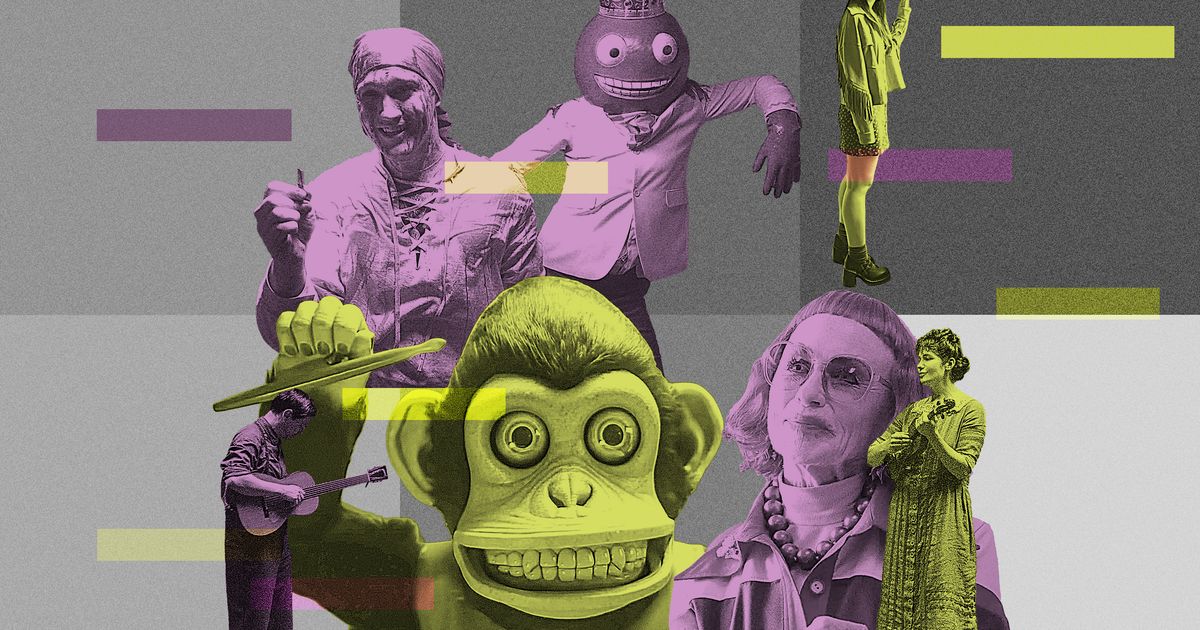
The second Osgood Perkins film on this list — and one of several Stephen King adaptations released in 2025 — The Monkey is a throwback splatter film designed to show just how many ways human bodies can be demolished. To be clear, there is a plot: Hal (Theo James) is trying to protect his son, Petey (Colin O’Brien), and the world at large from a cursed toy monkey that kills people with the turn of its wind-up key. But the real draw of the movie is its darkly funny sadism and blood-drenched violence, as Perkins mines comedy from the shock of brutalizing his characters. “Overkill” is an understatement. At the same time, the filmmaker finds a surprising pathos underneath all the viscera with Hal forced to confront the randomness and inevitability of death. For Perkins, who lost his father to the AIDS crisis and his mother to the September 11 terrorist attacks, The Monkey is both his goofiest film and his most personal, a lighthearted reminder of death’s nasty sense of humor.
While arguably more of a psychological thriller, Charlie Polinger’s debut feature, The Plague, is designed to look and feel like a horror movie, resulting in one of the most harrowing cinematic experiences of 2025. Everett Blunck, also tremendous in this year’s Griffin in Summer, stars as Ben, a 12-year-old boy who encounters sadistic hazing at an all-boys water-polo camp. The social dynamics are a little Lord of the Flies, but a better comparison might be 2018’s Eighth Grade, which was also painfully realistic about the trauma of adolescence. The Plague takes things one step further by using body horror to drive home the anxieties of getting older and desperately trying to fit in. If the rapidly worsening events of the third act don’t jangle your nerves, the sound design will. It’s the kind of movie that makes you endlessly grateful not to be a kid anymore.
As with the first Influencer, saying too much about the plot would ruin the fun. Kurtis David Harder’s last two films are go-in-blind thrill rides that follow the machinations of CW (Cassandra Naud), a serial killer with a real disdain for the professionally online. In Influencers, CW and her girlfriend, Diane (Lisa Delamar), are taking an anniversary trip when an influencer named Charlotte (Georgina Campbell) becomes an unwelcome third wheel. But that’s merely the setup for this impressive escalation of the first film with more twists and a higher body count. Naud continues to be this franchise’s most valuable asset, helping bring real nuance to a character who wavers between villain and anti-hero, sometimes within the same scene. Credit, of course, is also owed to Harder’s script, which keeps its characters’ plans and interiorities vague as it slides effortlessly from thriller into horror terrain.
The V/H/S series has become an institution since its 2012 debut, particularly in recent years, with Shudder releasing new installments of the anthology film franchise every October. Those of us who look forward to these drops are willing to overlook the variable quality of short films within a given V/H/S movie, but this year, though, there’s no need: V/H/S/Halloween has nary a weak leak in its collected shorts. There are clear standouts, of course — “Fun Size,” a thrilling example of Adult Swim contributor Casper Kelly’s fucked-up sense of humor; “Kidprint,” Alex Ross Perry’s deeply disturbing look at a serial killer who is mutilating children; and “Home Haunt,” a showcase for exceptional effects work from filmmaking team Micheline Pitt-Norman and R.H. Norman. On the whole, V/H/S/Halloween is as nasty and mean-spirited as we’ve come to expect from the series, combined with a level of consistency that’s been sorely lacking.
Like Osgood Perkins, Steven Soderbergh had a prolific 2025 with both Presence and Black Bag hitting theaters. (His film The Christophers also premiered at TIFF. How does he find the time to watch Below Deck?) Only one of these movies qualifies for inclusion on this list, however. Some would argue that Presence is more drama with supernatural elements than horror, but this is a haunted-house movie filmed from the perspective of a poltergeist. And it does have a hint of the schlock that screenwriter David Koepp bought to such genre throwaways as Stir of Echoes and Secret Window. Like so many recent ghost stories, Presence is largely a story about grief, but Soderbergh’s unique formal approach to telling this one gives it fresh urgency. The film is also buoyed by its performances, particularly Lucy Liu and Chris Sullivan as two parents working in very different ways to hold everything together.
It is rare for a horror series to still be worth watching in its sixth installment — and rarer still for that movie to be one of the best entries so far (or the very best, depending on who you ask). Final Destination, of course, isn’t like other franchises with each more-or-less stand-alone movie featuring a new cast of characters being picked off one by one by Death. Zach Lipovsky and Adam Stein’s Final Destination: Bloodlines offers some slight tweaks to the formula, including an extended opening that travels back in time to the ’60s, but it wisely remembers what we come to these films for: hilariously over-the-top Rube Goldberg–inspired kills. Like The Monkey, Final Destination: Bloodlines is more about all the horrific ways you can die than character development. But also like The Monkey, it’s an effective look at facing one’s own mortality. In the movie’s most unexpectedly poignant scene, series standby Tony Todd — who knew he was dying when he scripted his final lines — bids a touching farewell to Final Destination and, well, to life.
When I said that, by and large, 2025 wasn’t a great year for horror, that was with the major caveat that two of the year’s best and most successful films fall under the horror umbrella. Sinners in particular is a contender for the defining film of 2025, a stunning genre experiment that uses a From Dusk Till Dawn–flavored vampire story to explore themes of racial oppression and cultural appropriation. In light of the continued assault on individual expression from our political leaders — and the assault on originality and creativity from AI peddlers — Sinners’s thrilling defiance could not be better timed. We should expect no less from Ryan Coogler, whose bold vision continues to stretch the limits of his genres as he did in Creed and Black Panther. Michael B. Jordan, who appears in each of those films, stars in the roles of twins Smoke and Stack, two war veterans using stolen money to open a juke joint. Jordan’s dual performance is impressive enough to make an Oscar nomination feel inevitable, but he’s likely to be joined by a few of his co-stars. Wunmi Mosaku, Hailee Steinfeld, Delroy Lindo, and Miles Caton are just some of the standout performers who help hold Coogler’s epic together.
In contrast to Sinners, Weapons doesn’t have much on its mind. That’s not to say that Zach Cregger’s film is empty-headed but that it purposely eschews the metaphors that have overwhelmed contemporary horror. A teacher (Julia Garner) and a father (Josh Brolin) try to discover what happened to 17 children who walked out of their houses in the middle of the night, a mystery that turns out to have a surprisingly straightforward (albeit fantastical) explanation. Weapons is, at its core, a dark fairy tale. The greatest tricks up its sleeve are not plot twists but Cregger’s handsome filmmaking, wicked sense of humor, and the story’s shifting perspectives. And yes, of course, the casting of Amy Madigan, who — with the help of a fantastic makeup team! — transforms Aunt Gladys into the kind of instantly iconic villain most genre movies can only dream of. Her performance is a feat worthy of all the accolades it will continue to earn, and it helps Weapons become not only the best horror film of the year but also the kind of nightmare fodder that lingers months after the fact.