Let’s break down our Pluribus survivor’s breakdown, one episode at a time.
Photo: Apple TV
Carol Sturka was not a particularly happy individual even before the emergence of the perpetually peppy “We” in the first episode of Pluribus, and after We takes over, her condition deteriorates … rapidly. The Carol we’re left with as the credits roll on the premiere is a veritable layer cake of depression, shock, anger, grief, and loneliness. The cherry on top of her mental breakdown? Well, it seems to have fallen on her to single-handedly solve the biggest crisis mankind has ever faced. Life truly isn’t fair sometimes.
Pluribus is a show that gives viewers lots to consider and contemplate, and at the center of all of it is Rhea Seehorn’s deft portrayal of Carol. Celebrated for her role as Kim Wexler on Better Call Saul, Seehorn is an actress with astounding range and emotional depth — even a minute widening of her eyes or a twitch of her lip can convey volumes — and it’s easy to see why Pluribus creator Vince Gilligan wrote this role specifically for her. Seehorn imbues Carol with festering rage, unresolved traumas, and a deep well of sadness that make her a compelling character study in a world where her discontent clashes with all the happiness that surrounds her.
Since the kindly We poses no direct threat to Carol’s physical well-being, her emotional journey is the engine that controls the narrative. Her shifting moods, use of various coping skills — both healthy and unhealthy — and choice of communication styles are all indicative of a woman in great distress. Why wouldn’t she be? Even though she’s surrounded by people, she’s basically all alone. As a therapist, I’m concerned for her! So in the interest of gauging Carol’s mental health, I’ll be checking in with her every week as her waking nightmare continues to unfold. Let’s break down Carol’s breakdown, episode by episode, shall we?
Spoilers follow for the most recent episodes of Pluribus.

Both We and the small group of survivors have decided that they want nothing to do with Carol, and she is donning all her emotional armor in order to weather this storm.
Photo: Apple TV
Finding that the AGRI-JET warehouse is chock-full of carved-up human remains, Carol seeks to connect with one of her fellow survivors. She doesn’t trust We to copy her footage of the warehouse and send it out to everyone else, so she hightails it to Las Vegas to meet Koumba Diabaté. Koumba is living his postapocalyptic life somewhat differently than Carol, choosing to puppeteer hundreds of We to cater to his hedonistic whims. When Carol arrives, the entirety of We vacates the casino, leaving only Carol and Koumba to chat. Via the individual who was once John Cena, Carol learns that We is reluctantly using human bodies to supplement their food source because they cannot interfere with any form of life, plant or animal. Koumba informs Carol that the rest of the survivors know about this as well and that they are concerned for the future of We. Carol also learns that the process of turning the survivors would require their express consent, and she denies that consent in no uncertain terms. Elsewhere, Manousos watches Carol’s first recording, and it inspires him to leave the storage facility and hit the road.
How Are You Doing, Carol?
Carol experiences some real highs and lows in this episode. Let’s start with the positive news: Carol is overwhelmed with relief when she learns that We cannot get her to join them without her express consent. This is her one win of the episode, and it’s a big one. The knowledge that her individuality will not be taken from her is what allows her to leave Las Vegas with her head held high and her motivation intact. However, throughout the rest of her Vegas vacation, she’s faced with stinging rejection after stinging rejection. The information she brings to Koumba about the cannibalistic nature of We? Not only does he know, but all the survivors know, and they talk about it at regular meetings that Carol was not (and will not be) invited to. Ouch.
As the survivors refuse to vilify We, they have chosen Carol as their target; she has become the villain in their story. How very high school of them. Upon learning that she has been branded a social pariah among almost all the remaining members of humanity, Carol tries very hard to keep her cool. Carol asks a few follow-up questions of Koumba before excusing herself to the bathroom. Here, she allows herself to break down a bit, shaking with rejection, shame, and anger. The waves of emotion that flood her are palpable. Later, she also tries to float the idea of her staying in the casino and is surprised, but not unprepared, to see Koumba’s negative reaction. Her eyebrow arches for a single second before she downshifts into using dismissive humor to deflect her true desire for community and companionship. At the end of the episode, she’s more alone than she’s ever been, but she also seems determined to keep it that way.
Sad Carol: Rejection is hard. Rejection by the entire world is another thing entirely. Both We and the small group of survivors have decided that they want nothing to do with Carol, and she is donning all her emotional armor in order to weather this storm. Underneath her snippy anger and snide tone is all the rejection she faced in her formative years, from her family and from her inner self. Back then, she likely protected herself from feeling sad by controlling what she could control — choosing to go into isolation so that she didn’t feel the sting of being an outcast — and it’s what she’s gearing up to do again.
Mad Carol: Anger continues to be the emotion that Carol reaches for most often, and we see that in her continued interactions with Koumba. He recognizes that she’s lonely, but he wants We in his orbit more than he wants to help this shrill woman who doesn’t seem to be embracing their helpful new overlords. Carol’s anger rises many times throughout her visit to Koumba, and it’s curious to see what her social patterns look like when she’s one-on-one with someone else who isn’t Helen. Every time he disagrees with her or says something she doesn’t like, her anger rapidly bubbles to the surface. Her indignation and unwillingness to see things from various perspectives continues to be a hindrance to her cause, to say the least. However, in a fun twist, we do see that her general annoyance with the rest of the survivors is endearing to Manousos, the survivor from Paraguay. Her prickliness is what convinces him to finally leave his bunker and head out to collaborate with a like-minded person. So … maybe Carol’s anger isn’t all bad?
Cheers, Carol: After initially declining Koumba’s offer of Champagne — much like she did in her first meeting with the English-speaking survivors — Carol starts drinking when it becomes clear that things aren’t going to go her way. She’s hung-over when she wakes, but she shakes it off quickly with some avocado toast. The scene in which Carol smashes her avocado on her bread and Koumba quickly follows suit is one of the great moments of this episode, highlighting an innocuous example of why individuality and differing perspectives are so valuable and worth fighting for. Carol doesn’t drink for the rest of the episode, but she might want to raise a glass soon because it looks like she might have a friend from Paraguay coming her way.

Carol would never ever admit it out loud, but she’s super-bummed that We has left the building.
Photo: Apple TV
After sending Zosia into cardiac arrest, Carol reels with guilt. Waiting for an update on Zosia, she hangs around the hospital and takes a snooze, waking to find the entirety of We has abandoned the city of Albuquerque. A recording (hi, Patrick Fabian!) on the We hotline states that they need space but will still help Carol any way they can. Carol takes this opportunity to make videos to send to the 12 other survivors, first noting that there’s a way to reverse the We virus and then chronicling her discovery of an odd amber-colored drink the hive mind is consuming en masse. Carol isn’t sleeping, partially thanks to a band of wolves sniffing around Helen’s grave in her backyard, but once she chases them off, she continues to do detective work after dark, heading to a food-processing facility in the dead of night. What she finds there makes her gasp, but her discovery is a cliffhanger for another day.
How Are You Doing, Carol?
Carol wants to believe she’s better off without We or even her fellow survivors, but she keeps making attempts to reach out to both groups. Carol would never ever admit it out loud, but she’s super-bummed that We has left the building. Every time she makes a call or asks to have something picked up from her house, she gets a hopeful look on her face that’s quickly dashed when a drone shows up or a recording is on the other end of the phone. Carol does attempt to get back to some semblance of a normal schedule by trying to sleep in her own bed for the first time since Helen died and cutting back on the drinking, but a pack of wolves gets in the way of her plans. Overall, Carol’s mental status has gotten dicier due to her newfound loneliness, but she has a shred of hope thanks to her milk-carton discovery.
Sad Carol: As lonely as Carol is, the lack of other people in the vicinity gives her space to let a little grief into her life. When wolves come scratching at Helen’s burial site (I can’t believe We didn’t properly dig a grave, but no matter), Carol is forced to handle the situation on her own. Initially, she panics, scrambling for the gun in her police cruiser, and when she’s unable to remove it, she uses the entire police car as a battering ram, scaring away the wolves. Then she spends the entirety of the next day sourcing and placing large cement pavers on top of Helen’s resting place. It’s an act of love; the physicality and commitment to protecting her dead partner finally allows Carol a moment of solo catharsis. Later that night, when she’s finished, she paints a lovely headstone with flowers and takes a moment to reflect at the gravesite. We can see Carol wants to let go, but she’s afraid she’ll never be able to get back. In this one moment, however, she finally allows herself to be sad for a beat, and I’m proud of her. It’s progress, not perfection, my friends.
Mad Carol: As We has fled the ABQ, Carol turns her perpetually percolating ire to another group of people: her fellow survivors. She presents her best self in her first message to the rest of the unafflicted, doing her makeup and hair and getting dressed up for the occasion. She writes a speech and delivers it well. Unfortunately, no one takes the opportunity to reach back out to her, and her loneliness begins to take on a spiky quality. After discovering that We drinks an amber-colored beverage out of milk containers, she goes to record another informational missive, but her emotions get the best of her. The hurt she feels over being rejected by her fellow humans and the shame she feels at not being able to endear them to her begin to seep through the cracks. Wondering aloud if anyone is getting her tapes, she snaps. Thankfully, Carol has the presence of mind to rerecord the video, but it’s clear her loneliness is beginning to impact her day-to-day life. She feels as if she’s screaming into the void when what she needs is human connection. People need people, it’s just a fact.
Cheers, Carol: There’s not a ton of substance use in this episode. A few times, Carol debates whether to pour herself a drink, and she abstains more often than not, indicating she feels a need to keep her wits about her now that she can truly rely only on herself.

It doesn’t come as a surprise that Carol is remarkably capable of operating as a lone wolf.
Photo: Apple TV
Carol deals with the (literal) fallout of her grenade request and uncovers a few illuminating truths about We in the process. Her interrogation of an individual named Jeff Hiller, er, Larry, confirms that We cannot tell a lie, information she uses to ask Zosia about whether the We virus can be reversed. When Zosia gives her a non-answer, indicating that it can, indeed, be reversed, Carol decides to up the ante by injecting Zosia with truth serum, a.k.a. thiopental sodium (after trying it on herself first, with amusing results). The dose Carol gives Zosia puts her into cardiac arrest, and the remainder of We starts to sob while pleading with Carol to stop her line of questioning. The conclusion of the episode sees We attempting to resuscitate Zosia as Carol looks on in horror. Elsewhere, we meet Paraguayan survivor Manuosos (Carlos-Manuel Vesga) as he fields a call from Carol (seen from Carol’s perspective last week) and attempts to find food.
How Are You Doing, Carol?
With a break in the case, Carol is fully in her element. She’s an intelligent person who loves a sense of purpose, and the idea that she could single-handedly reverse all this madness energizes her. It’s fun to watch her gears turn as she brainstorms — her elaborate whiteboard wall reminding us that Carol is an independent thinker who works best on her own — and even more exciting to watch her interact with Larry. As Carol questions We about her books (which she disdained) and her fans (whom she dismissed) and Helen’s perspective on her work (which she doubted), it’s never been clearer that her naysaying attitude is diametrically opposed to the sunny spin that We puts on everything. Carol’s books? Well, they’re as wonderful as Shakespeare. Why? Because they brought people joy, and that’s the most important thing, right?
In Carol’s pursuit of the truth, she picks at her own emotional scabs, asking Larry to tell her what Helen really thought of her work. Larry is pained to tell Carol that Helen thought the Wycaro series was “meh.” Carol isn’t thrown by this, but she is a little shook when Larry tells her that Helen never finished reading her novel Bitter Chrysalis. This truth opens a door for Carol as she realizes We is incapable of lying, even if the answers are potentially hurtful.
It doesn’t come as a surprise that Carol is remarkably capable of operating as a lone wolf. We’ll get to the specifics, but the rest of the episode sees her concocting a plan and executing it with verve. However, when the plan backfires spectacularly, she’s left reeling with guilt, confusion, and hopelessness.
Sad Carol: Under the influence of thiopental sodium, Carol finally gets to grieve Helen’s death a bit. We see her break down and sob on her couch, chanting, “I miss you, I miss you, I love you.” The sober Carol, however, continues to stuff down her grief, stifling her tears and fast-forwarding the tape when she gets to this part. As Carol watches the rest of her drug trip, we see her experience a whole host of emotions that she hasn’t been letting herself feel since the world ended; it’s a veritable smorgasbord of feels, and also absolutely hilarious. She toys with a Blair Witch camera angle, muses about her books being made into movies, and then admits that Zosia is “fuckable.” The fact that Carol would never soberly admit that a woman literally handpicked to be the most attractive person on earth to her is actually attractive to her speaks to how tightly wound she really is.
Mad Carol: Carol doesn’t have a major outburst in this episode, but we do get a look at the roots of her anger issues. During her first visit to the hospitalized Zosia, we learn about Carol’s past trauma and why she might be harboring so much resentment toward herself and the world. When Carol was 16, her mother sent her away to a conversion camp called Freedom Falls. As she recalls her time there, she reflects that the counselors were just like the members of We, smiling all the time and promising her that life would be better if she could just be more like them. The behavioral parallels are eerily similar, and it tracks that Carol’s past would be triggering protective survival responses (isolation, anger) in the present moment. No wonder Carol has rage issues; she was raised to hate the very idea of who she is.
Cheers, Carol: Ah, thiopental sodium, that old chestnut. Carol is a woman who likes her substances. The running joke about Carol’s history with heroin use is good for a few laughs, but it further illustrates that she is a woman who looks to numb herself before she’ll feel a single complex feeling. Carol’s addictive nature is well documented at this point, but one question remains: If Carol is such an expert on substance use, then why does she nearly double the dose of thiopental sodium when she drugs Zosia?

Anger is the only acceptable feeling for Carol since it allows her to shift the onus onto others so she doesn’t have to do the difficult work of parsing all those pesky emotions herself.
Photo: Apple TV
Carol returns home from her summit with the other English-speaking survivors and feels defeated. When Zosia gives her a gift from Helen that was in transit when the world ended, Carol almost flips into rage-monster mode again but manages to barely hold it together. She tells “We” to forget that Helen existed, and then rejects their offer of food, opting instead to go grocery shopping. Carol’s favorite Sprouts is empty, but in a worker-bee show of power, members of We scuttle out from the wings of the world and fill it back up again in an hour. Later, when Carol’s power accidentally gets shut off, she goes on a rant to Zosia, sarcastically stating that a hand grenade would make her happy. Zosia delivers one, and a completely wasted Carol pulls the pin, thinking that the grenade is fake. It is not fake. Zosia saves Carol’s life, and while Carol waits for her to recover at the hospital, she talks to another member of We, requesting increasingly dangerous items until the individual before her tells her that they’d even source an atom bomb for her (!) if she said it would make her happy.
How Are You Doing, Carol?
Carol’s mental state can be summed up in two words: frozen dinner. This woman has an entire grocery store of fresh food to pick from, and she chooses a gross-looking frozen entrée. What about a nice charcuterie plate, Carol? This episode makes it very clear that Carol has mostly given up, choosing to dissociate by hiding under a blanket on her couch, binging DVDs of the Golden Girls, and methodically working her way through a bottle of Xanax.
Interestingly — and thankfully — Carol does not seem to be actively suicidal. Instead, she’s numbing the world out as much as she can. However, We can see that Carol is tragically unhappy, and they want to do everything they can to cheer her up. Curiously enough, the gift of the hand grenade does change things. Once Carol finds out that We would go to the ends of the earth to give her even an atomic bomb, she shifts to a different mood. Right before the credits roll, we watch as her face sets in an expression of quiet contemplation.
➼ Sad Carol: The (literally) cold open of this episode flashes back seven years to a trip that Carol and Helen took to a boutique ice hotel. As they check into their absolutely stunning and magical room, Helen takes in all the splendor around them while Carol just gripes about everything. Her list of complaints includes that the bed is made of ice (it’s an ice hotel, Carol), that the trip was too expensive (yes, $100,000 is astronomical, but you’re a best-selling author, babe), and that the aurora borealis looks like a screen saver (okay, it kind of does). Helen deflects all of her complaints with a cheery wave, and Carol finally sits down next to her, taking a second to enjoy the moment with her favorite person on earth. This beat is not only an Apple TV budget flex, but it also establishes Carol as a person who believes that happiness is a weakness. For Carol, to be happy would be to show vulnerability, and she seems terrified of allowing almost anyone to see her pink underbelly.
Carol’s aversion to emotion also extends to sadness. In fact, Carol doesn’t really let herself feel any feelings. That Inside Out control panel in her brain is mostly just controlled by one emotion, and one emotion only …
➼ Mad Carol: Because Carol so frequently bottles up her emotions, they often explode out of her in the form of anger. Rhea Seehorn is truly wonderful at playing Carol’s emotional beats out in real time, with a flicker of her true emotion passing across her face before she quickly stifles it and shifts to blame and anger mode instead. (See: the heartbreaking moment when Zosia reminds Carol of the ice-hotel trip, and Carol forces herself to choke back tears before impulsively grabbing the grenade.) Anger is the only acceptable feeling for Carol since it allows her to shift the onus onto others so she doesn’t have to do the difficult work of parsing all those pesky emotions herself. Thankfully, Carol has been able to calm her rage impulses around We by stopping and taking a shaky breath (it feels like she’s probably been in anger management before), but it’s probably only a matter of time before her temper triggers another We meltdown.
Carol knows she has to control her temper when it’s directed at We, but she doesn’t have to censor herself around others. We get to see furious Carol in action when she attempts to call Manousos, the survivor from Paraguay, and he cusses her out. Carol demands that Zosia get him back on the phone, not to reason or negotiate with him, but to tell him to go fuck his mother. It’s a hilarious beat, but it also underscores Carol’s complete inability to keep her cool, even when the fate of the world might just depend on it.
➼ Cheers, Carol: Or should I say “shoopy shoop shoop”? Carol is as loose as a goose, my friends. I’m concerned about her liberal mixing of Xanax with alcohol — this can be a very dangerous combination of substances — but it feels like she might back off of this routine after her stoned ass activated a literal grenade in her house.
If we look at the stages of grief, Carol is certainly in the anger stage.
Photo: Apple TV
“We” works overtime to keep Carol happy, selecting a woman named Zosia (Karolina Wydra) they believe Carol will like and sending her halfway across the world for a visit. Carol is preoccupied with burying Helen in the backyard, so she is annoyed to see Zosia at first but becomes downright apoplectic when Zosia suggests that Helen “joined” them before she died. When Carol directs her shrieking rage directly into Zosia’s face, all of We feels it, the entirety of the human race falling to the ground with seizures. Later, we learn that 11 million people died as a result of Carol’s outburst.
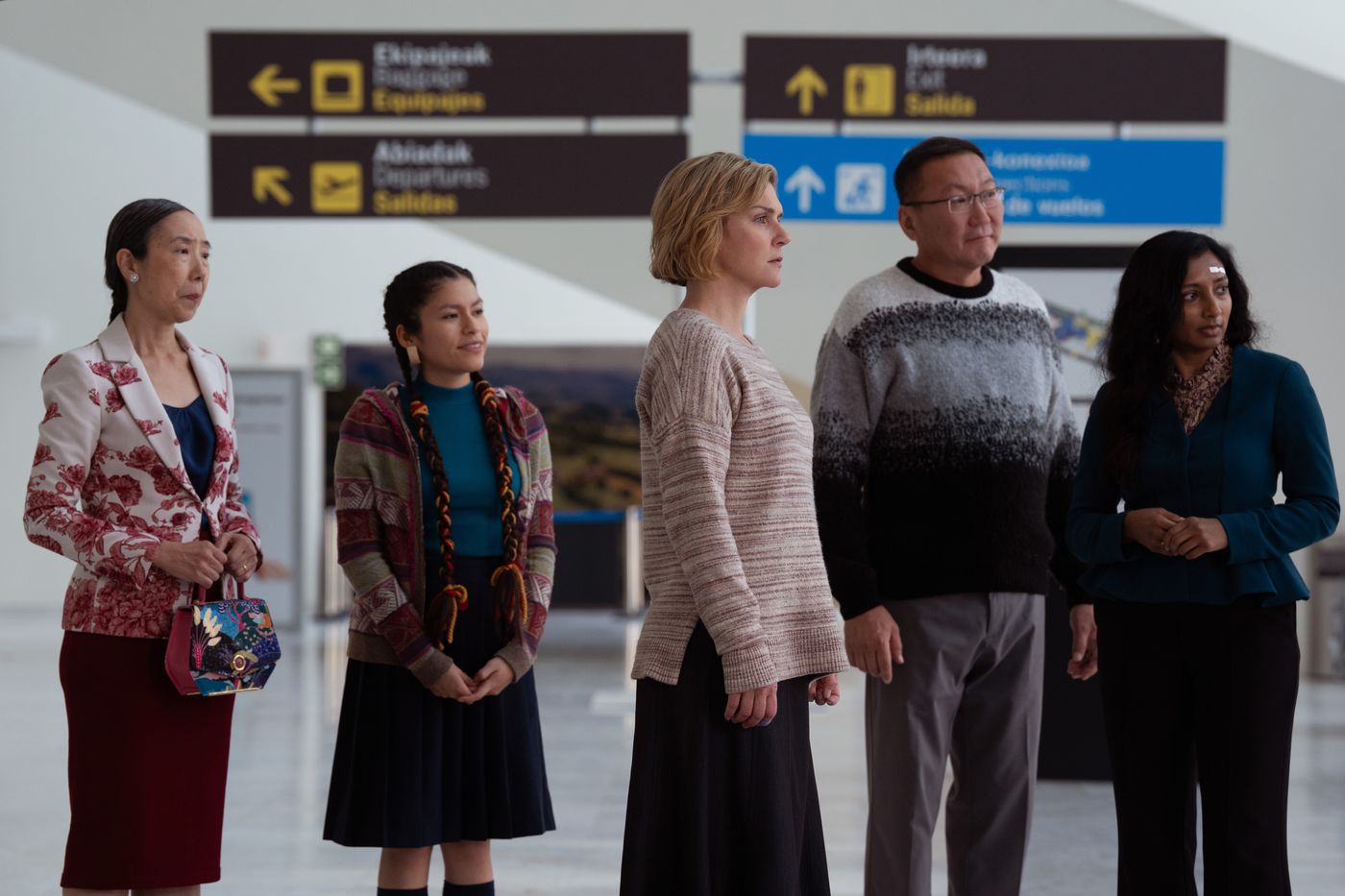
After burying Helen, Carol arranges a meeting with the remaining unjoined survivors who speak English and is astonished to find that all five of them are content with how things have changed. Horrified that no one sees the problem with this twisted new world, she has another outburst and triggers We to shut down yet again. In the morning, she finds that all but one of the surviving humans has left, and that the one remaining — Koumba Diabaté (Samba Schutte) — is requesting to take Zosia with him as a part of his traveling harem. As a part of We, Zosia claims she cannot choose as it will hurt someone. Carol initially says she doesn’t care, but as the planes begin to take off she races in front of Diabaté’s departing aircraft to reclaim her pirate lady.
How Are You Doing, Carol? Carol is actively detaching from anyone who might be of help to her. It’s understandable that she might want to put some distance between herself and the pod people, but when she meets her fellow survivors she immediately puts up her defenses instead of getting curious about why the others have reacted the way they have. When another survivor named Kusimayu claims that she wants to join We so she can be with her family members, Carol scoffs; she clearly doesn’t have a ton of compassion or patience for others … or for herself. It’s been mere days since the end of the world, so we should definitely cut Carol a break, but it’s clear that she never learned that you can catch more flies with honey than vinegar.
➼ Sad Carol: Currently, Carol does not have room for sadness in her repertoire of emotions. A fellow therapist once told me that anger is hurt turned outward, and Carol’s unprocessed hurt is causing We some trouble. Compounding Carol’s inner hurt seems to be the fact that she wasn’t out to the world about being a lesbian. When Zosia first arrives, Carol realizes that she’s basically the female version of the character Raban from her popular Wycaro book series. The only one who knew that Raban was originally written as a woman was Helen. Coupled with the fact that Carol pushed back against telling her readers the truth about who Raban was based on in the premiere — Helen encourages her to tell the truth; Carol insists on responding with “George Clooney” — it feels like Carol has lingering issues with how she hid her sexuality and, now that the world is ending, perhaps some regrets.
➼ Mad Carol: Whew. There has never been a rage like Carol’s rage in the history of the world. If we look at the stages of grief, Carol is certainly in the anger stage. She is fully correct to blame We for Helen’s death, so the wrath she directs at them is not wholly unearned. However, it is also killing people. Is Carol’s rage a secret superpower? Or is it something she needs to reckon with before it’s too late?
➼Cheers, Carol: Carol initially declines an offer of Champagne, presumably to stay sharp in order to problem solve with the other survivors, but the minute it’s clear that things aren’t going to go her way she grabs the glass and keeps drinking. Waking up with a hangover in the apocalypse has got to be awful.
Helen appeared to provide some balance to Carol’s Eeyore-like existence, but now Helen is gone … and so is the rest of the world.
Photo: Apple TV
The premiere doesn’t immediately introduce us to Carol. First, it tracks the discovery of a mysterious signal from space. Eventually, an overeager astronomer (hi, Allan McLeod!) realizes that the signal is code for an RNA sequence. Before considering the potential consequences of their actions (cue Dr. Ian Malcolm’s immortal words), the scientists of the world create and unleash the virus-not-a-virus, and the entire world quickly succumbs. Carol is casually chatting with her manager and romantic partner, Helen (Miriam Shor), when the pathogen descends on everyone, creating a horrific scene of silent, seizing bodies. As the only unafflicted person, Carol freaks out but does not panic, loading Helen into a nearby truck and bringing her to the hospital where she finds more twitching bodies. Tragically, Helen dies in the truck at the hospital just as the horde wakes up and calls Carol by her name. She flees home where a man addresses her directly from her television and attempts to explain what has happened, telling her that all of humanity is now a hive mind called “We.” When he eventually tells Carol that he’d like her to join them, she finally allows panic to flood her body, curling up in a fetal position on her couch and screaming into her living room.
How Are You Doing, Carol?
This episode shows us how Carol was kind of miserable even before the We-pocalypse: She roundly dismisses her best-selling romance novels as “mindless crap” and drowns her sorrows in a giant Manhattan at the conclusion of her wildly successful book tour. She also has an ignition interlock system with a breathalyzer installed in her car, indicating that she’s struggled with alcohol use in the past. Helen appeared to provide some balance to Carol’s Eeyore-like existence, but now Helen is gone … and so is the rest of the world.
➼ Sad Carol: This episode doesn’t give Carol one solitary second to process her grief over losing both Helen and the entire structure of life on earth. Carol is experiencing a whole host of traumas all at the same time and while it’s clear she’s not in denial about what is happening, she’s certainly in shock.
➼ Mad Carol: Carol seems to have some pent-up rage inside of her. See: the promotional material for Pluribus that’s just a close-up of Rhea Seehorn’s screaming face. However, we haven’t seen much of this side of her yet because, understandably, she’s in total shock.
➼ Cheers, Carol: Another indicator that Carol likes to get her drink on is the sequence in which she, desperate to find any information, flips through the channels on her TV, finally landing on C-Span. Seeing the highly specific chyron that asks her to call in directly, she heads to the phone but first makes a sharp detour to her liquor cabinet, taking a quick shot of brown liquor and then dumping a healthy pour into the glass before making her call. We don’t see her face at all during these moments, only decisive action. Whom among us hasn’t grabbed some booze in times of stress? (We all did during COVID, am I right?) But given how Gilligan treats this beat, it’s clear that this is a woman who likes to numb her feelings instead of delving into her pain headfirst.
Check back next week for the latest on Carol’s well-being.