In 2013, the anthology series Black Mirror opened its second season with an episode called “Be Right Back.” In it, a young couple played by Domhnall Gleeson and Hayley Atwell have just moved into an old house in the country when the man dies in a car crash. Devastated and (she’s just discovered) pregnant, the woman decides to try out a service that uses AI software to re-create lost loved ones by culling their likeness and personality from their digital footprint. At first, it’s just (a word that now comes with a shiver attached) a chatbot. Then its parent company launches a new beta program: They send the woman a synthetic body that, once activated, will essentially replace her dead husband with more and more accuracy as it (another shiver) learns. In one of the episode’s eeriest moments, the woman has to dump the dormant flesh droid in the bathtub and wait for it to be “filled” like one of those compressed-sponge creatures from the science-museum gift shop.
Two years and change later, Jordan Harrison’s Marjorie Prime had its New York premiere at Playwrights Horizons. To say something must have been in the water would be disingenuous — we know exactly what that something was, and in the past decade it has only metastasized. Or is that Meta™-stasized? In Marjorie Prime, set somewhere in the middle of the 21st century, an 85-year-old woman named Marjorie talks to an AI reconstitution of her late husband, Walter, helping it to become more Walter-like by feeding it tidbits of reminiscence. (“I’ll remember that fact,” says the bot with a blurry amalgam of stilted neutrality — just code updating itself — and solicitous sympathy.) A few years later, after Marjorie dies, her daughter, Tess, talks to a re-creation of her. The new Marjorie and Walter are known as Primes. In the future Harrison has imagined, they seem like relatively standard technology. And why not? There are already chatbots out there based on dead friends, and in 2022 Amazon announced Alexa would soon be able to speak in the voice of your deceased loved one. As Tess insists to her husband, Jon, “Science fiction is here.”
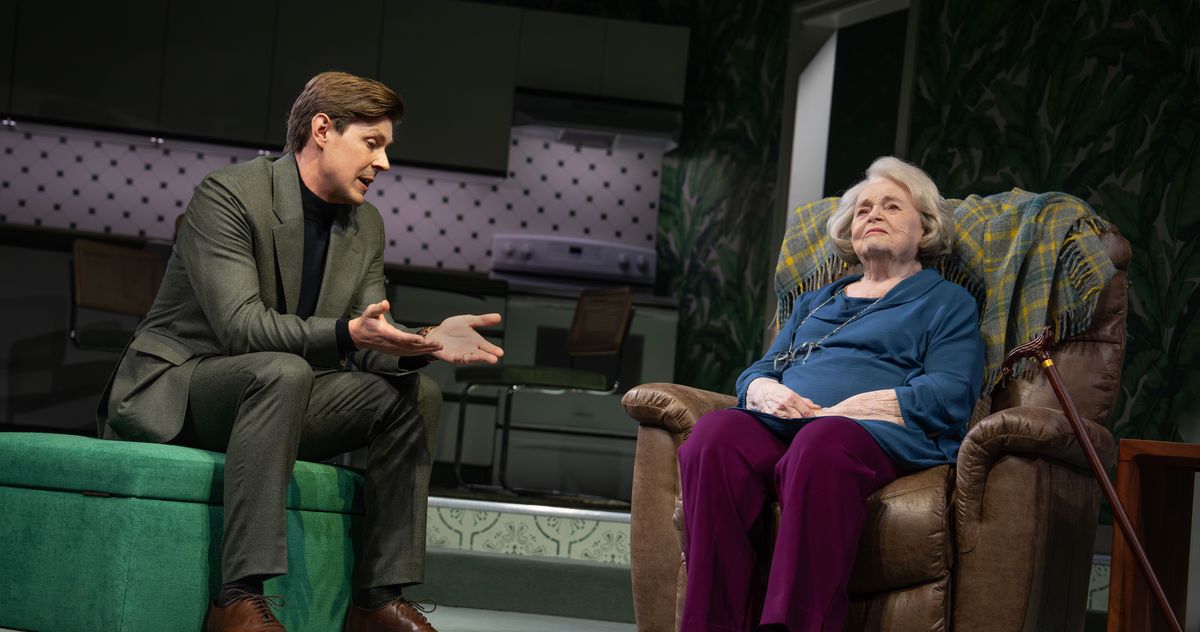
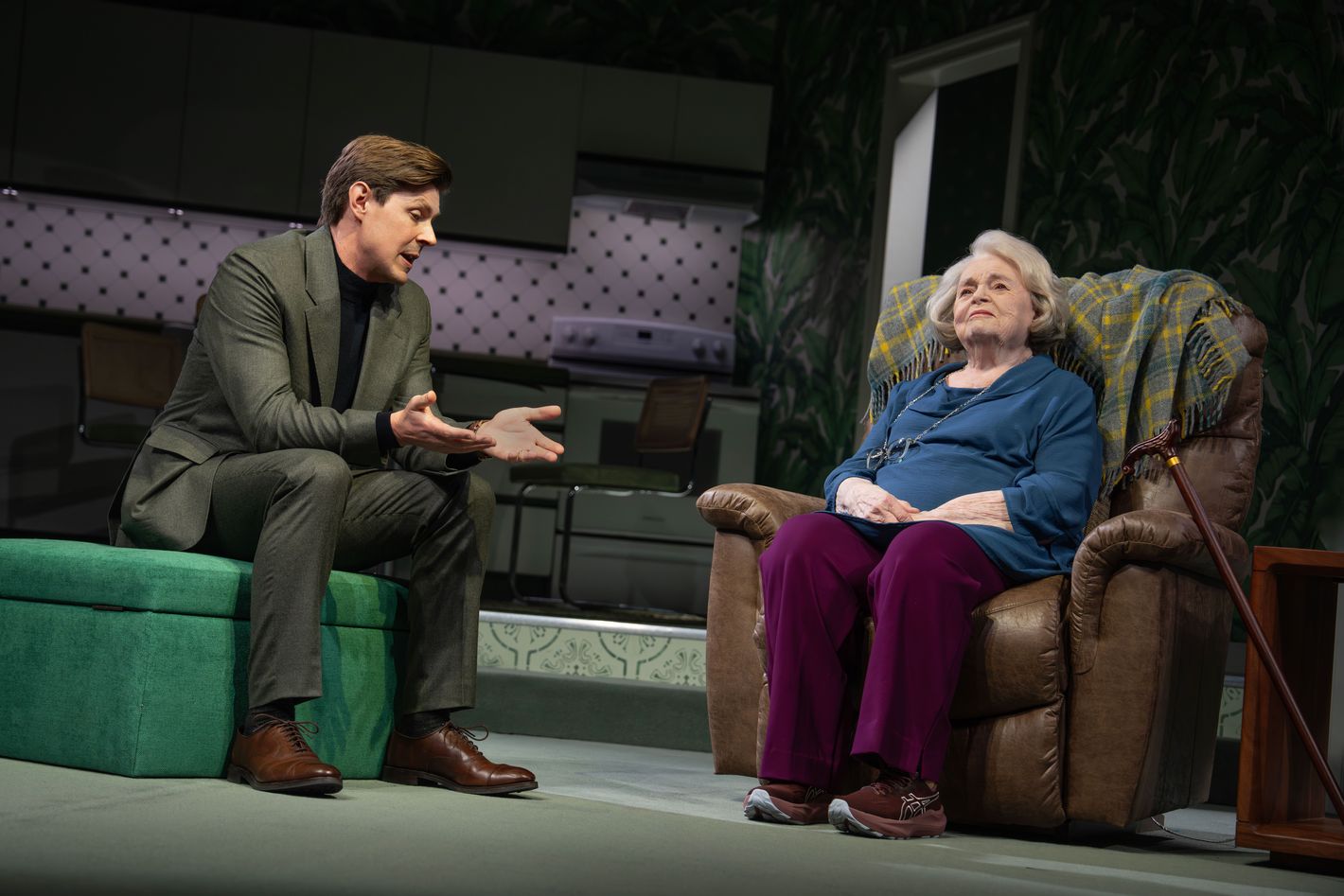
In our present reality, with the floodwaters of AI slop licking at the rolled cuffs of our pants, it’s a pretty sure bet that Second Stage’s elegant revival of Harrison’s play will be applauded for its (then) prescience and (now) timeliness. Yet watching Marjorie Prime — staged on Lee Jellinek’s set of crisp angles, with its green hues engineered for tranquility, by Anne Kauffman, who directs with spare, delicate rigor, as if she’s conducting Arvo Pärt’s Spiegel im Spiegel — I kept waiting to feel … well, more. More rapt, more heartbroken, more rattled by the harrowing questions presented by the long, slow, terribly seductive suicide humanity seems bent on carrying out via technology. Harrison is a formidable craftsman and Marjorie Prime is built very well, but in a way it resembles one of its own artificial humans: It’s an extremely palatable version of the thing. It has studied how to be a play, and it’s a good one — if only the feeling of study weren’t quite so palpable in that goodness. If only it didn’t place so much value on the neatness of its own construction.
In the near-future home where, when the play begins, Tess (Cynthia Nixon) and Jon (Danny Burstein) are caring for Marjorie (June Squibb), one can play Vivaldi simply by asking the ether for the composer and touching the wall. It’s a clever flourish in a play that functions like a string quartet: Along with Walter Prime (Christopher Lowell) — who appears, owing to Marjorie’s desires, as his square-jawed, 30-something self, not as the old man she lost — the family members create distinct registers, their voices weaving in and out of one another in a series of duets and trios. There’s Walter’s serene cello and Marjorie’s pensive, slightly coy violin, sometimes playful or petulant or, still, a little vain and secretive — other times thin and trembling, lost in the haze of dementia. Tess is the other violin, anxious and strained and full of unresolved hurt; Jon, the sweet, warm viola, always supporting, his identity built around harmony. Harrison moves events forward in chronological order but without too many markers: There’s a soft-edged quality to his sci-fi, a sign that a writer is still primarily interested in human beings. The genre is a lens — yes, a black mirror — rather than an object receiving its own meticulous examination. Questions about where the Primes come from, how they function on a physical level, and who profits from them go unanswered. “It’s amazing what they can do with a few zillion pixels,” says Jon, which left me wondering if a Prime can exist only in a location where several thousand tiny projectors are installed. (Notably, Harrison evades the inherently messy idea of flesh.) Are they holograms, some kind of synthetic biomatter, or — but that’s not really the point. The point is how they enable a meditation on attachment, memory, and grief.
When that meditation traverses its most poignant peaks, it does so here in no small part because of the strength of the show’s performances. Squibb — a marvel at 96, playing with ease and lightness at the production’s center — and Burstein are especially affecting. When Jon and Marjorie talk without Tess present, there’s a trace of conspiracy that both endears us to them and elicits our sympathy for poor, fraught Tess. “She’s the mother now,” snips Marjorie — the nag, the skeptic, the one who finds the whole idea of Primes disturbing and manipulative. Jon and Marjorie take it easier. Is it so bad, asks Jon, if Marjorie is “pacified” at this point in her life? Marjorie herself goes even further — when Walter Prime tells her the story of how he proposed to her after they went to see My Best Friend’s Wedding, she wrinkles her nose. “Kind of unfortunate, isn’t it,” she sniffs. “Julia Roberts, forever etched upon our lives. What if we saw Casablanca instead? Let’s say we saw Casablanca … Then, by the next time we talk, it will be true.”
One of Harrison’s preoccupations in Marjorie Prime is the way people — families, especially — rewrite their shared memories, gradually burnishing the unpleasant ones until they take on a new shape and shine. Was it baby Tess that Walter and Marjorie took with them to the pound to adopt a little black poodle named Toni? Or was it Damian? Wait, who’s Damian? “We should save that for another day,” says Tess to the Prime of her mother. “That’s a whole other story.” Kauffman often has the Primes hover on the edges of scenes in which they don’t play a part — seated peacefully on a couch or standing in a doorway, half lit, like devices left to charge. But they aren’t the only inhuman presences haunting the play. Tess’s brother, Damian, looms like a shadow. Who he was and what happened to him are in the process of being rewritten — pain blurred and etched over, pixel by pixel, like a doctored photograph.
The play’s strongest scenes come as a pair, one after another, at its end. In the first, Jon speaks to a new Prime, and Burstein is exquisite in his grief; in the second, the Primes talk together for the first time with no humans present. Again, wider-world questions have to be put aside (in what context would a Prime be without a human? Can they be turned off, or must they be physically abandoned, or …?), and again, Harrison’s revelations aren’t exactly shattering: Humans will always have something that machines don’t. But there’s real refinement in the way he scores the final bars of his piece. We keep waiting for conflict that never comes, that will never come again. After all, when our AI descendents sit together reminiscing and the memories don’t match up, or a buried trauma spills onto the table, there will be no mess, no tears, no monologues of recrimination or apology. There will be only polite recalibration.
Marjorie Prime is at the Hayes Theater.