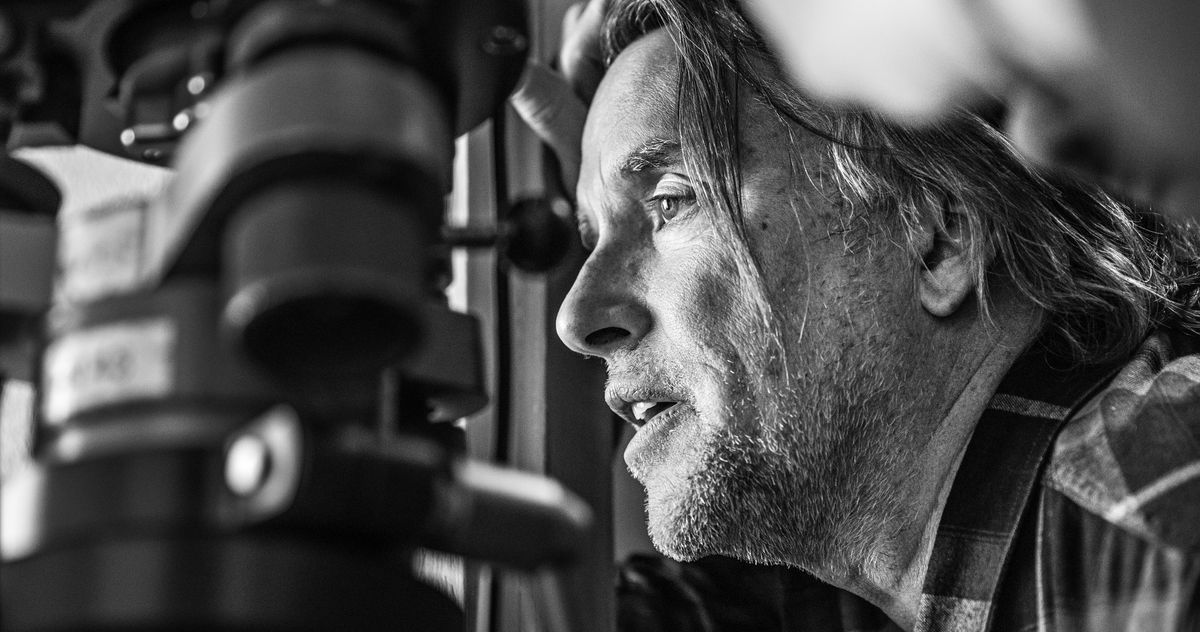

The Blue Moon and Nouvelle Vague director on his surprise Golden Globes nominations and where Netflix is taking the movie industry next.
Photo: Jean-Louis Fernandez/Netflix
Heading into this week’s Golden Globes nominations, certain movies, certain filmmakers (cough James Cameron), and, more centrally, certain A-list celebrities seemed all but guaranteed invitations to Hollywood’s booziest annual awards bacchanalia. Timothée Chalamet and Dwayne Johnson for their career-making star turns in Marty Supreme and The Smashing Machine, respectively? Of course they made the nominations list. Avatar: Fire and Ash for the Cinematic and Box Office Achievement award? Check.
Richard Linklater, despite being responsible for two tiny but critically beloved movies that quietly reached screens this fall, was almost nobody’s shoo-in to get Globes love. The Texan writer-director shocked many awards pundits on Monday morning when both of his 2025 films landed on the Best Motion Picture — Musical or Comedy list: the spirited Lorenz Hart biopic Blue Moon (released by Sony Pictures Classics) and the rollicking homage to French New Wave cinema Nouvelle Vague (on Netflix). In the first, fellow Globe nominee Ethan Hawke portrays Hart struggling through an alcoholic haze and with various erotic longings while his career prospects go up in smoke. The second is a black-and-white, French-language portrait of the young, incorrigible, sunglasses-clad firebrand Jean-Luc Godard (Guillaume Marbeck) marshaling his discontents to revolutionize cinema via his breakthrough debut, Breathless.
Linklater is no stranger to the awards rigamarole. In 2015, he picked up a pair of Golden Globes — Best Director and Best Picture — for his meticulously textured, shot-over-a-dozen-years coming-of-age drama Boyhood (which also landed Academy Awards nods for Best Director, Best Original Screenplay, and Best Picture). And his Julie Delpy–Ethan Hawke romantic gabfests Before Sunset and Before Midnight were nominated for Best Adapted Screenplay Oscars in 2004 and 2015, respectively.
Speaking with Vulture from his longtime home base in Austin, Texas, Linklater maintained his signature chill-bro vibe while also seeming genuinely joyful at the dual nomination — the first time a director has racked up two Globes nods in the Best Picture category in a single year since George Sidney competed against himself with the romantic comedies Bye Bye Birdie and A Ticklish Affair in 1964. He gets “no joy” out of Nouvelle Vague (which cost $9.9 million to produce) being viewed by pundits as the film that knocked the $150 million event movie Wicked: For Good out of the Musical or Comedy category. And he makes a calm, firm defense for Netflix’s potential ownership of Warner Bros.
It’s impossible not to notice that both movies are biopics about people in the entertainment world. Why was tackling those kind of stories front of mind for you last year?
Both projects I’ve been kind of developing for well over a decade each. It was part of a trilogy. Me and Orson Welles was 15 years ago or something. That was the beginning. Put them together, you have two beginnings and one end of artistic careers by these iconic figures in each of their fields. So it’s just a great way to explore a certain moment in time, for sure. To explore what it must have been like to be an artist at that time. There’s both a specificity to the time and a universality to the artistic process. I mean, I do think that timing is everything.
Speaking of timing, Nouvelle Vague presents a director — Jean-Luc Godard — rebelling against the conformity of the film business: the artificiality, the financial bloat. It made me wonder if you were compelled to make this movie in reaction to modern-day, risk-averse Hollywood.
Oh, I think you could make Nouvelle Vague anytime in the last 50 years and call it that. That’s what they’ve been saying about Hollywood forever. You go back and read the big think pieces of the time and Pauline Kael is raging on how the studios are run by the bean counters, the accountants, and the lawyers. And the corporations are taking them over. The sky’s always falling in Hollywoodland. So there’s always been a certain kind of against-the-system-ness to it. It is a system of a kind. But so was the French system of Godard and Truffaut. The amazing thing was Breathless was made within the French system. You look back at all our favorite films and go, How the hell did that get made? You’ve got to tip your hat to not only the artists but the people who believed in film at that time.
In Nouvelle Vague, you show Jean-Luc Godard effectively saying, “This system sucks! Okay, system, gimme some money to make my movie!”
You know, my first couple of movies were done the typical American indie way: credit cards and loans. You’re still going, This system sucks. It’s not helping me any. And then I remember making the leap with Dazed and Confused after Slacker. And I’m like, Yeah, the system is pretty good! It’s paying for these songs. I could see the support. Orson Welles called moviemaking “the largest toy set a boy’s ever been given.” I feel grateful every time I look out on a set.
The Globes have tended to lean toward big-budget things like Wicked, especially in the Best Picture — Musical or Comedy category. How much more surprising is all of this in light of what we know about the Golden Globes and their capricious selection process?
You just never know. I think the Globes rebooted. There’s a lot more people. It’s more international. So maybe they would go more for Nouvelle Vague now or something. I don’t pretend to be in their heads. But I didn’t really grasp that Nouvelle Vague would be seen as a Wicked spoiler or something. And I kind of feel bad about that.
People are basically saying Nouvelle Vague and Blue Moon killed Wicked: For Good’s chances for a Globe nom.
I mean, Godard would probably get a kick out of that. But I get no joy. That’s not how it should be seen. It’s just one moment in time with one group of people.
My perspective is you just have to be grateful. We don’t have advertising budgets. These are the opposite of films that are being foisted on the American public. In the indie world, it’s hard to let people know you exist. So I’ve got to be grateful that if anyone looks at that list and goes, Yeah, that was on Netflix. Maybe I’ll click on it. Likewise, Blue Moon is playing at that one theater in town or on pay-per-view. That’s what you wish for.
With every Golden Globes nominations announcement, there are surprises and there are snubs. Blue Moon and Nouvelle Vague both being nominated for Best Picture are among the surprises. Some people are saying you got snubbed by not being nominated for Best Director. Thoughts?
Well, let’s face it, there are twice as many movie slots as there are director slots. Right? So not every nominated movie can get its director nominated.
And I admit, both those films are in the lower tier of popularity. [Laughs] So I would be an asshole: Hey, what do you mean I’m not blah, blah, blah? I think it’s silly because it’s just the math. A lot of directors are left out of it.
This is just a feel-bad interview: Why don’t you feel more like crap about this, Rick?
I’m not being purposely self-deprecating. But I am a realist.
Let me ask you one more thing. Three of your last four movies have come out on Netflix. A couple of years ago, you made some comments that were fairly critical of its distribution model, especially as it pertained to your animated movie Apollo 10½. I’d love to hear your impressions of Netflix’s attempt to buy Warner Bros. What impact do you think that would have on the movies ecosystem?
You know, it’s pretty fascinating how fast the business morphs and changes and consolidates.
A while ago on Apollo 10½, yeah, it didn’t get out there [in terms of receiving broad public awareness]. I just think the algorithm didn’t know what to do with it. And I was a little frustrated. But I did get to make the movie. I love the movie. And I had two subsequently very good experiences with Netflix. So you don’t catch me ragging on Netflix because they’re great to work with. I think they’re good people. Ted’s a good guy. I trust him on this Warner Bros. acquisition in a way.
The industry’s got to go where the industry goes. And it always has. I don’t know. I’m neutral on this.
I just thought because you have worked so much in the indie world —Yeah. I’m not as worked up as some people.
— that maybe you’d say Ted Sarandos is the Antichrist and enemy of all theatrical distribution.
I don’t really think that! He loved Nouvelle Vague. Who picked up Nouvelle Vague? Netflix. And we talked about the system. They love movies. And they will deliver them to where the public wants them.