
Photo: John Wilson/Netflix
Daniel Craig doesn’t show up until 40 minutes into Wake Up Dead Man: A Knives Out Mystery, but this third installment in Rian Johnson’s whodunit franchise is still the best one yet. That is not a slight against Craig, whose ’90s-boy-band bangs and Foghorn Leghorn accent make private detective Benoit Blanc a delightful iconoclast. It’s praise for the way this latest Knives Out shakes off the franchise’s winking timeliness and instead embraces a timeless foe: asshole Christians — those who use their pulpits to attack all whose faith doesn’t quite align with their own; those who rely on hate and divisiveness instead of charity and love. Our new Chicago pope would love this movie, and he’d probably be upset it’s not in theaters for longer. So am I.
Wake Up Dead Man, now streaming on Netflix, is the most beautiful-looking and ideologically curious of the Knives Out films, while mostly following the formula of the preceding two. There’s an insular group of people (in Knives Out, they were neoliberals obsessed with inheriting Daddy’s money; in Glass Onion, they were sellouts indebted to a tech mogul). Their bubble of self-assurance is interrupted by an outsider who doesn’t quite understand their whole deal, like Ana de Armas’s kindhearted first-gen immigrant in the inaugural film and Janelle Monáe’s vengeance-seeking twin sister in the second. That intrusion aligns with a murder, and of course, the newcomer is the group’s first suspect — until Blanc comes to the rescue, always willing to defend the downtrodden, forgotten, and ignored. Johnson’s Knives Out protagonists have until now been nurses and teachers, working-class people doing jobs that come with union protection, because these films are really about the nature of community and how inclusive or exclusive it can be.
Wake Up Dead Man wastes no time introducing its hero and villain. The good guy: Father Jud Duplenticy (Josh O’Connor), a former boxer who shocked himself with an act of extreme violence, joined the church, and is still trying to figure out what kind of priest he wants to be. He’s a little talky and naïve, his affect a cross between a Freaks and Geeks character and one of the stevedores from The Wire. (These are all compliments.) As Duplenticy explains, he ended up at a small New York parish after punching an “asshole deacon who said something way out of line.” Unfortunately, Duplencity’s now working under another asshole: Monsignor Jefferson Wicks (Josh Brolin), a sneering megalomaniac who forces Duplenticy to take his confessions — lengthy recountings of how, and how often, he masturbates. He uses his homilies to attack newcomers to his parish who don’t align with his conservative politics, and his small group of regular churchgoers regards him with awe and fear.
When Wicks drops dead from what looks like a literal backstabbing during a service, those regulars become the police chief’s (Mila Kunis) suspects. There’s Wicks’s assistant Martha (a scene-stealing Glenn Close), nearly as hateful as her boss, and her partner Samson (Thomas Haden Church), the church’s groundskeeper. (Some of the film’s most gorgeously lit scenes occur in the dense emerald woods surrounding the church.) Also under suspicion is Wicks’s boys club of followers: Dr. Nat Sharp (Jeremy Renner), who turned into a misogynist after his divorce; author Lee Ross (Andrew Scott), turned misogynist by the manosphere; and aspiring politician Cy Draven (Daryl McCormack), a misogynist by ambition. Or maybe the two women in Wicks’s church who were beginning to doubt him are his killers: Vera Draven (Kerry Washington), Cy’s adoptive mother who gave up her dreams of a big-city law career to raise him, and Simone Vivane (Cailee Spaeny), a former star cellist who hopes that the thousands of dollars she’s donated to Wicks will generate a miracle cure for her chronic pain.
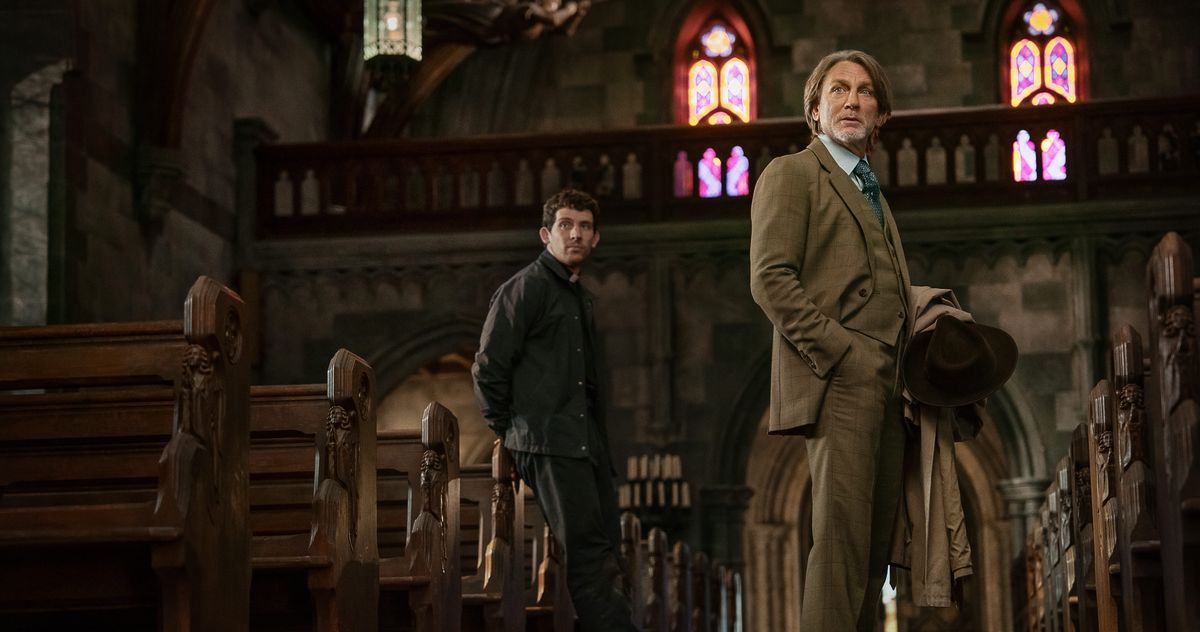
The strongest suspect, though, is Duplenticy, whom Cy caught threatening Wicks before his death and whose growing hatred of his superior and recurring short temper seem like ammunition and a lit fuse. That’s where Blanc comes in, and soon, a number of other contrasting motives appear — secret parentage, a lost fortune — that Blanc and Duplenticy investigate together. Craig and O’Connor are a wonderful pair, the former firm with Blanc’s rejection of religion and the latter gently confident in Duplenticy’s Catholicism. Craig pulls faces and rolls his eyes, as is Blanc’s wont, but he also ensures the detective is actively engaged with Duplenticy’s dilemmas, as sympathetic or furious as he needs to be. The two have a lot of fun with a recurring bit about a brain wave being “a road to Damascus thing” and amusingly flutter around each other as they search Martha’s files for clues; Johnson has a patience for repetition that allows audiences to accumulate information and try to solve the whodunit for themselves.
Yet, through his villains, Johnson has always made clear that the how of Knives Out is not nearly as important as the why. The first film was both a critique of superficial liberalism and a warning about the allure of Trump’s agenda for the white man in America with nothing left to gain. The second was a response to the likes of Elon Musk, Mark Zuckerberg, Sam Altman, and so many other casually evil tech bros who would gladly destroy the world to pretend they’re the only ones who can rebuild it. (As long as we pay them, of course.) Those of-the-moment critiques made Knives Out and Glass Onion entertaining, but they also ensured each film’s fizziness went flat fast. There’s a certain hopefulness to those films that became harder to watch as, in the real world, their targets only grew more powerful and shameless.
Wake Up Dead Man chooses bigger and more ancient targets and actually ends up feeling more urgent than either of its predecessors. Of course, Wicks still rails against “feminist Marxist whores,” Lee complains about the “liberal hive mind,” and Cy lists all the different Republican talking points he cynically used to try and gain voters (including socialism, BLM, and “the trans thing”). But Wake Up Dead Man suggests they’re operating within a long tradition, cockroaches zooming along in the slipstream trailing behind a long-corrupted version of the biblical playbook. The real battle here is in turning ourselves away from the lure of bigotry and greed. That’s a quieter and darker struggle, and as a result, Wake Up Dead Man sticks with you longer.
In the film’s best scene, Duplenticy gets a call back from the manager of a construction-equipment-rental company who had been short with him on the phone before. Louise’s (Bridget Everett) mother is sick, and she’s worried their time together has run out. Suddenly, she’s admitting her loneliness and her fear to Duplenticy, and O’Connor is calm and self-possessed as he tells her, “You’re not alone. I’m right here.” No plot details are furthered here, no additional element of mystery revealed. Duplenticy closes the door on Blanc to take the call in private, in effect closing the door on the possibility of clearing his own name. Helping a person in need — a stranger, no less — matters more in that moment, and it’s the tenderest Knives Out has ever been. The franchise has always centered Blanc as the champion of the underserved, but in leaning away from his shenanigans and slapstick and making space for someone like Father Jud to illustrate the film’s worldview, Wake Up Dead Man shows how much it has on its mind.