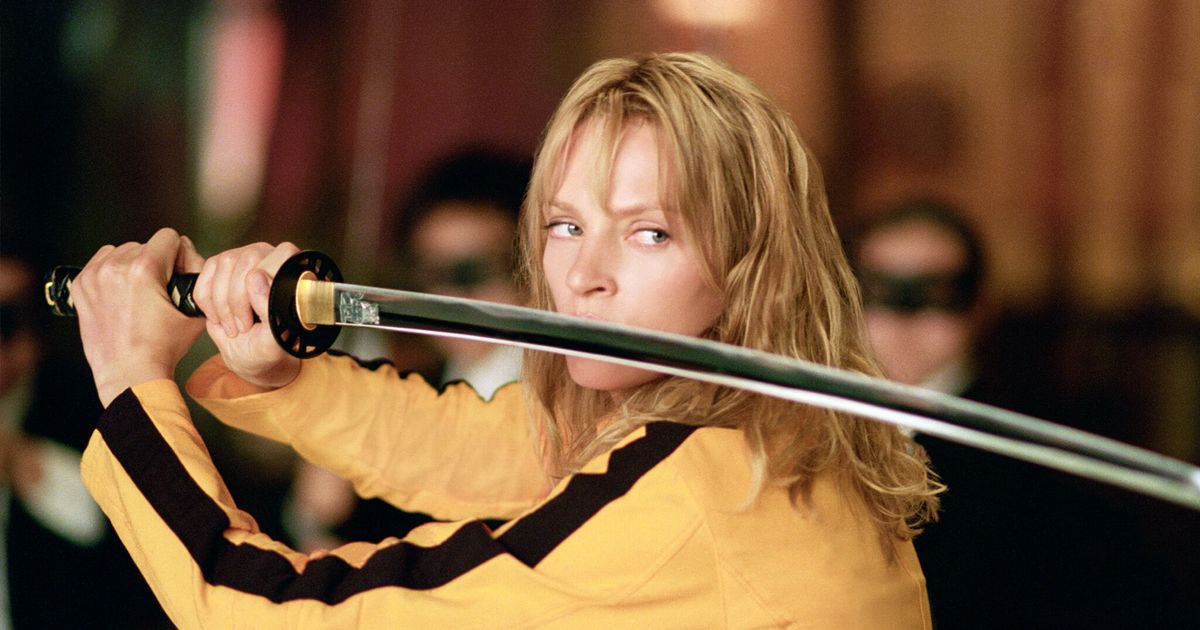

Back in 2003, when Quentin Tarantino’s first Kill Bill film, Kill Bill Vol. 1, came out, we all knew the production’s complicated saga: The director and his star, Uma Thurman (who had come up with the concept together), had intended to make one giant martial-arts revenge movie, but it wound up being so long that it got split into two pictures. By the time Kill Bill Vol. 2 came out a few months later, many of us felt that this division was the right solution. Both movies were excellent, but they were so tonally different from each another. Vol. 1 was a vibrant, no-holds-barred, mixed-media action fest, while Vol. 2 was more elegiac, sadder — a minor-key slow burn leading to a long, talky but ultimately moving finale. Plus, the entire story was already so episodic, constructed of chapters that jumped back and forth in time, that serializing the films felt very much in the spirit of the whole thing.
Over the years, Tarantino’s reconstitution of the full saga, titled Kill Bill: The Whole Bloody Affair, has done some festival and repertory rounds in a slightly modified version. But it’s finally being released properly in theaters, running at well over four hours with an intermission. And it is a revelation. The tonal mismatch I feared could have turned one giant movie into a bit of a slog turns out to be among its greatest strengths. The reflective second half recontextualizes the first, and the progression of colorful action fantasia to quiet existential reckoning is overwhelming. Thurman’s performance, already one of the pinnacles of her career, gains a new emotional dimension with the narrative’s added weight. By the end of the four-plus-hour journey, we feel her exhaustion, her elation, her unfathomable sadness and rage and joy. She was always good — we knew that — but taken as a whole, this feels like one of the greatest performances of the young century.
Before, the whole thing could be summarized with a simple logline: A former deadly assassin who was shot and left for dead (while pregnant) on her wedding day by her former partners, Beatrix Kiddo (whose name is delectably bleeped out in the film’s first half, as if she were some demonic-divine figure) wreaks systematic revenge on the people who did her wrong. The film starts in medias res, so from the beginning, we know Beatrix, also known as “the Bride,” has killed the first person on her hit list, O-Ren Ishii (Lucy Liu), bringing added poignancy when the movie later doubles back to tell the sad, bloody story of O-Ren’s own origins.
Tarantino loves surprises, but he doesn’t give a shit about spoilers. Just as we know that O-Ren’s a goner early on, we pretty much know that the Bride will eventually triumph and that she will make her way to Bill (David Carradine), her boss and former lover who ordered the hit on her and, as seen in the film’s opening, pulled the trigger meant to blow away her face. And we certainly know that the Bride will emerge victorious from the unhinged slaughterfest of her confrontation with the Crazy 88, O-Ren’s crack army of black-suited, sword-wielding killers — a sequence that has already secured its place in action-film history.
Look, Tarantino can be a blowhard in his interviews, and he recently appears to have stepped in it yet again. To be clear, he will never stop doing that. But that will also never take away from his extraordinary skills as a filmmaker, and the Kill Bill saga, in whichever presentation, was always one of his great achievements. There are a couple of added bits in this new full version — mainly an extra (and super-gory) sequence in the anime flashbacks to O-Ren’s origins. But perhaps the biggest change is what’s not there. Back in 2003, Vol. 1 ended with some brief scenes meant to entice us for the second entry, and among them was a line from an as-yet-unseen Bill informing us that the Bride’s daughter, unborn and presumed dead in that initial massacre, was still alive. This was a fun, melodramatic cliff-hanger, but it’s not included in this full version of Kill Bill; the viewer only finds out the daughter is alive when Beatrix herself does: when the girl suddenly shows up in the film’s final sequence.
How would that have played had the earlier line never been there? I can’t tell you. But even with that foreknowledge, the moment hits us like a truck full of dynamite, aided immensely by Thurman’s explosive shock at the sight of her daughter. The scene properly reframes the whole picture as the emotional journey of a mother, turning all the expertly choreographed action spectacle and narrative trickery of the film’s earlier scenes into something akin to a great big metaphor for life itself. In so doing, it also restores the movie’s sweep and the complexity of its epic scope. Before our very eyes, Kill Bill: The Whole Bloody Affair becomes a modern-day Odyssey.