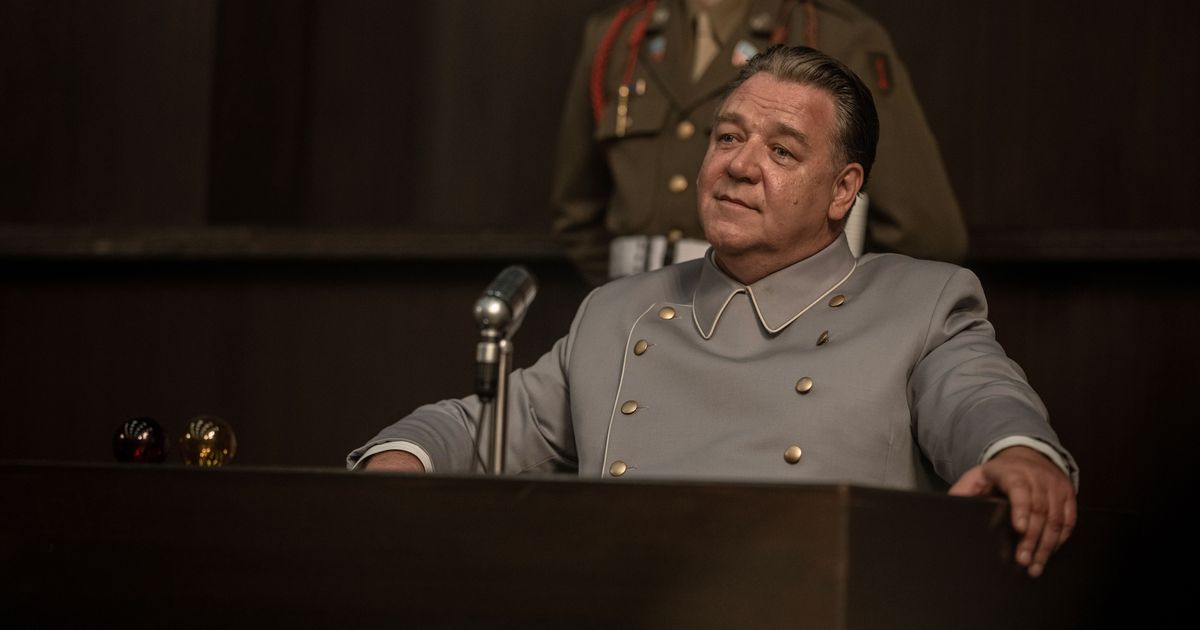

He’s transformed from bare-chested Method hunk to ruddy-cheeked scene stealer, and his body of work has never been better.
Photo: Scott Garfield/Sony Pictures Classics
Hermann Göring, the highest-ranking Nazi tried for war crimes after World War II, is not the protagonist of Nuremberg. The story is focused more on Göring’s psychiatrist, Douglas Kelley (Rami Malek), and the head of the Allies’ prosecution team, Robert H. Jackson (Michael Shannon). Yet Göring dominates the movie thanks to Russell Crowe’s performance, somehow both indulgently big and dexterously subtle. He is the poisonous lure of machismo, incarnated as a boisterous psychic seducer of other men — a guy who can make anybody feel special and understood, even the psychiatrist hired to crack open his brain.
It’s the latest brilliant Crowe performance in an era that’s seen him abandon any interest in regaining the exalted position of movie star in favor of supporting roles and villain parts. These days, you’re more likely to see Crowe’s name associated with still-disreputable genres like horror, superhero fantasy, and R-rated action. Not only is Crowe comfortable in such categories, he seems to be liberated by them. Part of the Crowe-issance comes from the actor getting comfortable with the transition from bare-chested Method hunk to ruddy-cheeked, plus-size scene stealer who seems delighted to lead with his belly.
Twenty-five years ago, Crowe would not have entertained such choices. Back then, his face was on gigantic billboards, his adolescent dreams of rock stardom were reanimated by his acting celebrity, and the tabloids (plus South Park) were covering his public fisticuffs and affair with Meg Ryan. He’d transformed from a Method stud in Australian and New Zealand drama (as the man who betrays his blind best friend in Proof, a vicious neo-Nazi in Romper Stomper, and a cutthroat salesman in Spotswood) to a serious actor whose superstar period kicked up with a pair of “Who is that guy? He’s amazing!” performances in Hollywood action flicks: the outlaw turned preacher backing up Sharon Stone’s avenging gunslinger in The Quick and the Dead and the virtual serial killer unleashed on reality in Virtuosity (opposite Denzel Washington). After an acclaimed supporting performance as brute cop Bud White in L.A. Confidential, he got promoted to lead slots in Oscar-bound dramas, including a trio of lead performances that made him one of a handful of individuals nominated for Best Actor in three consecutive films (The Insider, Gladiator, and A Beautiful Mind; he won for Gladiator). His run continued through the aughts, with well-liked but less successful features like Cinderella Man, Master and Commander: The Far Side of the World, American Gangster (reteaming with Washington), and 3:10 to Yuma.
A turning point seems to have occurred around 2010, after Crowe played the top-billed part in two commercial and critical bombs Paul Haggis’s kidnap thriller The Next Three Days and Ridley Scott’s too-morose version of Robin Hood. He took a year off from acting, then returned in two surprising supporting roles. One was Inspector Javert in Les Misérables, a box-office hit where all the singing was done live during filming. Javert is a deluded man who mistakes mindless obedience to the state for righteousness; his devotion to the letter of the law is what he has instead of a personality. Crowe’s good-enough-for-a-bar-band voice can’t do justice to Claude-Michel Schönberg and Herb Kretzmer’s songs, but Crowe leans into the mismatch with such sincerity that his own inability to master the music becomes inseparable from Javert’s inability to take stock in himself and realize he’s on the wrong side.
He also played one of the fighters in RZA’s hip-hop kung-fu flick The Man With the Iron Fists: an English adventurer known as Jack Knife who carries a dagger-revolver and tells a would-be combatant, “I seek no quarrel with you, young fellow,” before gutting him like a Christmas goose. Jack is the selfish lone wolf who becomes part of a team in order to defeat Brass Body, a destructive force whose flesh can transform into metal (played by Dave Bautista). Crowe isn’t the actual hero, but the hero’s friend and erstwhile mentor. And frankly, Crowe seems happier in the part than he ever did in noble, beleaguered paladin roles.
His choices since have been inspired and rarely haloed by prestige. Crowe was hilarious as seemingly amoral enforcer Jackson Healy in Shane Black’s The Nice Guys, a human bulldozer who can crack wise with the best but would rather crack skulls. The film is really about Ryan Gosling’s Ryland Grace, a private detective hired to locate a missing porn star who stumbles through a farcical film noir that’s what Chinatown might’ve turned into if it starred Jack Lemmon and had been written by Billy Wilder. Crowe was ferocious in 2020’s Unhinged as a MAGA type in an emotional-support truck who becomes obsessed with destroying a young mother who honked at him too emphatically. He also starred in two back-to-back medium-budget horror flicks about demonic possession. As Father Amorth, the title character of 2023’s seriocomic The Pope’s Exorcist, Crowe used his bulk for comic and dramatic effect, as Orson Welles and Peter Ustinov once did, even becoming a human sight gag by riding around on a too-small Lambretta scooter while dressed like Judge Doom from Who Framed Roger Rabbit. (My colleague Bilge Ebiri said the image had “bear-on-a-tricycle vibes.”) Crowe has such exquisite control over this character, and the audience, that dialogue that might not have been written as funny plays that way, as in the opening sequence where Amorth baits a demon into leaving his host by telling him he’s not capable of possessing a nearby pig, talking like a pub bloke betting a month’s salary that he can’t remove his socks with his teeth. And dialogue that’s intentionally funny gets an extra push into hilarity, as when the demon declares itself Amorth’s worst nightmare and Crowe delivers the riposte, “My worst nightmare is France winning the World Cup,” as if the priest truly means it.
Crowe followed The Pope’s Exorcist with 2024’s The Exorcism, playing a respected actor who ruined his career through drink and drugs but gets the chance to return to the spotlight when an actor playing a priest in a demonic-possession flick dies mysteriously on the set. The film-within-a-film is called The Georgetown Project but is clearly another pass at William Peter Blatty’s novel The Exorcist — an aspect that’s foregrounded by director-cowriter Joshua John Miller, the son of playwright-actor Jason Miller, who played the young priest in William Friedkin’s screen adaptation. Crowe’s character, Anthony “Tom” Miller, has to dig deep into his childhood and exorcise his own demons — the ones that led him to self-medicate, contributed to the death of his wife, and damaged his relationship with his now-adult daughter. (In addition to being an unusual take on a horror subcategory, it’s one of the great recent films about deeply flawed parents whose kids absorb their issues and manifest them in their own ways.) The story around Crowe is majestically gloomy and self-aware, but Crowe’s acting in the non-possessed scenes is understated and naturalistic, treating the threat of takeover by an actual demon as as stand-in for fears that Tom is too weak to remain sober and match his youthful creativity and that he’d rather be dead than continue failing.
A lot of Crowe’s recent roles have a thematic through-line. They incarnate and critique aspects of toxic masculinity: worshiping toughness, prizing power above all else, and purging any trait coded as feminine. In the 2019 miniseries The Loudest Voice, Crowe played one of the most toxic men in American public life, Roger Ailes, who started out in the 1960s as the wunderkind political adviser who rehabbed Richard Nixon’s image; morphed into a political kingmaker whose signature invention, Fox News Channel, repackaged reactionary fearmongering as journalism; then lost it all when his sexual harassment of female employees was publicly exposed. Both characters in Crowe’s exorcism movies would’ve done a lot better if they’d gone into their new gigs with eyes open to their own flaws, but they couldn’t, because they’ve been raised to believe that evil isn’t as strong as they’ve been told — that it can be outsmarted, outfought, or outlasted through skill and persistence, rather than by divesting themselves of ego and humbling themselves before God.
In Prizefighter: The Life of Jem Belcher, about the birth of boxing as a sport and the training of the youngest-ever world champion, the title role is played by then-31-year-old Matt Hookings (who also wrote the script). Crowe is Jem’s grandfather Jack Slack, a bare-knuckle fighter and a model of crudely ritualized masculinity who destroyed his family with his drinking and fighting and whose values possessed young Jem. Crowe is as much of a grandiose pathetic demon here, playing a wreck of a man who all but demands that his son drink with him to make an interaction meaningful and whose bedrock belief is, “In life, don’t no one give two shits about you. The only defense is attack.” The spiritual exhaustion in Crowe’s cloudy eyes tells us that some part of Jack recognizes he’s talking nonsense, even as he blusters and brawls and clings to his code like a toddler to his lovey. Flamboyantly narcissistic injury is another recurring trait in Crowe’s recent character performances. Jack Slack might be a distant historical ancestor of the burly stalker in Unhinged, who gripes, “Every effort, every sacrifice I’ve ever made in my invisible life has been dismissed, ignored, and judged. I’ll make my contribution this way: through violence and retribution. ’Cuz it’s all I got left.” But where the stalker remains self-deluded to the end, Jack’s self-righteousness is tinged with self-awareness. “I have worked every day of my life,” Jack admits, his bulk folded over a bar, his voice slightly trembling, “and I’ve thrown it all away.”
Crowe’s Göring is the culmination of the work he’s been doing over the past 15 years. Nuremberg explores how authoritarian regimes take over democracies — not by making a detailed intellectual case that persuades on its merits but by validating the power fantasies of those who feel shut out. Like his by-then-deceased boss, Adolf Hitler, Göring tapped into Germany’s collective sense of humiliation after losing World War I and being forced to sign the Treaty of Versailles. Hitler and his cronies characterized this as a national emasculation destined to be avenged with a Third Reich that would last a thousand years. Crowe’s interplay with the actors who play the other Nazis held in the Nuremberg penitentiary foregrounds the lie that Germany’s greatest mistake was not being meaner. Crowe seems to intuitively understand how fascism is rooted in fear of not being manly enough. His Göring is a monster whose lethal temper erupts when he’s denied the advantages he seeks. But he presents himself as the boisterous bloke who drinks too much and gets into fights sometimes — who tells great stories and jokes and will always have your back, even when you’re wrong. In other words, the Russell Crowe that some men see in Gladiator, Master and Commander, and American Gangster and think, If that guy were my friend, everything would be all right. It’s the latest in a series of roles that dissect the strong-silent-suffering men with codes in some of his earlier films, and showing how the codes themselves can destroy men or bring destruction to their world.
Perhaps not coincidentally, Crowe has been on a long-running, hit-and-miss self-improvement program for at least two decades. He’s an active donor to charitable causes, everything from international nonprofits battling AIDS and homelessness to an Irish book club and an English cancer-research center. But he rarely takes credit for it, telling the Irish Examiner, “There’s a lot that can be achieved by putting a cheque in the right place and shutting up about it.” (A conspicuous exception to that policy was his 2018 Art of Divorce auction at Sotheby’s, which auctioned personal mementoes, including his jockstrap from Gladiator, and raised $3.7 million for charity.) Crowe has also spoken of how much better his life became after he wrapped Nuremberg, which captured what he looked like at 277 pounds, and he resolved to get healthy. He told Joe Rogan that he embarked on a new regimen, eating better food, taking regular injections to reduce “thick bands of arthritis” in spots where he’d suffered athletic injuries, and most importantly, reducing his drinking to an occasional glass of wine. Crowe said, “I’m a big proponent of having a drink; it’s my cultural heritage, and as a working-class man, it’s my goddamn right,” but was forced to acknowledge that with age, “there are certain things you start to learn about your capacities.”
As a teenage singer-songwriter with the stage name Russ Le Roq, Crowe wrote and performed a single that feels prescient now: “I Just Wanna Be Like Marlon Brando.” He’s gone beyond that, becoming a version of Brando who didn’t just recognize his own sins but tried to atone for them through the work. He’s still mesmerizing as a presence onscreen, but increasingly also as a stealthy critic of the same brand of hale-and-hearty machismo that made him a global star in his 30s. In the exorcism movies, Crowe plays the guy who fears being possessed. In Nuremberg, he’s the possessor, scanning everyone he meets for cracks in the façade wide enough for evil to slip through. Even when the other characters aren’t talking about Göring, the audience is thinking about him, like Hannibal Lecter in The Silence of the Lambs or the demon in The Exorcist. The greatest performances don’t just incarnate a character; they show how they fit into, and were made by, their culture. They are people, but also ideas.