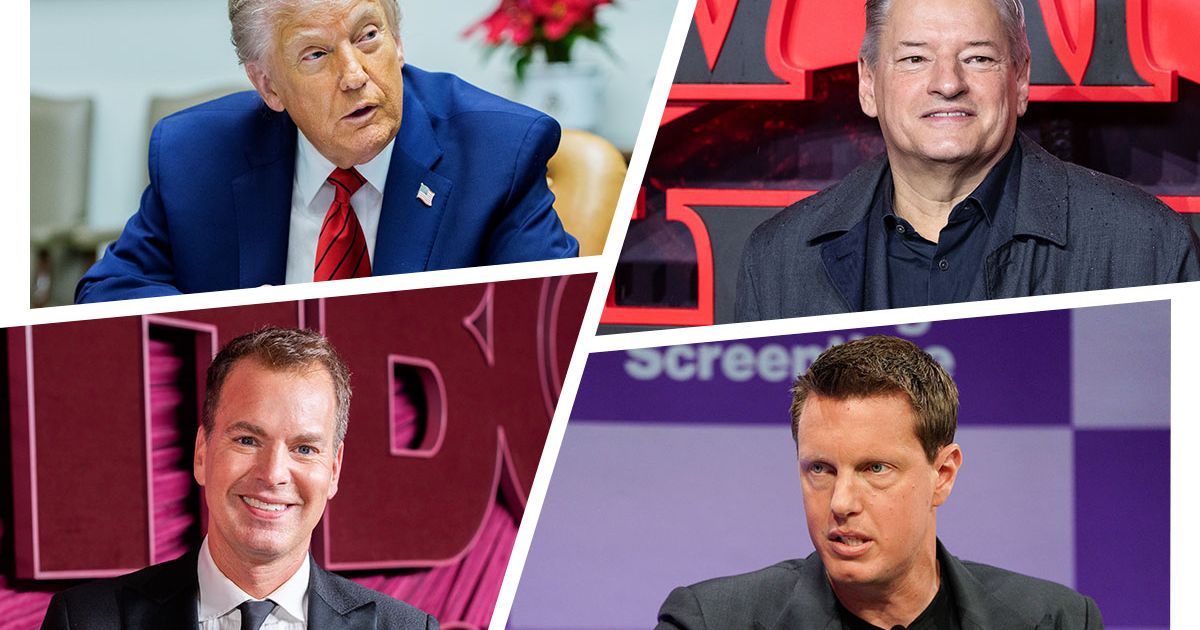

Photo-Illustration: Vulture; Photos: Getty Images (Jeff Spicer, Kyle Grillot/Bloomberg, David Jon, Aaron Schwartz/CNP/Bloomberg)
What a year the past week has been in the battle for Warner Bros. Discovery. In just seven days, Hollywood has gone from thinking that Paramount was the inevitable winner of the David Zaslav–led media empire to the shock news that Netflix had signed a purchase agreement for the WB studio and streaming assets — only to wake up Monday to witness Paramount and its CEO David Ellison mounting a hostile takeover attempt for the company. Even the Animaniacs would have trouble squeezing all these developments into a single song.
Given how much of a rollercoaster ride this story has already been, it would be foolish to try to predict what will happen next, let alone how this whole thing ends: Maybe Comcast somehow re-emerges with a new bid, or some other unexpected player pops up. Except for Zaslav walking away with another massive payday, very little feels certain. What we do know is that right now, WBD shareholders are pondering what to make of Paramount’s counter to the Netflix deal that their company’s board accepted last week. In this era of late-stage capitalism, most probably only care about which deal is the most financially lucrative for their own portfolios.
But for the rest of us, what happens to Warner Bros. Discovery is about the fate of a whole bunch of beloved brands and channels, and the kinds of TV shows and movies and news reporting we’ll get from them. So which of the two suitors — Netflix and Paramount — would do the best job as custodians of the Warner Bros. Discovery assets? Here’s the current tale of the tape as seen on four key fronts:
Hours after the deal was announced last Friday, one Warner Bros. Discovery veteran told me Netflix buying the company’s studios and streaming business “may be the least worst option” for HBO vs. being folded into Paramount or Comcast. This person’s thinking: Netflix has the money to keep the iconic brand fully-funded, plus the tech acumen and global reach to connect its shows to the widest possible audience (particularly more niche plays like The Rehearsal or I Love LA).
What’s more, an HBO leadership based at Netflix would be able to fully focus on the brand’s historic mandate — to make the best, most prestigious shows on television — and not have to worry as much about making more mainstream fare to flesh out the “Max” part of HBO Max. “They have been doing gymnastics to make themselves into a general entertainment brand,” Sarandos said Monday during an appearance at the UBS media conference, referring to HBO execs. “I think under this transaction, they don’t have to do that anymore. We already have a very well-established general entertainment brand, and we want HBO to double down on the things that people have loved for 50 years about HBO.”
Of course, there’s no reason to think Paramount leadership would mess with the HBO formula, either. Under Par’s old leadership, that company’s own premium brand, Showtime, has been all but destroyed, leaving Paramount+ desperately in need of the kind of upscale content that gets a certain subset of subscribers to shell out for a higher tier. Indeed, one of the key reasons Ellison and Skydance recruited former Netflix content boss Cindy Holland to run Paramount+ is because of her chops at making exactly that kind of programming. While in theory that might result in some overlapping of skill sets between her and Bloys, Holland is not known as a micromanager (just the opposite), and both execs have a reputation for getting along well with others.
And yet, even if Netflix and Paramount are likely to leave HBO alone — at least in the short term — there are some red flags attached to either takeover scenario. At Paramount, the company’s close relationship to the Trump White House, plus the fact that Paramount+ is already pretty conservative-coded (Taylor Sheridan, CBS crime dramas), might limit its appetite for the sort of risk-taking and edgy fare HBO is known for. As for Netflix, despite all the talk of giving HBO the freedom to operate as its own independent unit, it’s probably worth worrying that Sarandos and Peters will eventually want HBO to adapt the Netflix Way of doing things: Data-driven decision-making, binge drops of series, limited marketing of all but the biggest titles, worshipping at the altar of the algorithm. But these fears could also be overblown: Disney, the most family-friendly brand on earth, ultimately had no problem adding shows like All’s Fair and Dying for Sex to its streaming universe, and has also given FX boss John Landgraf a wide berth to keep operating not much differently than he did before the Mouse House took over. And if HBO can survive a decade of management by a phone company and a cost-cutter like Zaslav, it will probably be OK no matter which conglomerate gets control. “Casey will be in a position to do whatever the hell he wants,” says one industry vet.
WBD’s would-be buyers take two very different approaches to the company’s basic cable channels: Paramount wants them; Netflix doesn’t. That’s because Ellison & Co. want to buy Warners as it is today, while Netflix prefers to let Zaslav continue with the plan he announced last summer to spin off the cable holdings into a new company called Discovery Global, leaving Netflix to snap up everything that’s left behind (the studios, HBO Max, HBO and, per a WB networks spokesperson, Turner Classic Movies). Either way, big changes would result.
At least in the short term, the culture shock for the cable side of the business would be most severe if the Paramount plan succeeds. If it takes control, it would almost surely fold networks such as CNN, TNT, HGTV, and TLC into the same division which now houses everything from CBS, Comedy Central, and MTV to the smoldering ashes of Showtime. That would certainly create a ton of scale, but also all sorts of what business folks like to call “redundancies.” While the Warners cable networks are already running on a shoestring budget, they’d face even deeper cuts under Paramount since there would be no need for separate divisions running marketing, PR, business affairs, etc. And while the new Skydance leadership team have said some hopeful things about trying to reverse the years of damage their predecessors did to the company’s once-mighty cable brands, it’s hard to see the streaming-obsessed Ellison caring about any of the WB basic cable brands, save one: CNN. (More on that in a bit.)
By not buying the cable networks, Netflix offers a different future — one that might actually be a bit more hopeful. If Paramount doesn’t succeed in the next few months and Discovery Global becomes a thing, its cable networks will become part of a new company that, for the most part, will care only about preserving the linear cable channels, since they’ll be its primary (and still lucrative) source of revenue. We’ve seen this movie already in the form of Versant, the new home of most of NBCUniversal’s legacy cable channels (save Bravo). It’s still an infant, but already, the company has moved to hire new staff, announce plans for ways to stream its content, and launched big marketing campaigns for channels such as MS Now (the former MSNBC) and CNBC. It is laser-focused on taking the hundreds of millions its cable channels still bring in and funneling it back into Versant — rather than watch as those revenues get diverted to NBCU’s main priority, Peacock.
Something similar would likely play out during the first few months of Discovery Global — though the post-separation euphoria might be short-lived. That’s because a stand-alone Discovery Global might then decide to snap up more cabe holdings, or vice-versa, perhaps creating a scenario where CNN and MSNBC end up under one roof. But even if that did happen, that combined cable behemoth might leave its individual networks with more autonomy — and upside — than if Paramount claimed them.
It’s no secret that wide swaths of the movie business — theater owners, producers, directors — are not fans of Netflix. The company makes most of its films for its own platform vs. cinemas, and even when it does put movies in theaters, it’s only for a couple weeks. Unsurprisingly, then, the conventional wisdom in much of the reporting around both bids has been that Paramount offers a brighter future for Warner Bros. Pictures (and the movie business in general) then does a world where Netflix owns everything from Barbie to Casablanca. My colleague Chris Lee has also mulled the competing bids, and his main takeaway is: Trust no one. “Paramount said it is going to do 30 films a year, which is nuts,” Lee told me. On the other hand, “I don’t think anyone believes Sarandos when he says he will honor the theatrical commitment, at least not beyond what is currently contractually obliged.” In other words, either outcome in this deal drama is likely to result in fewer movies being made and higher unemployment in Hollywood — which is exactly what happened when Disney bought 20th Century Fox. “That studio division is a ghost town now,” Lee says.
I don’t disagree with my colleague’s gloomy assessment of the situation: These kinds of mergers are almost never good for artists, and time and again, we’ve seen consolidation result in less risk-taking, a greater reliance on “franchises” and, almost always, many people losing their jobs. I also get why many folks think Paramount will be “better” for movies since that company has historically been far more respectful of industry norms regarding theatrical windows.
But while I don’t think Sarandos will ever give up his quest to shorten those windows or to make a whole bunch of movies that live exclusively on Netflix, I do think that, as with HBO, there’s a chance Netflix actually wants Warners to do what it does well: Cranking out movies that make $1 billion or more in theaters. As Apple demonstrated with F1: The Movie this year, it is possible for a streamer to make a (modest) blockbuster that gets a long theatrical run and still adds value to your digital platform. Netflix doesn’t have the decades of experience in the distribution business that Warner Bros. Pictures have, and it’s only just beginning to understand the franchise business. Warners gives it both of those things, as well as a license to start experimenting with more traditional releases. Maybe I’m being naive, but I think it would do just that.
Quite frankly, a Paramount win feels like Disney-Fox all over again: 1 + 1= 1.25. Whether it means slashing staff at Warners or Paramount, Ellison will have enormous incentive to combine operations at the two studios and focus solely on maximizing the IP of both libraries. And unlike Netflix, which already has a massive global distribution base to justify significant spending on movies (and content in general), the combined Paramount Warner Bros. would be swimming in debt, a balance sheet made worse by the spending that will be needed to improve the awful tech behind Paramount+ and to get its global subscriber base close to where Netflix stands. So while the filmmakers who get greenlights from a Par-owned Warners won’t have to worry about their movies being seen in theaters, it seems entirely possible to me that there will be fewer overall greenlights from Warners if Paramount’s wins than if Netflix does.
This one is easy: From the minute he started making his play for Paramount, Ellison has shown he will leave no MAGA ass un-kissed in his quest to win the approval of Trump, his administration, and even its admirers. If you’ve paid even a little attention the past year, you know the list: Hiring Bari Weiss to run CBS News and putting a Trump supporter in place as an ombudsman for the division; agreeing not to edit Face the Nation interviews after White House officials threw a tantrum; signing on to distribute Rush Hour 4 at the apparent behest of the president himself; and several other micro-capitulations. (Stephen Colbert’s cancellation and the settlement of Trump’s 60 Minutes lawsuit happened before Ellison took over the company, though it seems likely he was fine with both.)
As if that weren’t enough, one of the key financial backers of Paramount’s bid for Warners is an investment group called Affinity Partners that’s owned by First Son-in-Law Jared Kushner. And The Wall Street Journal this week reported that during a recent D.C. trip, Ellison himself personally “offered assurances to Trump administration officials that…he’d make sweeping changes to CNN” if he ended up with WBD.
To be sure, Netflix brass have not shied away from trying to stay on the good side of the president. Sarandos quietly met with Trump in the White House last month, presumably to brief him on Netflix’s plans, and perhaps with the hope of getting his blessing — or, at least, avoiding an immediate declaration of war on the deal from Trump’s Justice Department. He also had nice words to say about POTUS this week during the aforementioned UBS conference. But those moves, as depressing as they are, aren’t that far removed from the sort of lobbying and glad-handing big corporations have engaged in for years in order to help push big deals through. Plus, because of how Netflix wants to structure its deal, it would not own CNN.
By contrast, Ellison has done everything but slap a red MAGA cap on top of the Paramount mountaintop logo in his bid to win the love of Republicans in general and Trump in particular. And that’s scary because Ellison wants to control both CNN and CBS News — not to mention both The Daily Show and Last Week Tonight — giving a Paramount-WBD combo the ability to shape how millions of viewers get their news. I’m convinced Paramount ownership of CNN would be nothing short of a disaster, given what the Journal has reported— and what we’ve already seen of how Weiss is running CBS News. She would almost certainly have input into how CNN runs, too, and even if she has no intentions of turning either into the next Fox News, she can do plenty to mainstream the sort of conservatism her website The Free Press has pushed. Worse, she can shape what CBS and CNN don’t cover, like the daily scandals that come out of the Trump administration. It’s hard not to see that as anything other than a big win for the MAGA movement.