CONTROVERSIAL ALERT
The Constitution: A relic of the past, or a relic of the privileged?
As we approach three decades of democracy in South Africa, a growing sense of disconnection has emerged between the youth and the Constitution. The law of the land, once hailed as a beacon of hope and equality, has become a dusty relic, collecting cobwebs in the attic of our collective consciousness.
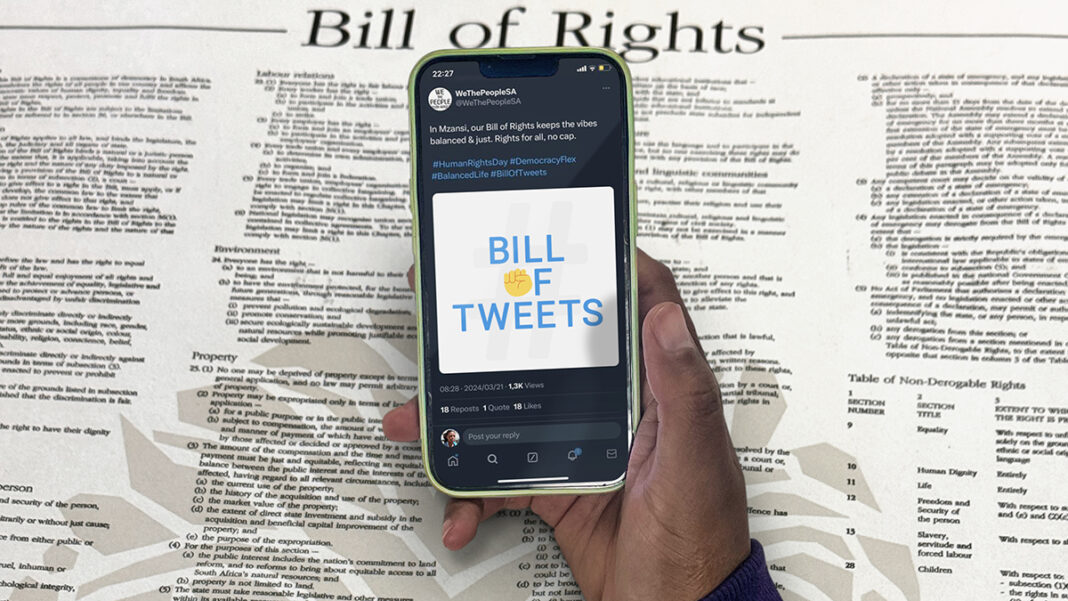
But fear not, dear readers, for a revolutionary solution has emerged to bridge this chasm. Enter We the People SA, a group of "progressive" individuals who have harnessed the power of generative artificial intelligence to reimagine the Bill of Rights in a language that speaks to the youth.
TheBillOfTweets: A bold experiment in linguistic colonialism?
We the People SA has taken the 4,675-word Bill of Rights and reduced it to 15 concise tweets, using "local contemporary phrases and words" to make it relatable to Gen Z. But is this a genuine attempt to empower the youth, or a cynical ploy to pacify them with a watered-down version of their constitutional rights?
Mbali Baduza, CEO of We the People SA, claims that this campaign will "demystify important legal rights and protections, fostering a stronger connection between the youth and their constitutional rights." But at what cost? By reducing the complex language of the Constitution to simplistic tweets, are we not sacrificing the very essence of democracy for the sake of clickbait headlines?
The Consequences of Simplification
The Constitution is not a Twitter thread; it’s a complex, nuanced document that requires critical thinking and analysis. By reducing it to bite-sized chunks, are we not undermining the very fabric of our democracy?
Furthermore, what’s to stop future generations from simplifying the Constitution even further, reducing it to a series of memes and hashtags? Where will this trend of linguistic colonialism end?
The True Cost of "Accessibility"
We the People SA’s campaign may have the best of intentions, but its methods are fundamentally flawed. By prioritizing "accessibility" over substance, they are sacrificing the very principles of democracy for the sake of fleeting attention.
As we move forward, we must ask ourselves: what is the true cost of "accessibility"? Is it worth sacrificing the complexity and nuance of our Constitution for the sake of a catchy hashtag?
The People Demand Better
We the People SA’s campaign may be a bold experiment, but it’s not the solution we need. It’s time for a new approach, one that prioritizes critical thinking, analysis, and substance over superficial simplicity.
Join the conversation and demand better from our leaders. Let’s reclaim the Constitution as a symbol of our collective power, rather than a relic of the past.